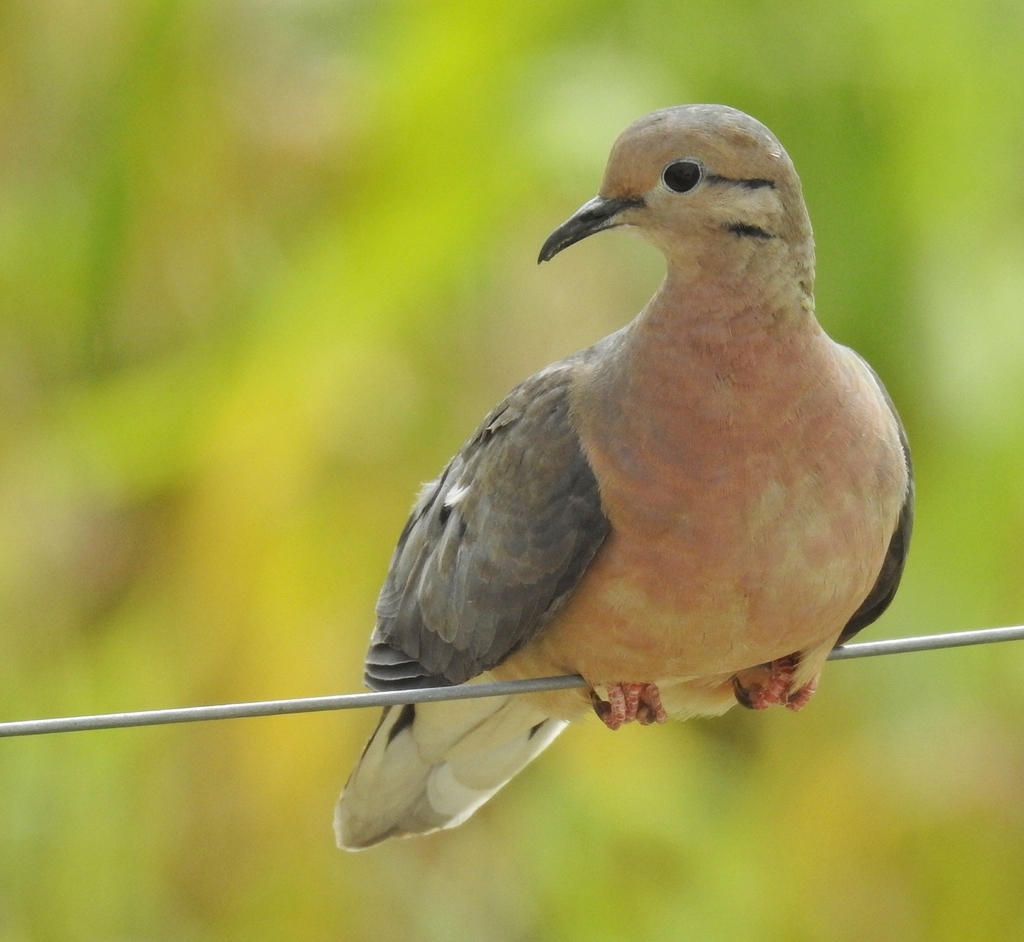
Eared Dove
Photo © Esteban Poveda
Photo © Esteban Poveda — CC BY 4.0 — Source: iNaturalist #64738980Identification
The eared dove is a compact pigeon measuring 24 cm in length, with a distinctive long, wedge-shaped tail and weighing around 112 g. Males display olive-brown upperparts with black spots on the wings, a grey crown, and characteristic black markings behind the eye and on the lower ear coverts—features that give the species its name. The underparts are vinous (wine-colored), and the tail is tipped with cinnamon. The bill is black and the legs dark red. Females are noticeably duller in plumage, while immature birds are greyish-brown and very dull with pale barring. In flight, listen for the species' distinctive deep, soft call: oo-ah-oo.
Range & Habitat
This New World dove is a resident breeder throughout South America, ranging from Colombia south to Argentina and Chile, and across offshore islands from the Grenadines southward. It may be a relatively recent colonist of Trinidad and Tobago. The species appears to be partially migratory, with movements driven by food availability rather than season.
Eared doves are common to abundant in savannahs and open areas, including cultivated lands, and they readily adapt to human habitation. They are frequently seen perched on wires and telephone posts near towns, throughout urban public spaces in cities like Bogotá, and feeding near beach resorts.
Behaviour & Diet
These are highly gregarious birds, forming large flocks especially during migration and at communal roosts. Their flight is characteristically high, fast, and direct, with regular wing beats punctuated by sharp flicks typical of pigeons. During breeding, males perform a spectacular display involving a steep climb followed by a semicircular glide back to the original perch. They build small stick nests several meters high in trees, laying two white eggs that hatch in 12–14 days, with fledging occurring within another 9 days. With abundant food and habitat, birds breed almost continuously with no fixed breeding season.
Eared doves feed primarily on seeds and grain taken from the ground. When agricultural crops are in season—wheat, rice, sorghum, maize, and soybeans—these may comprise their entire diet. They also consume seeds from savannah grasses and other wild plants. Animal foods such as caterpillars, insect pupae, aphids, and snails supplement their diet seasonally.
Best Time & Places to See It
Eared doves are easiest to observe in open agricultural areas and savannahs throughout their South American range. The most spectacular concentrations occur in northern Argentina around Córdoba, where populations sometimes darken the skies in enormous flocks moving between roosting woods and feeding fields. In Bolivia's Gran Chaco region near Santa Cruz de la Sierra, large flocks arrive seasonally (May to September) to raid grain crops. Urban areas across Colombia, Venezuela, Trinidad, and Tobago offer reliable sightings year-round, particularly near parks, cultivated lands, and coastal resorts where birds are accustomed to human presence.
Photography Tips
The eared dove's fast, direct flight and high-altitude movements demand quick reflexes and fast shutter speeds. Photograph perched birds on wires or in trees to capture the distinctive black ear markings and olive-brown plumage in good light. Early morning and late afternoon typically offer the best lighting for capturing the vinous underparts and cinnamon tail tips. In Argentina's Córdoba region, position yourself where flocks move between roosts and fields at dawn or dusk for dramatic flock photography. The breeding display—with its steep climb and gliding descent—is challenging but rewarding if you can anticipate the behavior from males on their territories.
Antisana National Park
Araucárias National Park
Baritú National Park
Brasília National Park
Cajas National Park
Calilegua National Park
Campos del Tuyú National Park
Campos Gerais National Park
Carlos Botelho State Park
Nothing matches these filters.
No community photos yet. Log in to add the first one.
No community observations of this species yet.