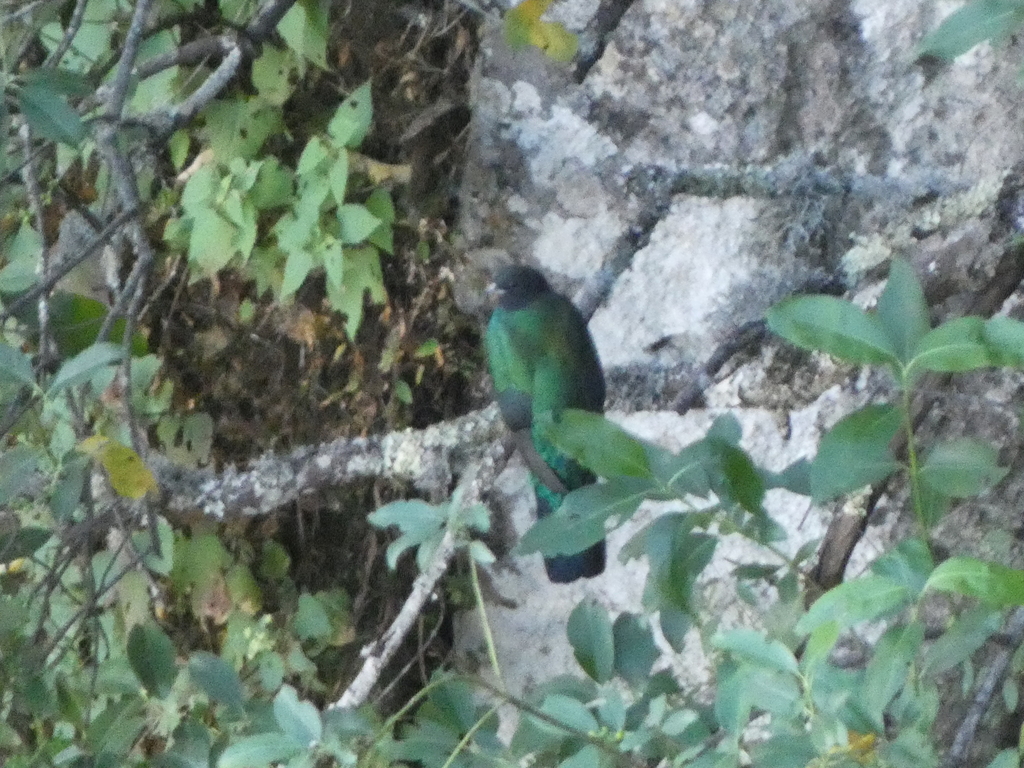
Eared Quetzal
Photo © datadan
Photo © datadan — CC BY 4.0 — Source: iNaturalist #334046092Identification
The eared quetzal is a medium-sized trogon measuring 33–36 cm in length, with distinctive iridescent green backs and dark blue central tail feathers. Males are particularly striking, featuring a blackish head, luminous green breast, and brilliant geranium-red belly and undertail coverts. Females are more subdued, with gray heads and breasts and less extensive red on the lower belly. Both sexes possess the wispy, hair-like auricular plumes that give the species its name, though these are rarely visible in the field. The bill is dull gray with a slightly darker tip, and notably smaller and narrower than in typical trogons. All birds display white outer tail feathers with black basal bands, and in flight, both sexes utter distinctive vocalizations ranging from tremolo whistles to loud squeals and strident cackles.
Range & Habitat
This species is endemic to the Sierra Madre Occidental of Mexico, ranging from northern Sonora and Chihuahua south to western Michoacán. It inhabits middle to upper levels of pine-oak woodlands and oak-conifer forests, showing a strong preference for streamside locations. The eared quetzal is a year-round resident throughout its range and has occurred on rare occasions in southeastern Arizona, where it has even been recorded nesting.
Behaviour & Diet
Eared quetzals are insectivorous and frugivorous, feeding on caterpillars, moths, katydids, cicadas, small lizards, and fruit—particularly the warty red fruit of madrone trees. Like other trogons, they characteristically pluck prey and fruit while hovering. The species breeds from April to October, nesting 5–9 meters high in unlined shallow tree cavities, typically in old woodpecker holes in pine, fir, maple, or aspen. Incubation and nestling periods are relatively long at 28–31 days and 17–21 days respectively. Interestingly, eared quetzals exhibit aversion to large areas of conspicuous color near human observers, including white, red, orange, and blue.
Best Time & Places to See It
The breeding season from April through October offers the best opportunity to observe this species, when males are vocal and birds are actively nesting. A dedicated 1995 survey recorded the species at 55 sites across Mexico, revealing it to be far more common in suitable habitat than previously believed. The Sierra Madre Occidental pine-oak forests of Sonora, Chihuahua, and Michoacán remain the most reliable locations. Streamside canyons and forest edges at middle to upper elevations provide the best habitat for locating this elusive resident.
Photography Tips
The eared quetzal's iridescent plumage demands careful attention to lighting; photograph in diffuse light to capture the full spectrum of green and blue iridescence without harsh shadows. The species' aversion to bright colors means photographers should avoid wearing white, red, orange, or blue clothing. Position yourself near streamside forests during early morning hours when birds are most active and vocal. The relatively small head and bill are diagnostic features worth capturing in portrait shots. Use a telephoto lens (at least 400mm) to maintain distance, as this will also help you avoid triggering the species' color-based avoidance response and allow for natural behavior documentation.
No community photos yet. Log in to add the first one.
No community observations of this species yet.