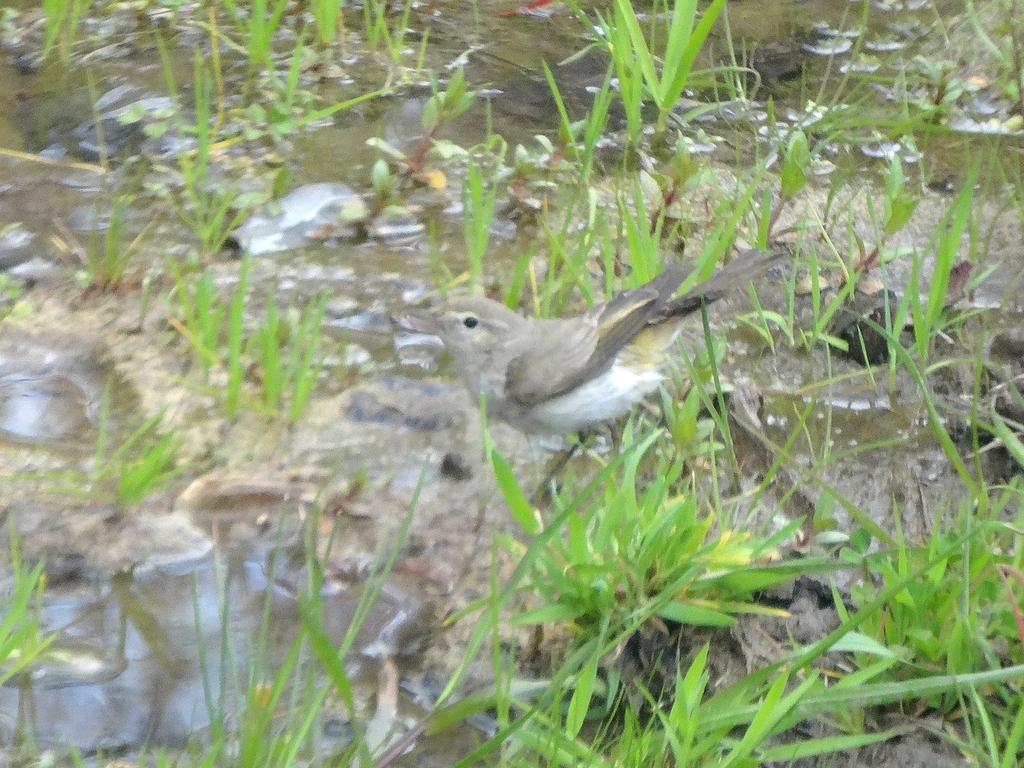
Eastern Bonelli’s Warbler
Photo © Ben Costamagna
Photo © Ben Costamagna — CC BY 4.0 — Source: iNaturalist #112664835Identification
The eastern Bonelli's warbler is a small passerine with subtle plumage that rewards close attention. Adults display a plain grey-green back, green-toned rump and wings, and whitish underparts. The bill is small and pointed, and the legs are brown. Males and females are identical in appearance, as is typical among warblers. A key distinguishing feature from its western counterpart is the absence of a browner tinge to the upperparts; instead, the eastern species often shows a greenish tinge overall.
Audio identification is particularly valuable for separating the two species. The eastern Bonelli's warbler produces a fast monotone trill that is only slightly different from the western species and shares some similarity to the wood warbler's song. However, its call is diagnostic: a hard "chup" sound reminiscent of a crossbill or house sparrow—completely different from the disyllabic "hu-it" call of the western Bonelli's warbler.
Range & Habitat
Eastern Bonelli's warbler breeds in southeast Europe and Asia Minor, with a range that does not overlap with its western congener. The species is strongly migratory, departing its breeding grounds to winter in sub-Saharan Africa. It is occasionally recorded as a rare vagrant in Northern Europe, making sightings outside its normal range noteworthy for birders.
In its breeding habitat, this warbler favours forest and woodland environments. Its small size and leaf-gleaning behaviour make it well-suited to these densely vegetated settings, where it can pursue its insectivorous diet among the foliage.
Behaviour & Diet
Like all warblers, the eastern Bonelli's warbler is insectivorous, gleaning small invertebrates from vegetation as it forages. During the breeding season, pairs establish territories in suitable woodland habitat. The species nests on the ground, where females lay between four and six eggs. Its small size and cryptic plumage provide camouflage in its woodland home, though its distinctive calls and song make it detectable to patient observers.
Best Time & Places to See It
Eastern Bonelli's warbler is best encountered during the breeding season in its southeast European and Asia Minor range. Spring and early summer are optimal for locating singing males in woodland and forest habitats. Autumn migration may offer additional opportunities, though the species is most reliably found on its breeding grounds rather than in vagrant locations.
Photography Tips
Photographing this species presents challenges due to its small size, preference for dense vegetation, and cryptic coloration. Wide-angle shots of habitat can establish context, while telephoto lenses will be necessary to capture detail of the bird itself. Early morning, when territorial males are most vocal, offers the best chance of locating individuals. The subtle plumage differences from the western species are worth documenting, and recording vocalizations—particularly the distinctive hard "chup" call—alongside images provides valuable documentation for identification and distribution records.
Camargue Regional Nature Park
Saintes-Maries-de-la-Mer, France
+378 birds+48 mammals
Where the Rhône Delta sprawls into the Mediterranean, a landscape of stark and haunting beauty emerges—vast salt marshes punctuated by shallow lagoons, reed beds, and scrubland…
VIEW NATURAL PARKStrandzha Nature Park
Kondolovo, Bulgaria
+215 birds+19 mammals
Where the Rhodope Mountains descend toward the Black Sea coast, ancient forests rise above limestone plateaus in a tapestry of ecological richness rarely found elsewhere in…
VIEW NATURAL PARKCentral Balkan National Park
Zhidov dol, Bulgaria
+135 birds+16 mammals
Where granite peaks pierce the Bulgarian highlands, ancient beech and conifer forests blanket mountains that rise dramatically from the Balkan range's heart. This wilderness encompasses three…
VIEW NATIONAL PARKPindos National Park
Ioannina Regional Unit, Greece
+163 birds+12 mammals
Where limestone peaks rise abruptly from the Pindus range in northwestern Greece, a landscape of dramatic gorges, alpine meadows, and dense beech forests creates one of…
VIEW NATIONAL PARKMount Parnitha National Park
Municipal Unit of Acharnes, Greece
+137 birds+4 mammals
Where pine-clad ridges rise abruptly from the Attica plains, Mount Parnitha National Park unfolds across nearly 4,000 hectares of Mediterranean mountain wilderness. The park's defining character…
VIEW NATIONAL PARKSamaria National Park
Chania Regional Unit, Greece
+103 birds+1 mammals
Vertical walls of pale limestone rise nearly a kilometre from the Cretan seabed, their flanks carved by the Samaria Gorge into one of Europe's most dramatic…
VIEW NATIONAL PARKKerkini Lake National Park
Serres, Greece
+291 birds+18 mammals
Where the Strymon River widens into a sprawling freshwater lake hemmed by the Rhodope Mountains, Kerkini National Park unfolds across northern Greece as one of southeastern…
VIEW NATIONAL PARKNo community photos yet. Log in to add the first one.
No community observations of this species yet.