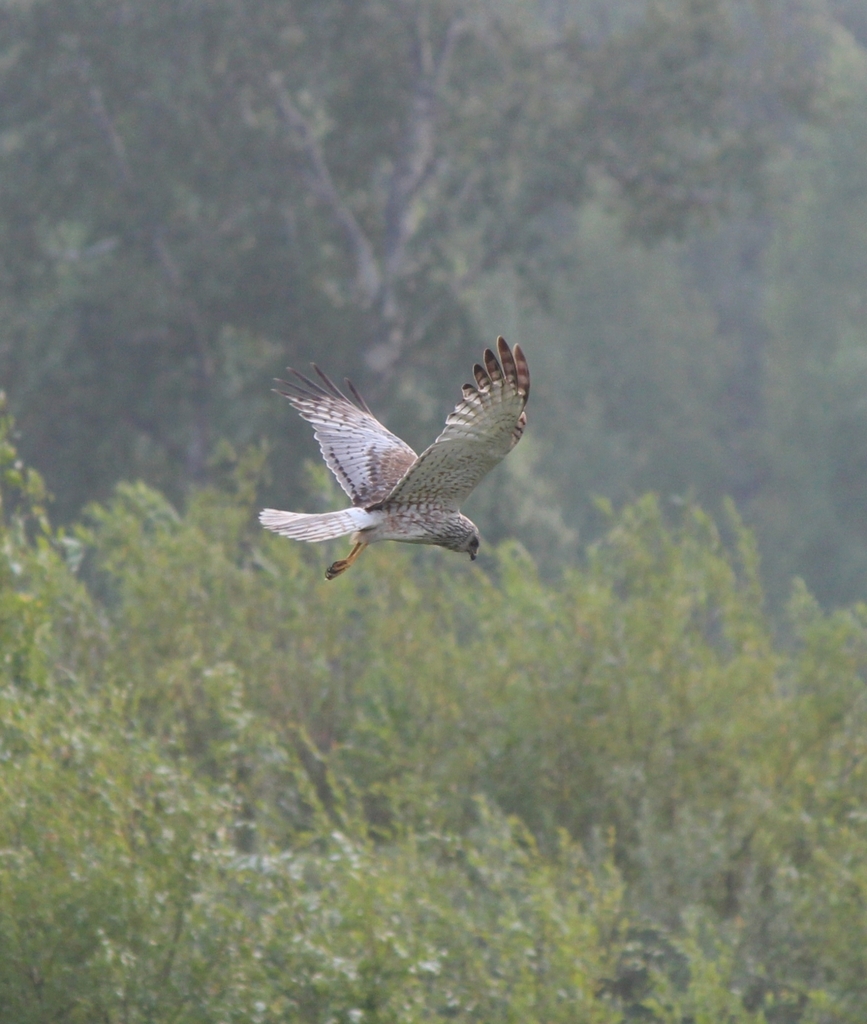
Eastern Marsh Harrier
Photo © Юлия
Photo © Юлия — CC BY 4.0 — Source: iNaturalist #102920054Identification
The Eastern Marsh Harrier is a medium-sized bird of prey measuring 48 to 58 cm long with a wingspan of 113 to 137 cm. Like most raptors, females are noticeably larger than males. Males display variable plumage with blackish heads, breasts, backs and wing-coverts marked with pale streaks, grey wings with black wingtips and a distinctive white front edge, grey tails, white rumps and mostly white underparts. Females are dark brown with buff streaking on the head and underparts, often whitish rumps and dark-barred tails. Young birds are dark brown with buff on the head and a pale underwing patch. The species is usually silent, though it produces a mewing call most often heard at roost sites.
Range & Habitat
The Eastern Marsh Harrier breeds across north-east China, Mongolia and south-east Siberia as far west as Lake Baikal, with small numbers in northern Japan on Hokkaidō and northern Honshū. Most populations are strongly migratory, wintering across southern China, Taiwan, Korea, southern Japan, northeast India, Bangladesh and Southeast Asia reaching as far south as the Philippines, Borneo and Sumatra. The subspecies C. s. spilothorax, known as the Papuan Harrier, inhabits New Guinea where it is sedentary. Large-scale migrations occur along the Chinese coast, with thousands of birds funnelling through key sites like Beidaihe during autumn passage.
The species favours open country including marshland, paddy fields and grassland, making it a characteristic raptor of wetland and agricultural landscapes across eastern Asia.
Behaviour & Diet
Eastern Marsh Harriers hunt by flying low over open ground with wings held in a shallow V-shape, a characteristic hunting technique that allows them to surprise prey. Their diet consists of small mammals, birds and frogs, reflecting their preference for wetland and grassland habitats where such prey is abundant. Breeding begins in April, with pairs constructing stick nests on the ground, typically within reedbeds. Females lay four to seven eggs that are incubated for 33 to 48 days, and the young fledge after a further 35 to 40 days.
Best Time & Places to See It
For observing Eastern Marsh Harriers, timing and location are crucial. During breeding season (April onwards), look for them in suitable habitat across their north-east Asian breeding range. However, the most accessible viewing opportunities occur during migration periods, particularly autumn, when large numbers concentrate at coastal migration hotspots such as Beidaihe in China. Wintering birds can be found throughout southern China, Taiwan, Korea, southern Japan and Southeast Asia in open wetland and grassland habitats.
Photography Tips
The low, buoyant hunting flight of Eastern Marsh Harriers makes them challenging but rewarding photographic subjects. Position yourself where you can capture their characteristic shallow V-wing posture as they quarter the ground. Early morning and late afternoon typically offer the best light and most active hunting behaviour. During migration periods at concentration sites, anticipate their flight paths to secure cleaner backgrounds. The sexual and age-related plumage variations offer opportunities to photograph multiple distinctive patterns within a single location, though patience and a good telephoto lens are essential given their wariness.
Orang National Park
Rangagarapathar, India
+298 birds+1 mammals
Where the Brahmaputra's floodplains meet the foothills of Assam, Orang National Park unfolds across a mosaic of riverine grasslands, forests and wetlands that pulse with the…
VIEW NATIONAL PARKHat Noppharat Thara-Mu Ko Phi Phi National Park
Ao Nang, Thailand
+253 birds+9 mammals
Where limestone karsts rise dramatically from turquoise waters, Hat Noppharat Thara-Mu Ko Phi Phi National Park unfolds across a mosaic of beach, mangrove forest, and island…
VIEW NATIONAL PARKKhao Yai National Park
Prachantakham District, Thailand
+377 birds+46 mammals
Evergreen dipterocarp forest blankets the rolling terrain of this national park in eastern Thailand, where limestone hills rise abruptly from the forest floor and seasonal streams…
VIEW NATIONAL PARKBaikal National Park
Ольхонский район, Russia
+184 birds+11 mammals
Where the world's deepest freshwater lake meets ancient Siberian taiga, Baikal National Park sprawls across 66,203 square kilometers of one of Earth's most singular ecosystems. The…
VIEW NATIONAL PARKKaziranga National Park
Kohora, India
+422 birds+26 mammals
Dawn breaks over the floodplains of the Brahmaputra, where tall grasslands stretch endlessly beneath monsoon-heavy skies. This sprawling wilderness of northeastern Assam is a mosaic of…
VIEW NATIONAL PARKHustai National Park
Altanbulag, Mongolia
+198 birds+16 mammals
Where the steppe rolls endlessly beneath vast Mongolian skies, Hustai National Park preserves one of Central Asia's most dynamic grassland ecosystems. Rolling hills and open prairie…
VIEW NATIONAL PARKGobi Gurvan Saikhan National Park
Tsagaan Subarga Hural, Mongolia
+183 birds+23 mammals
Where rust-coloured badlands rise from the southern Gobi steppe, the terrain transforms into a landscape of geological drama that few visitors expect to find in Mongolia's…
VIEW NATIONAL PARKLand of the Leopard National Park
Khasansky District, Russia
+83 birds+11 mammals
Where coniferous and mixed forests sweep across the rolling terrain of Russia's Far East, Land of the Leopard National Park embraces a landscape shaped by the…
VIEW NATIONAL PARKNortheast China Tiger and Leopard National Park
Mu Dan Jiang Shi, China
+202 birds+19 mammals
Across the temperate forests of northeastern China, where winters grip the landscape in subzero silence and summers remain cool and brief, the Mudanjiang region supports a…
VIEW NATIONAL PARKYancheng National Nature Reserve
Yancheng, China
+208 birds+4 mammals
Where the East China Sea's tidal rhythms sculpt the Jiangsu coast, Yancheng National Nature Reserve sprawls across one of Asia's most dynamic wetland complexes. This vast…
VIEW NATURE RESERVEZhalong National Nature Reserve
Qiqihar, China
+78 birds
Across the wetlands of northeastern China, where the Heilongjiang climate swings between brutal winters and warm summers, lies one of East Asia's most vital refuges for…
VIEW NATURE RESERVEPoyang Lake National Nature Reserve
Shangrao, China
+270 birds+7 mammals
Where the Yangtze River's massive floodplain spreads across central China, Poyang Lake National Nature Reserve encompasses one of the continent's most dynamic and water-rich wetland systems.…
VIEW NATURE RESERVECaohai National Nature Reserve
Bijie, China
+93 birds
At roughly 1,900 metres elevation on Guizhou's high plateau, Caohai sprawls across a temperate landscape shaped by pronounced seasonal extremes. Winters here are dry and cool,…
VIEW NATURE RESERVEQinghai Lake National Nature Reserve
Hainan Tibetan Autonomous Prefecture, China
+243 birds+11 mammals
At 3,200 metres above sea level on the Tibetan plateau, where winter temperatures plunge far below freezing and snow blankets the landscape for half the year,…
VIEW NATURE RESERVEGaoligong Mountain National Nature Reserve
Nujiang Lisu Autonomous Prefecture, China
+443 birds+13 mammals
VIEW NATURE RESERVENo community photos yet. Log in to add the first one.
No community observations of this species yet.