Identification
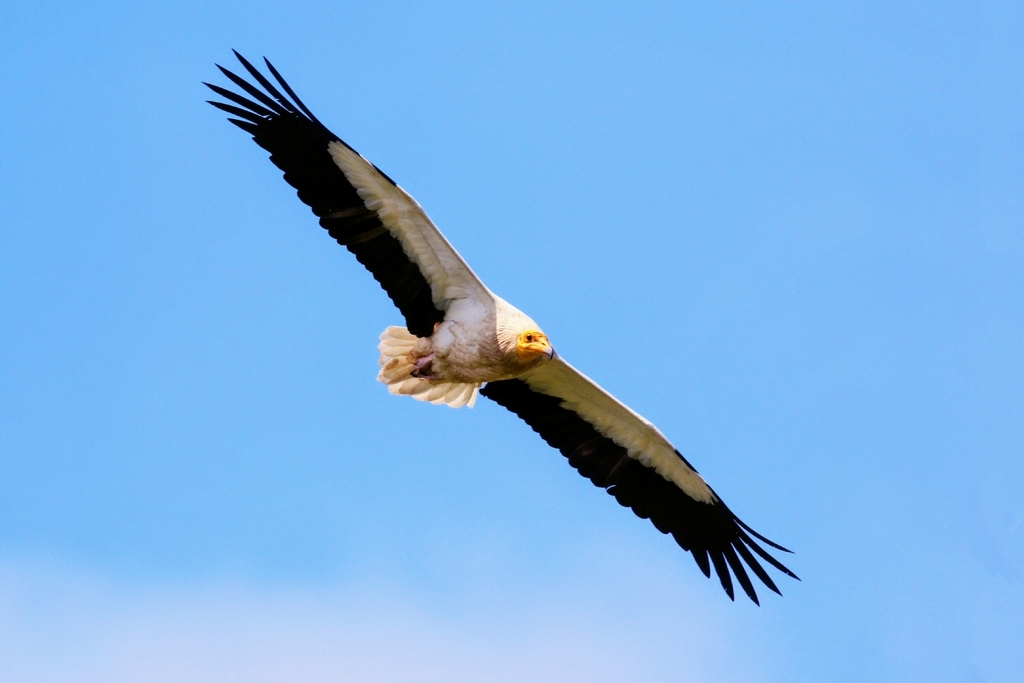
The Egyptian vulture is a small Old World vulture with distinctive white plumage, black flight feathers, and a wedge-shaped tail that make it unmistakable in flight. Adults typically appear soiled with rusty or brown shades derived from mud or iron-rich soil in the wild, though captive birds maintain clean white plumage. The bird features a slender, hooked bill, long neck feathers forming hackles, and pointed wings with the third primary being the longest. Adults have pink legs and long, straight claws, while juveniles display grey legs.
Bill colouration varies by subspecies: the nominate subspecies has a dark grey bill, the Indian ginginianus subspecies shows a pale yellow bill, and intermediate patterns suggest subspecies intermixing. The facial skin is yellow and unfeathered. The contrasting underwing pattern and wedge-shaped tail are particularly diagnostic when observing the bird soaring in thermals during warmer parts of the day.
Range & Habitat
The Egyptian vulture is widely distributed across the Old World, ranging from the Iberian Peninsula through North Africa, West Asia, and India. Three recognized subspecies occupy distinct regions: the nominate N. p. percnopterus occurs across southern Europe, northern Africa, the Middle East, Central Asia, and north-western India; N. p. ginginianus inhabits the Indian subcontinent; and the genetically distinct N. p. majorensis is found exclusively in the eastern Canary Islands, where it is known locally as the guirre.
Populations vary in migratory behaviour depending on geography. Subspecies breeding in temperate regions migrate south during winter, while tropical populations remain relatively sedentary. The Canary Islands population is notably non-migratory and has existed on the islands for approximately 2,500 years.
Behaviour & Diet
Egyptian vultures feed primarily on carrion but are opportunistic hunters that will take small mammals, birds, and reptiles. Notably, they feed on the eggs of other birds, demonstrating remarkable tool use by breaking larger eggs by tossing pebbles onto them. This behaviour represents one of the rare examples of tool use among birds.
The species exhibits additional tool-use behaviour, employing twigs to roll up wool for use in nest construction. These vultures soar in thermals during the warmer parts of the day in search of food and suitable air currents for flight.
Best Time & Places to See It
Egyptian vultures are most active during the warmer parts of the day when thermals are strongest, making midday observation optimal. Temperate populations are seasonal visitors, present during breeding season but absent in winter. Tropical populations are year-round residents. The species can be observed throughout its extensive range from southern Europe and North Africa to the Middle East and the Indian subcontinent. The Canary Islands population offers a unique opportunity to observe the non-migratory majorensis subspecies year-round.
Photography Tips
Photograph Egyptian vultures during daylight hours when they soar in thermals, allowing you to capture their distinctive silhouette with contrasting black flight feathers against white plumage and characteristic wedge-shaped tail. The underwing pattern is particularly striking and diagnostic in flight photography. Position yourself with the sun behind you to illuminate the white plumage while capturing the contrast with black wing feathers.
Note that wild birds often appear rusty or brown-tinged due to soil, which adds authentic character to field photographs. Ground-level behaviour such as feeding on carrion and the remarkable tool-use of stone-throwing at eggs provides additional photographic opportunities. Include environmental context to show the bird's preferred habitat and soaring behaviour in thermal columns during warm daylight hours.