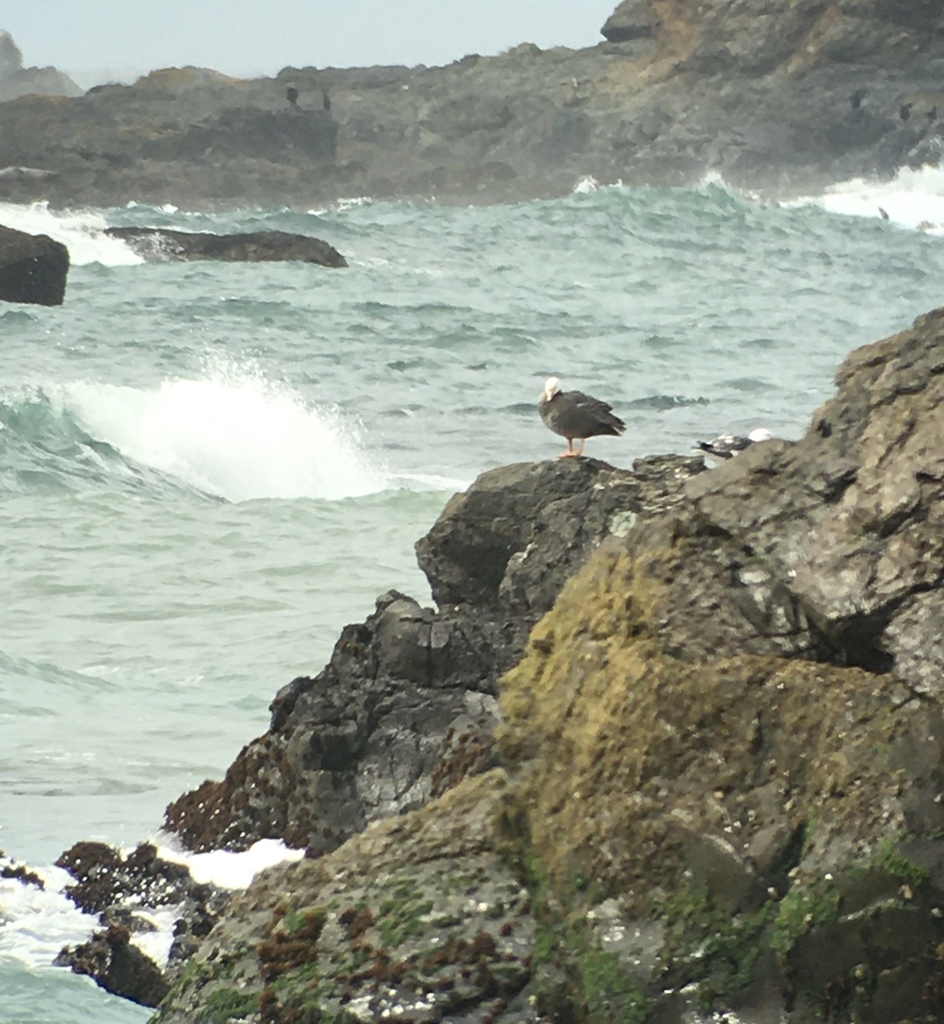
Emperor Goose
Photo © Adam J. Searcy
Photo © Adam J. Searcy — CC BY 4.0 — Source: iNaturalist #40062600Identification
The emperor goose is a distinctive waterfowl with a striking appearance that sets it apart from other northern geese. Adults display a stout, blue-gray body covered in black and white spots that create a distinctive "scaled appearance." The head and back of the neck are white with an amber-yellow tinge, though unlike snow geese, this white coloring does not extend to the front of the neck. A black chin and throat, white tail, pink bill tipped with white, and yellow-orange legs and feet complete the plumage. The underside of the wings is gray, contrasting with the black and white underwings of snow geese. In summer, adults frequently develop a reddish-brown coloration on the head from feeding in iron oxide-rich tidal pools. The species is relatively compact, with males measuring 26–28 inches in length and females slightly smaller at 25.6–27.5 inches, and possessing short wings that result in slow, rapid-stroke flight.
Young birds differ noticeably from adults. Goslings are grayish-white with black bills and gray, brown, or black feet, retaining white areas around the bill for their first three weeks. Juveniles are mostly gray with scattered white feathers; younger birds have dark heads with dusty patches of white, which gradually transition to mostly white by October. By their first winter, juveniles resemble adults in coloration.
Range & Habitat
The emperor goose is a migratory species with a restricted range in the North Pacific. In summer, it breeds in remote coastal areas near the Bering Sea in arctic and sub-arctic Alaska and the Russian Far East. For breeding, the species favors tundra habitat within 10 miles of the coast, typically constructing nests in marshes. During winter, the species migrates south to ice-free mudflats and coasts, with populations concentrated mostly in the Aleutian Islands of Alaska and British Columbia in Canada, rarely reaching the contiguous United States.
Behaviour & Diet
Unlike many goose species that migrate thousands of miles, the emperor goose is a short-distance migrant, typically traveling 370–470 miles between breeding and wintering grounds. The species is monogamous, with females maintaining a single mate for life and only selecting a new partner if their mate dies. Breeding begins in late June in Russia and between late May and early June in Alaska, with only individuals three years or older participating in breeding. Females construct nests as ground holes that they build up with vegetation and feathers plucked from themselves. Clutches typically contain 4–6 eggs, though the range can be 2–8 eggs, and incubation lasts approximately 24 days and is performed solely by females. Young are precocial, able to walk, swim, and feed themselves within hours of hatching, and can fly by 50–60 days old. The species leaves its breeding grounds later than any other goose species and molts from late July to early August.
Best Time & Places to See It
Summer visits to remote coastal areas near the Bering Sea in Alaska and the Russian Far East offer the best opportunities to observe breeding emperor geese. In winter, the Aleutian Islands of Alaska and British Columbia's coasts provide the most reliable viewing locations. The species' remote breeding habitat and relatively short migration distance make it a specialty for dedicated birders willing to undertake challenging travel to arctic and sub-arctic regions.
Photography Tips
The emperor goose's distinctive scaled plumage and unique coloration make it a rewarding photographic subject. The striking contrast between the white head and amber-yellow tinge, the blue-gray spotted body, and the bold black chin and throat provide excellent detail for close-up shots. Photographing birds in their breeding colonies near the coast offers opportunities to capture family groups and behavioral interactions. The summer transformation of head color due to iron oxide staining in tidal pools presents a unique photographic opportunity. Given the species' slow flight due to short wings, photography of birds in flight is achievable for patient photographers. The remote nature of both breeding and wintering habitats requires appropriate preparation and planning for field photography.
Katmai National Park
Lake and Peninsula Borough, United States
+160 birds+19 mammals
Across southwestern Alaska's Lake and Peninsula Borough, nearly 27,000 square kilometers of subarctic wilderness sprawl between volcanic peaks and coastal wetlands, anchored by the confluence of…
VIEW NATIONAL PARKSt. Paul Island
Saint Paul, United States
+255 birds+8 mammals
Windswept tundra rolls across this remote Pribilof island, where volcanic basalt cliffs plunge into the Bering Sea and fog rolls in thick enough to erase the…
VIEW PROTECTED LANDSCAPEKodiak National Wildlife Refuge
United States
+221 birds+22 mammals
Where temperate rainforest meets subarctic coast, Kodiak National Wildlife Refuge sprawls across Alaska's largest island, a sanctuary defined by steep valleys carved by tidewater glaciers and…
VIEW WILDLIFE SANCTUARYAlaska Maritime National Wildlife Refuge
Alaska, United States
+391 birds+58 mammals
Where the North Pacific collides with Alaska's rugged coastline, a sprawling archipelago of islands, rocky outcrops, and coastal headlands forms one of North America's most remote…
VIEW WILDLIFE SANCTUARYYukon Delta National Wildlife Refuge
Bethel, United States
+156 birds+12 mammals
Across the Yukon Delta sprawls one of North America's most expansive coastal wetland sanctuaries, where the boreal subarctic climate strips down existence to essentials. This vast…
VIEW WILDLIFE SANCTUARYIzembek National Wildlife Refuge
Cold Bay, United States
+138 birds+9 mammals
Where the Aleutian archipelago reaches westward into the Bering Sea, subarctic tundra and shallow coastal waters converge to create one of Alaska's most ecologically vital wildlife…
VIEW WILDLIFE SANCTUARYBecharof National Wildlife Refuge
United States
+146 birds+2 mammals
Across southwestern Alaska's windswept lowlands, where the Bristol Bay watershed spills into vast tidal flats and sedge marshes, lies one of North America's most pristine subarctic…
VIEW WILDLIFE SANCTUARYNo community photos yet. Log in to add the first one.
No community observations of this species yet.