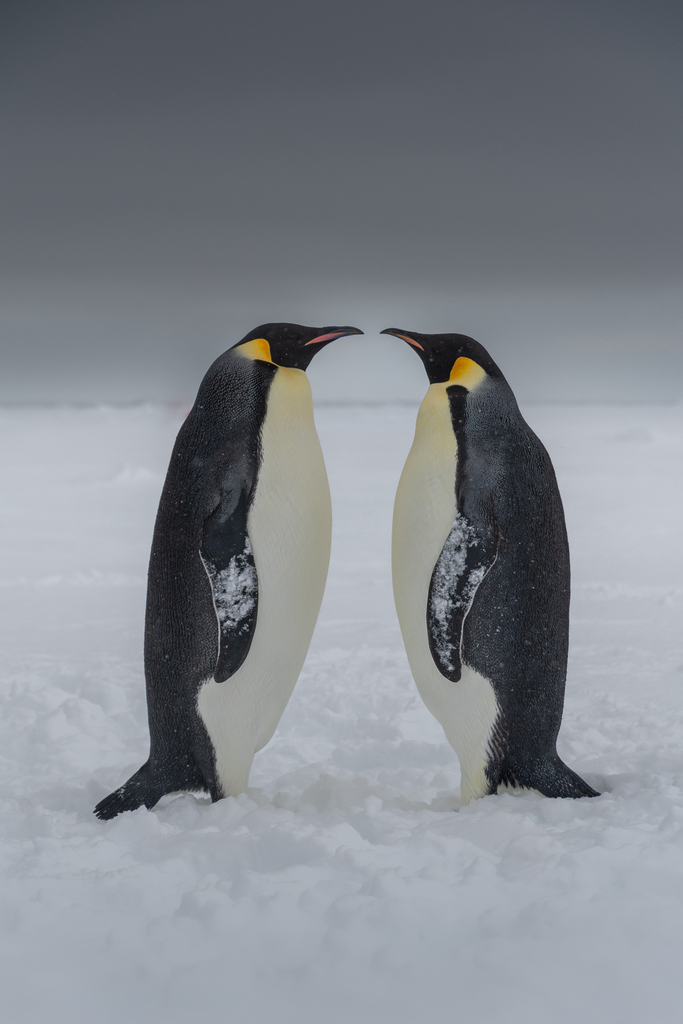
Emperor Penguin
Photo © Julien Renoult
Photo © Julien Renoult — CC BY 4.0 — Source: iNaturalist photo #358659548Identification
The emperor penguin is the tallest and heaviest of all living penguin species, reaching 100 cm in length and weighing 22 to 45 kg. Males and females are similar in appearance. The plumage is striking and unmistakable: deep black feathers cover the head, back, and tail, sharply contrasting with a white belly. The upper breast is pale yellow, and bright-yellow ear patches are distinctive. The bill is 8 cm long, with a black upper mandible and lower mandible that can be pink, orange, or lilac. Juveniles have white auricular patches, chin, and throat, with black heads and white masks. Chicks are covered in silver-grey down with black heads.
Range & Habitat
Emperor penguins live exclusively in Antarctica, the only penguin species to breed during the Antarctic winter. They trek 50–120 km over the ice to breeding colonies that can contain up to several thousand individuals. Like all penguins, they are flightless but superbly adapted to marine life, with streamlined bodies and wings modified into stiffened, flattened flippers.
Behaviour & Diet
Emperor penguins are remarkable divers, capable of remaining submerged for around 20 minutes and diving to depths of 535 m. Their diet consists primarily of fish, supplemented by crustaceans such as krill and cephalopods such as squid. They possess extraordinary physiological adaptations for deep diving, including unusually structured haemoglobin that functions at low oxygen levels, solid bones that reduce barotrauma, and the ability to reduce metabolism and shut down non-essential organ functions. Breeding is unique among penguins: the female lays a single egg, which the male incubates for just over two months without eating, while the female returns to sea to feed. Parents subsequently alternate foraging at sea and caring for their chick. Emperor penguins typically live 20 years in the wild, though some individuals may reach 50 years.
Best Time & Places to See It
Emperor penguins breed exclusively in Antarctica during the Antarctic winter, making them accessible only to visitors who undertake specialized Antarctic expeditions. Access to breeding colonies is limited and highly regulated. The best opportunity to observe these remarkable birds is through dedicated Antarctic voyages, typically during the Antarctic summer months (November to February), when ice conditions permit travel and chicks are visible in colonies.
Photography Tips
The emperor penguin's striking coloration—jet-black upperparts contrasting sharply with white underparts and yellow accents—makes it highly photogenic. Photograph individuals in breeding colonies to capture family groups and parental behaviour. The bright-yellow ear patches are a key identifying feature worth highlighting. In the Antarctic summer (November–February), natural daylight is abundant; use it to capture the rich blacks and brilliant whites of their plumage. Wide-angle lenses work well for colony shots, while telephoto lenses help isolate individuals and behavioural details without disturbance.
Brown Bluff
Cuverville Island
Danco Island
Deception Island
Half Moon Island
Lemaire Channel
Neko Harbour
Paradise Bay
Paulet Island
Nothing matches these filters.
No community photos yet. Log in to add the first one.
No community observations of this species yet.