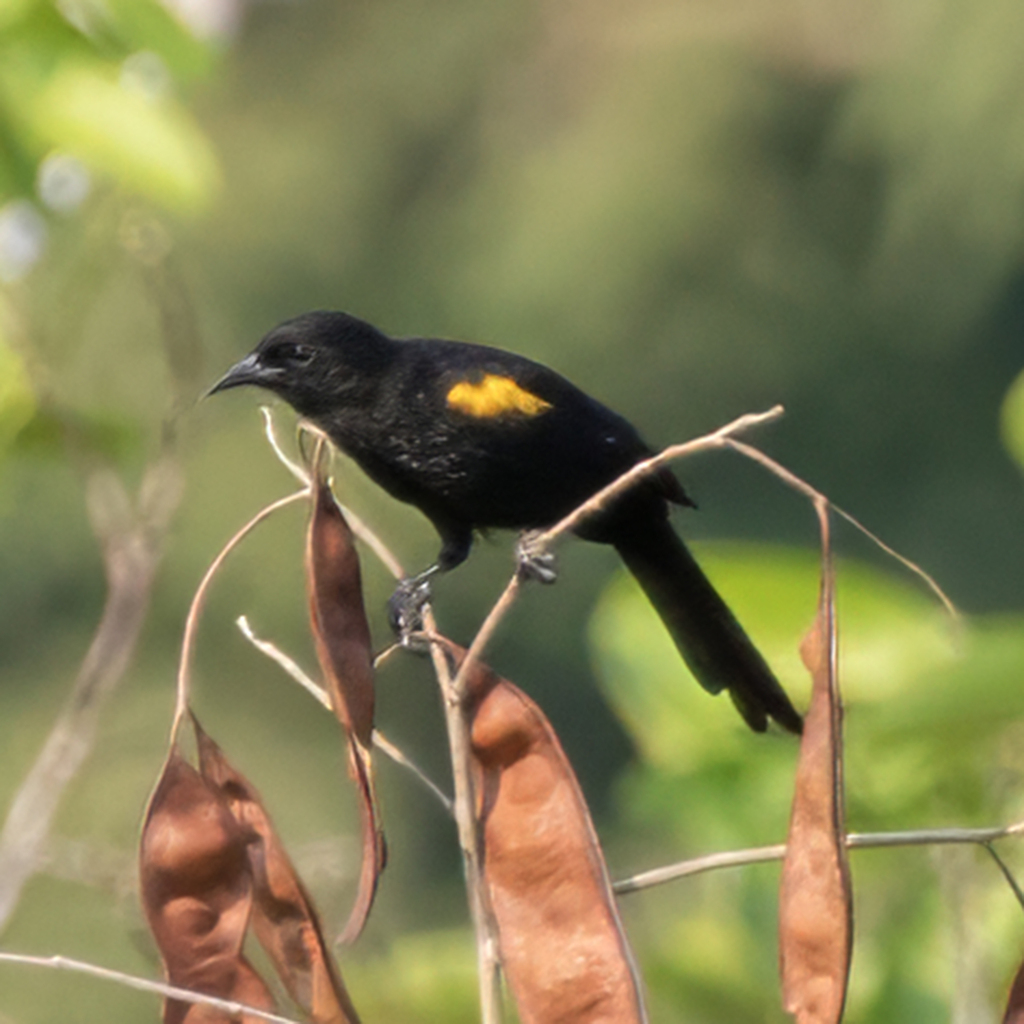
Epaulet Oriole
Photo © Dan Vickers
Photo © Dan Vickers — CC BY 4.0 — Source: iNaturalist #335987519Identification
The Epaulet Oriole is a medium-sized bird measuring about 22 cm (8.7 inches) in length, with males averaging 45 g and females 42 g. The two subspecies differ noticeably in plumage. The nominate subspecies (I. c. cayanensis) is almost entirely black, with distinctive yellow lesser and median wing coverts that form the characteristic epaulet visible on the closed wing. The other subspecies (I. c. chrysocephalus) is predominantly black but features a striking golden-yellow crown, nape, rump, epaulets, and thighs. Both sexes share identical plumage patterns. Juveniles are blackish brown rather than pure black, with duller yellow markings. All birds have a brown to deep red-brown iris, blackish bill, and leaden gray to blackish legs.
Range & Habitat
This species is endemic to the Amazon Basin, with its range spanning Bolivia, Brazil, Colombia, Ecuador, French Guiana, Guyana, Peru, Suriname, Trinidad, and Venezuela. The golden-crowned subspecies (chrysocephalus) occupies the northwestern portion of this range, from southeastern Colombia through Ecuador into northern Peru, while the nominate subspecies ranges across the southern and eastern Amazon. The bird inhabits diverse landscapes including forest edges, clearings, mature forest canopy, swamp forest, and gallery forest, occasionally venturing into parks and gardens. Across much of its range, it shows a marked preference for moriche palm groves in marshes and waterways. Elevational range varies by region, from sea level to 900 m in Brazil, reaching 1,500 m in Peru and 1,200 m south of the Orinoco in Venezuela.
Behaviour & Diet
The Epaulet Oriole is a year-round resident and apparently sedentary throughout its range. Although its diet has not been formally studied, it is believed to feed primarily on insects and other arthropods, supplemented with fruits, nectar, and sap. This species typically forages singly or in pairs but readily joins mixed-species feeding flocks, working mostly in the forest canopy and descending to lower levels in more open areas. The breeding season varies geographically: August to October in French Guiana, September to February in Suriname, and July to January in northwestern Brazil. Nests are distinctive woven "hammocks" fashioned from plant fibers and suspended beneath large leaves or palm fronds. Clutches typically contain two creamy or bluish-white eggs marked with brown. Both parents feed the nestlings, though full details of parental care remain undocumented. The species is known to be parasitized by Shiny Cowbirds.
Best Time & Places to See It
The Epaulet Oriole is a resident species present year-round throughout its range, making timing less critical than location. The bird is considered fairly common in Colombia and Peru, somewhat local and seldom very numerous in Venezuela, and frequent to uncommon across Brazil. Seek this species in humid lowland forests, particularly in areas with moriche palms and waterside gallery forests. Early morning hours when the bird is most active in the canopy offer the best viewing opportunities. Look for movement among the treetops and listen for its distinctive vocalizations to locate individuals.
Photography Tips
The Epaulet Oriole's predominantly dark plumage demands careful exposure management; meter on the yellow epaulets or crown (depending on subspecies) to avoid underexposure of the black body. Position yourself to capture the characteristic yellow wing marks that give this species its name—these are most visible on perched birds with closed or partially open wings. The species' canopy-dwelling habits and preference for early morning activity mean fast film speeds or high ISO may be necessary. Use a telephoto lens (at least 300 mm equivalent) to isolate birds among dense foliage. Patient waiting near fruiting trees or known roosting areas often yields better results than active searching through thick forest.
Yasuní National Park
Aguarico, Ecuador
+601 birds+43 mammals
Where the western Amazon basin converges with Ecuador's Orellana Province, lowland rainforest reaches toward the horizon in an unbroken canopy of staggering botanical density. Yasuní National…
VIEW NATIONAL PARKNatural Sierra de Chiribiquete National Park
Solano, Colombia
+359 birds+27 mammals
Massive table-top mountains rise abruptly from the lowland rainforest of southeastern Colombia, their sheer sandstone cliffs and isolated summits creating some of the most dramatic topography…
VIEW NATIONAL PARKNatural Sierra de la Macarena National Park
Vista Hermosa, Colombia
+566 birds+15 mammals
Across nearly 20,000 square kilometres of Colombia's Meta Department, the terrain rises from lowland savanna into Andean foothills through a mosaic of gallery forests, palm-fringed wetlands,…
VIEW NATIONAL PARKViruá National Park
Brazil
+389 birds+6 mammals
Across the northern frontier of Roraima, where the forest canopy rises from ancient Amazonian lowlands, Viruá National Park protects nearly 3,700 square kilometres of terra firme…
VIEW NATIONAL PARKChapada dos Guimarães National Park
Brazil
+450 birds+1 mammals
Where weathered sandstone plateaus rise above the cerrado grasslands of central Brazil, Chapada dos Guimarães National Park protects 624 square kilometres of ecological transition zone that…
VIEW NATIONAL PARKPantanal Matogrossense National Park
Brazil
+322 birds+17 mammals
Where the flooded forests of central Brazil meet vast seasonally inundated grasslands, Pantanal Matogrossense National Park sprawls across nearly 2,900 square kilometers of one of the…
VIEW NATIONAL PARKAmazônia National Park
Brazil
+439 birds+6 mammals
Where the Rio Amazonas and its tributaries weave through the heart of Pará state, a vast tapestry of rainforest stretches across 23,611 square kilometers of unbroken…
VIEW NATIONAL PARKJaú National Park
Brazil
+354 birds+3 mammals
Vast floodplain forests and blackwater rivers define this remote corner of western Amazonas, where the Rio Negro and its tributaries have carved an intricate mosaic of…
VIEW NATIONAL PARKPacaás Novos National Park
Brazil
+279 birds+1 mammals
Across the border between Rondônia and Amazonas, vast tracts of humid tropical forest rise and fall in gentle undulations, carved by clear-flowing rivers that feed into…
VIEW NATIONAL PARKAnavilhanas National Park
Brazil
+468 birds+8 mammals
Across the Rio Negro in central Amazonas, an archipelago of over a thousand islands rises from the world's largest rainforest river system, creating a labyrinth of…
VIEW NATIONAL PARKSerra do Divisor National Park
Brazil
+448 birds+10 mammals
Where the western Amazon meets the Andes foothills, Serra do Divisor National Park sprawls across one of South America's most biodiverse and least accessible frontiers. Spanning…
VIEW NATIONAL PARKPico da Neblina National Park
Brazil
+103 birds
Where the Amazon's western rampart rises into perpetual mist, Pico da Neblina National Park sprawls across more than 33,000 square kilometres of some of Earth's least…
VIEW NATIONAL PARKYanachaga–chemillén National Park
Palcazu, Peru
+639 birds+6 mammals
Where the eastern slopes of Peru's central cordillera plunge into cloud forest, Yanachaga–Chemillén National Park protects nearly three thousand square kilometres of montane wilderness that few…
VIEW NATIONAL PARKManu National Park
Manu, Peru
+892 birds+26 mammals
Across the eastern slopes of the Peruvian Andes, tropical rainforest descends into the Amazon basin with a complexity that few terrestrial ecosystems match. Manu National Park…
VIEW NATIONAL PARKBahuaja Sonene National Park
San Pedro de Putina Punco, Peru
+602 birds+8 mammals
Where the Madre de Dios and Heath rivers converge in southeastern Peru rises one of South America's most biodiverse wilderness regions: a vast protected realm of…
VIEW NATIONAL PARKTingo Maria National Park
Mariano Dámaso Beraún, Peru
+423 birds
Where the eastern slopes of the Peruvian Andes descend toward the Amazon basin, the landscape fractures into a maze of limestone ridges, humid gorges, and cloud-wrapped…
VIEW NATIONAL PARKCordillera Azul National Park
Pampa Hermosa, Peru
+322 birds+1 mammals
Where the eastern Andes descend into the western Amazon basin, Cordillera Azul National Park sprawls across nearly 38,000 square kilometres of some of Peru's most pristine…
VIEW NATIONAL PARKNo community photos yet. Log in to add the first one.
No community observations of this species yet.