Identification
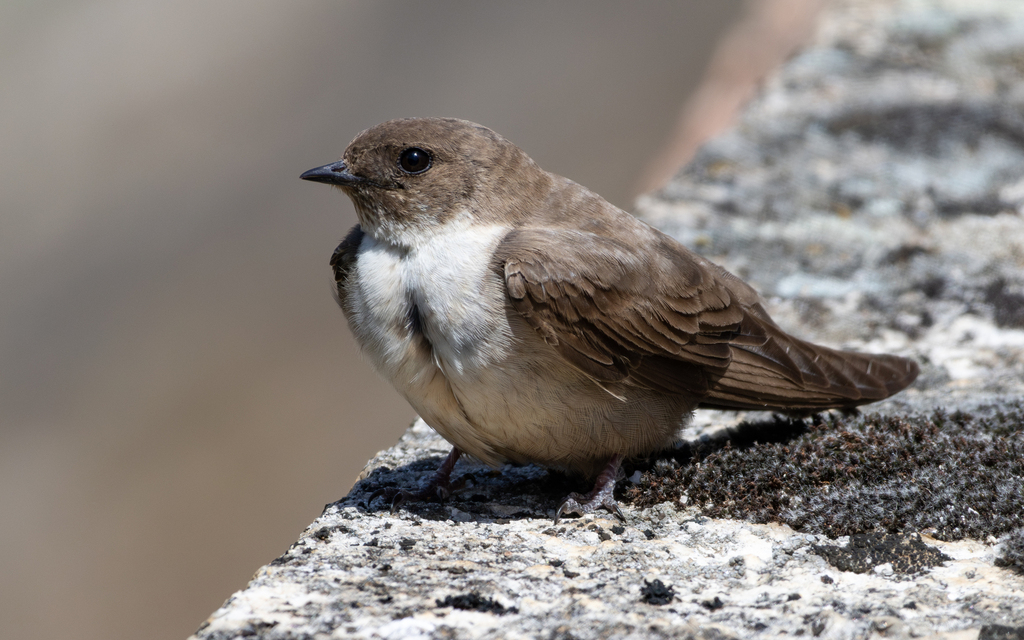
The Eurasian crag martin is a compact swallow, measuring 13–15 cm in length with a wingspan of 32–34.5 cm. Its most distinctive features are ash-brown upperparts contrasting with paler underparts, and a short, square tail displaying conspicuous white patches near the tips of most feathers. The underwing and undertail coverts are blackish, while the eyes are brown and the small bill is primarily black. This species has a notably broader body, wings and tail than any other European swallow, giving it a stockier appearance than its relatives. Juveniles show buff-brown tips to their plumage on the head, upperparts and wing coverts. Where ranges overlap with other Ptyonoprogne species, the Eurasian crag martin stands out as darker and browner than the rock martin, and larger with paler underparts than the dusky crag martin—its white tail spots are also significantly larger than those of both relatives.
Range & Habitat
This species breeds across an extensive range spanning the mountains of southern Europe, northwestern Africa, and throughout the Palearctic. Many European populations are resident year-round, but northern populations and most Asian breeders migrate seasonally, wintering in northern Africa, the Middle East or India. The crag martin favours rocky, mountainous terrain where it can exploit cliff faces for nesting and hunting.
Behaviour & Diet
The Eurasian crag martin constructs a distinctive half-cup nest of mud adhered to rocks beneath cliff overhangs or, increasingly, on man-made structures. The nest features a soft inner lining of feathers and dry grass. Breeding pairs are typically solitary, though several pairs may nest relatively close together at suitable locations. Clutches of two to five brown-blotched white eggs are incubated primarily by the female, with both parents feeding the chicks. Outside the breeding season, this species becomes gregarious. It feeds opportunistically on a wide variety of insects caught in flight near cliff faces, over streams and alpine meadows. The crag martin's flight appears relatively slow for a swallow, with rapid wing beats interspersed with flat-winged glides; its long, flexible primaries enable remarkable agility when manoeuvring near rock faces.
Best Time & Places to See It
The Eurasian crag martin's large, expanding range and large population mean it is generally accessible throughout its breeding range in mountain regions of southern Europe and northwestern Africa. Resident European populations can be observed year-round in suitable rocky habitats. Migratory populations are best encountered during breeding season in their northern ranges or in winter quarters across northern Africa, the Middle East and India. Look for them near cliff faces and rocky outcrops where they nest and hunt.
Photography Tips
Photograph this species near cliff faces and rock formations where it hunts and nests. Its relatively slow flight compared to other swallows, punctuated by glides, offers opportunities to capture it in action. The distinctive white tail patches are a key identifying feature worth highlighting in images. Early morning and late afternoon light will enhance the contrast between its ash-brown upperparts and paler underparts, and illuminate the characteristic white tail markings that distinguish it from related crag martin species.