Hide 9 Pins
Iberian Green Woodpecker · Great Spotted Woodpecker+17
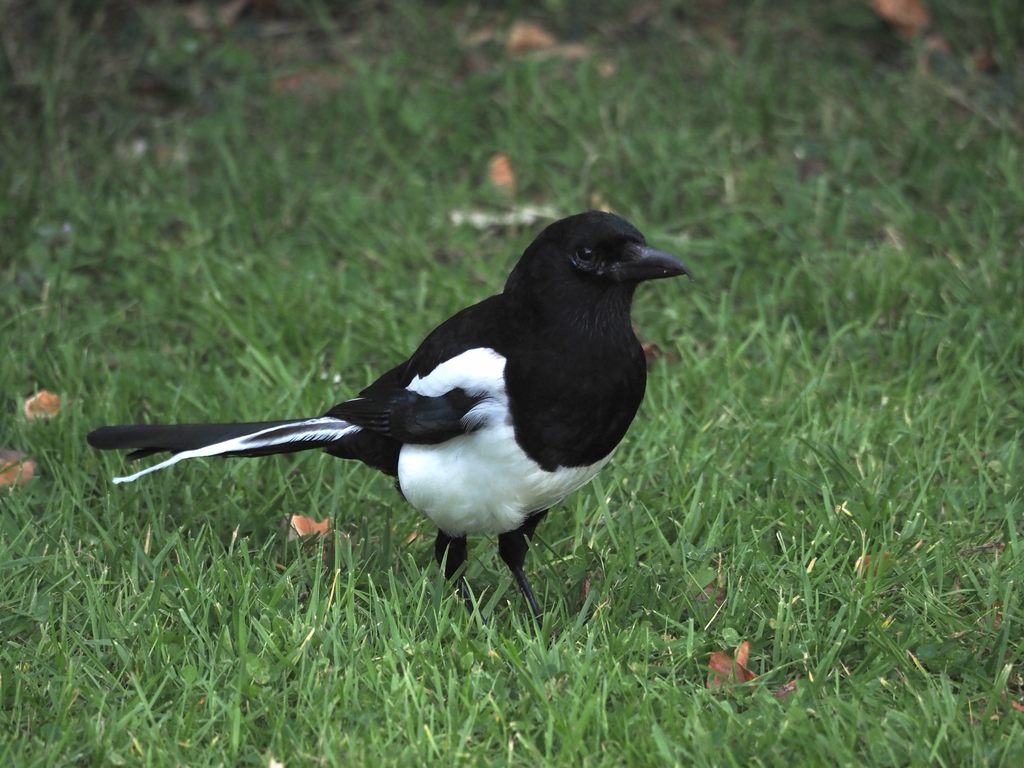
The Eurasian magpie is a striking and unmistakable bird, measuring 44–46 cm in length with a wingspan of 52–62 cm—more than half its body length consisting of a long, graduated tail. The adult is boldly patterned in black and white, with the head, neck, breast and vent a glossy black adorned with an iridescent green and violet sheen. The belly and shoulder feathers (scapulars) are pure white, while the wings are black with a metallic green or purple gloss; when the wings open, white inner webs on the primaries become conspicuous. The long tail feathers, measuring 12–28 cm, are black with reddish-purple and green iridescence. The rump is black with a white stripe above it—more prominent in some subspecies—while the legs and bill are black and the iris dark brown.
Females are slightly smaller than males and lack the glossy plumage sheen initially seen in young birds, which also have noticeably shorter tails and a pink malar region. Different subspecies vary in size and the extent of white markings, particularly on the primary feathers and rump; the Asian subspecies, for instance, displays more extensive white on the primaries and a more prominent white rump stripe.
The Eurasian magpie is a resident breeding bird throughout the northern part of the Eurasian continent, with six recognized subspecies distributed across a vast geographic range. The nominate subspecies, P. p. pica, occurs across the British Isles and southern Scandinavia, extending eastward to Russia and southward to the Mediterranean region. Other subspecies inhabit Siberia, the Caucasus, Central Asia, Pakistan, the Russian Far East including the Kamchatka Peninsula, and portions of China. This wide distribution reflects the species' remarkable adaptability to diverse environments across its range.
The Eurasian magpie ranks among the most intelligent bird species on Earth. The relative size of its nidopallium—the enlarged brain region—is approximately equivalent to that of chimpanzees, gorillas, orangutans, and humans. Most remarkably, it is one of the few bird species known to pass the mirror test, a key indicator of self-awareness and advanced cognitive abilities. These exceptional mental capacities underpin complex social behaviours and problem-solving abilities that distinguish the species among avian populations.
As a resident breeding bird throughout the northern Eurasian continent, the Eurasian magpie is present year-round across its range, making it accessible to birdwatchers and wildlife enthusiasts throughout the year. In Europe, where it is the only magpie species commonly encountered (the Iberian magpie being restricted to the Iberian Peninsula), it is a familiar sight across the British Isles, Scandinavia, and across to Russia and the Mediterranean regions where the nominate subspecies occurs. Travellers exploring the broader Eurasian range may encounter other subspecies in Siberia, Central Asia, and the Russian Far East.
The magpie's striking black-and-white plumage and iridescent sheens offer excellent photographic opportunities. The metallic green and violet iridescence on the head, neck and wings are best captured in good natural light, which brings out the subtle colour shifts in the glossy black feathers. The distinctive long tail, comprising more than half the bird's length, should be fully included in compositions to convey the species' elegant proportions. When photographing birds in flight, watch for the white inner webs of the primaries, which create striking contrast and become particularly visible as the wings open.
Nothing matches these filters.
Nothing matches these filters.
No community photos yet. Log in to add the first one.
We'd love to hear from you. We'll reply as soon as possible.
Found an error? Have a suggestion? We read every message.
A compact view of how this species lives, moves and responds to its environment.
Select a card to explore the details.
Please confirm the photo rights and credit terms first.
I'm the author of this photo or hold the rights to it, and I keep full ownership. I grant Wild Atlas Guide a free, non-exclusive licence to display it on the site and in Wild Atlas Guide's own channels, including social media, always credited to me by my display name or the Instagram handle I choose to provide. I confirm it does not reveal a sensitive wildlife location or a recognisable person without their permission. I can withdraw future social use for this photo or ask for it to be removed at any time.
Please accept the photo rights and credit terms to continue.
Uploading…
We use cookies to measure traffic and improve Wild Atlas Guide. You decide. Privacy policy