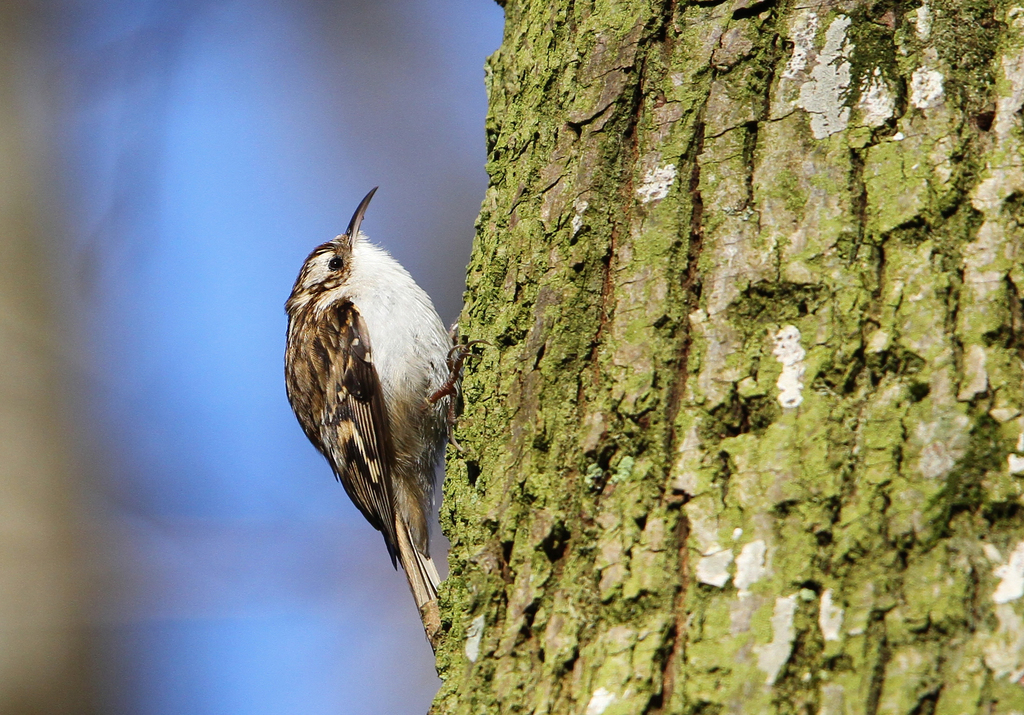
Eurasian Treecreeper
Photo © Christoph Moning
Photo © Christoph Moning — CC BY 4.0 — Source: iNaturalist photo #92807776Identification
The Eurasian treecreeper is a small bird measuring 12.5 cm in length and weighing 7.0–12.9 g. It features warm brown upperparts intricately patterned with black, buff and white, with a plain brown tail and whitish underparts tinged with buff on the belly, flanks and vent area. Its most distinctive feature is a long, decurved bill perfectly adapted for extracting insects from bark crevices. The sexes are similar in appearance, though juveniles have duller upperparts and dull white underparts with fine dark spotting on the flanks.
In Europe, the Eurasian treecreeper can be confused with the short-toed treecreeper, which shares much of its range. The Eurasian is whiter below, warmer and more spotted above, with a whiter supercilium and slightly shorter bill—though visual identification of poorly marked individuals may be impossible even in the hand. The most reliable identification method is by song: the Eurasian's distinctive pattern of srrih, srrih followed by twittering notes, a descending ripple, and a rising-falling whistle differs markedly from the short-toed treecreeper's evenly spaced notes.
Range & Habitat
The Eurasian treecreeper is found across the Palearctic region, with nine or more subspecies breeding in different parts of its extensive range. It inhabits woodlands of all kinds throughout its distribution. Where its range overlaps with the short-toed treecreeper in western Europe, the Eurasian treecreeper is more likely to be found in coniferous forests or at higher altitudes, suggesting a preference for cooler woodland habitats in areas of sympatry.
This species nests in tree crevices or behind bark flakes, and shows a notable preference for giant sequoia trees as nest sites where these introduced species are available. The female typically lays five or six pink-speckled white eggs in a lined nest. However, eggs and chicks remain vulnerable to predation by woodpeckers and mammals, particularly squirrels.
Behaviour & Diet
The Eurasian treecreeper is strictly insectivorous, employing a characteristic foraging technique: it creeps methodically up tree trunks in a mouse-like manner, using its long, stiff tail feathers for support as it searches bark crevices. Its fine curved bill is perfectly adapted for picking small insects and larvae from these crevices. Once it reaches the upper portions of a tree, the bird flies to the base of another tree with a distinctive erratic flight pattern, then begins its ascent anew.
During winter, the Eurasian treecreeper is solitary in habit. However, in cold weather it may form communal roosts, suggesting a behavioral flexibility that helps it survive harsh conditions. The species produces a very quiet, thin, high-pitched sit call, but its most distinctive vocalization is a penetrating, vibrato-quality tsree, sometimes repeated as a series of notes.
Best Time & Places to See It
The Eurasian treecreeper can be found year-round throughout its Palearctic range in suitable woodland habitats. In areas where it overlaps with the short-toed treecreeper in western Europe, look for it specifically in coniferous forests and at higher altitudes. The bird's solitary nature in winter means individuals may be more dispersed, though communal roosts may concentrate birds in particularly harsh conditions.
Listen for the bird's distinctive song or penetrating tsree call to locate it, particularly during breeding season when males are more vocal. Its mouse-like creeping behavior up tree trunks makes it easier to spot if you scan the trunk systematically rather than searching the canopy.
Photography Tips
Photographing the Eurasian treecreeper presents both challenges and rewards. The bird's small size and habit of creeping up tree trunks mean you'll need a telephoto lens and patience. Position yourself near a tree the bird is working, and wait for it to move into better light or an unobstructed position rather than pursuing it around the trunk.
The intricate patterning of warm brown, black, buff and white on the upperparts provides excellent detail for close-up photography when you can get near enough. Catch the bird in profile as it creeps up a trunk to showcase its distinctive curved bill and the long tail feathers that aid its climbing behavior. Early morning light will best reveal the subtle plumage patterns and the bird's characteristic posture against the bark.
Aggtelek National Park
Alpilles Regional Nature Park
Appennino Lucano Val d’Agri Lagonegrese National Park
Åsnens National Park
Baikal National Park
Bannau Brycheiniog National Park
Baronnies Provençales Regional Nature Park
Bavarian Forest National Park
Beinn Eighe National Nature Reserve
Nothing matches these filters.
No community photos yet. Log in to add the first one.
No community observations of this species yet.