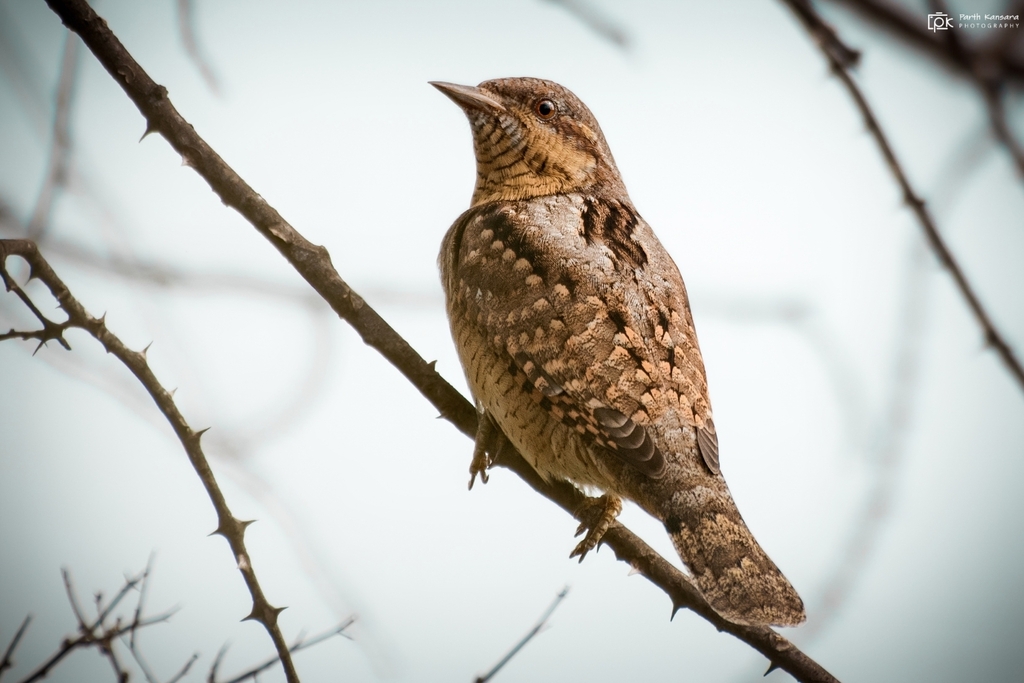
Eurasian Wryneck
Photo © Parth Kansara
Photo © Parth Kansara — CC BY 4.0 — Source: iNaturalist photo #211104086Identification
The Eurasian wryneck is a small, slim woodpecker measuring 16–18 cm in length, with an unusually thrush-like body shape. Unlike typical woodpeckers, it has a shorter, more delicate bill. The plumage is cryptically patterned with barred and mottled pale brown upperparts featuring rufous and blackish markings, while the underparts are creamy white with arrow-head-shaped brown spots. The rump is grey and speckled, and the rounded tail is grey with faint bands. The throat and cheeks are buff with brown barring. Its most distinctive feature is its remarkable ability to twist its head through almost 180 degrees—a trait reflected in both its English and scientific names.
When disturbed at the nest, the wryneck employs an extraordinary defensive display, hissing and contorting its head in snake-like movements to intimidate intruders. Its call is a distinctive series of repeated harsh, shrill notes—quee-quee-quee-quee—that can last several seconds and resembles the call of a lesser spotted woodpecker or small falcon.
Range & Habitat
The Eurasian wryneck breeds across temperate Eurasia from Portugal and Spain in the southwest to the Arctic Circle in the north, and east to the Pacific coast. The nominate subspecies occupies most of Europe to the Urals, though it has disappeared as a breeder from Great Britain in recent decades, arriving only as a migrant. Six subspecies are recognized across its range, occupying regions from northwestern Africa through Europe and across Asia to Japan. Most populations are highly migratory, wintering in tropical Africa and southern Asia from Iran to the Indian subcontinent, though populations in northwestern Africa are resident year-round.
The species favours open countryside, woodland, orchards, and other semi-open habitats where it can forage for its preferred prey.
Behaviour & Diet
Eurasian wrynecks are specialist insectivores with a strong preference for ants, which they locate in decaying wood or on the ground. This diet, combined with their relatively weak excavating ability compared to other woodpeckers, makes them well-suited to foraging on or near the ground rather than deep within tree trunks. They nest in holes, laying clutches of seven to ten white eggs during May and June—the white coloration being typical of hole-nesting birds where camouflage is less critical.
Best Time & Places to See It
The timing and location for observing Eurasian wrynecks depend on whether you are seeking resident or migratory populations. In Europe, the breeding season from May through June offers opportunities to find them in suitable open woodland and orchard habitats across the continent, though populations vary by region and subspecies. Spring and autumn migration periods may offer sightings in unexpected locations, particularly in southern Europe where small numbers pass through. In winter, observers should look to tropical Africa and southern Asia, where migratory populations congregate. Northwestern African populations, being resident, can be found year-round in Algeria and Morocco.
Photography Tips
The wryneck's cryptic plumage makes it challenging to locate and photograph despite its relatively open habitat preference. Patient observation of likely foraging areas—particularly ground-level feeding zones in open woodland—increases your chances. The bird's distinctive call is often the first indication of its presence. Early morning hours typically offer the best light and activity levels. When photographing, be mindful of the bird's snake-like threat display at the nest; while spectacular, disturbing nesting birds should be avoided. The wryneck's small size and tendency to perch motionless on tree trunks or on the ground require a telephoto lens and quick reflexes to capture sharp images before it moves.
Private Full-Day Birdwatching Tour from Lisbon to the Tagus Estuary
Week-long Birdwatching Programme in Northern & Central Portugal
Nothing matches these filters.
Kanha Tiger Reserve
Abijata-Shalla Lakes National Park
Aggtelek National Park
Alpilles Regional Nature Park
Alta Murgia National Park
Altai Tavan Bogd National Park
Asinara National Park
Åsnens National Park
Aspromonte National Park
Nothing matches these filters.
No community photos yet. Log in to add the first one.
No community observations of this species yet.