Hide 9 Pins
Iberian Green Woodpecker · Great Spotted Woodpecker+17
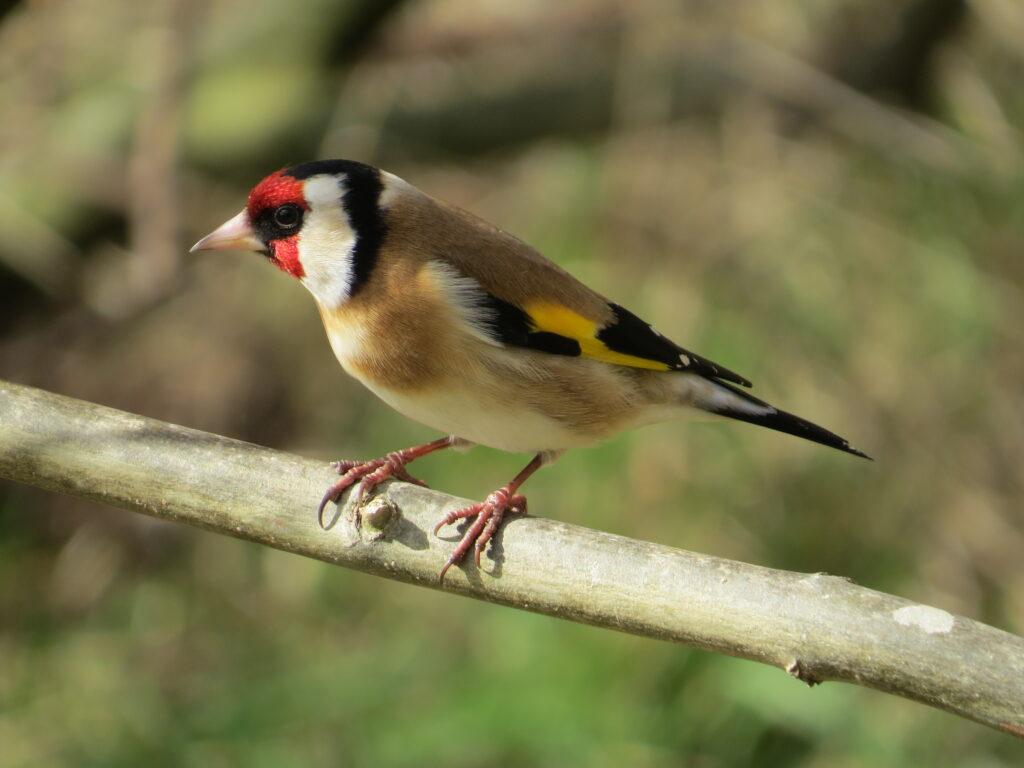
The European goldfinch is a small finch, averaging 12–13 cm long with a wingspan of 21–25 cm. Its most striking feature is its unmistakable red face contrasting sharply with a black-and-white head. The back and flanks are warm buff or chestnut brown, while the wings are black with a broad bright yellow bar—a feature particularly visible in flight. The tail is black, the rump white, and the bill is notably long and pointed with an ivory colour during breeding season.
Males and females are very similar in appearance, though females have a slightly smaller red facial area that does not extend as far behind the eye. Males also show darker red on their faces and black shoulder feathers, whereas females have brown shoulders. Juveniles lack the distinctive red face, appearing instead with plain heads and greyer backs, though the yellow wing stripe remains unmistakable. After their post-breeding moult, adults appear less colourful until feather tips wear away.
Native to the Palearctic zone, the European goldfinch occurs across Europe, northern Africa, and western and central Asia, with ten recognised subspecies occupying different regions from the British Isles to western Siberia. The species favours open, partially wooded lowlands. Birds in milder western regions are resident year-round, while those in colder areas migrate seasonally, and even western populations make local movements to escape harsh weather.
The species has been widely introduced beyond its native range and has become established in Australia, New Zealand, Uruguay, the United States, and several other countries. In Australia, populations now extend from Brisbane to the Eyre Peninsula, while in New Zealand they are spread throughout the country. In North America, they have become established in the western Great Lakes region.
The European goldfinch is vocal and musical, with a pleasant silvery song composed of tinkling trills and twitters. Its calls are distinctive: a melodic "tickeLIT" and a characteristic tri-syllabic phrase sounding like "teLLIT-teLLIT-teLLIT". The bird's name has resonated through Western culture since at least the 14th century, when Geoffrey Chaucer referenced it in his writings, and it became a favourite subject in Italian Renaissance paintings, often depicted alongside the Madonna and Child.
Females are responsible for nest-building, constructing a neat, compact nest that is typically completed within a week, while males accompany them but do not assist in construction. The species moults after the breeding season, with some individuals beginning as early as July while others may not complete the process until November.
The European goldfinch can be observed year-round in milder western regions of its native range, making it accessible to travellers during any season. In colder eastern areas, spring and autumn migrations offer excellent viewing opportunities. Open, partially wooded lowlands throughout Europe, North Africa, and western Asia provide suitable habitat for encountering this species. Those visiting introduced populations can find them in suitable habitats across Australia, New Zealand, and parts of North America.
The European goldfinch's vibrant plumage—particularly its red face, black-and-white head, and bright yellow wing bar—makes it a rewarding photographic subject. The striking contrast of these colours is most vivid during breeding season when birds are in fresh plumage with pale bills. Photograph birds in flight to capture the bold yellow wing markings, or wait for perched birds to display their distinctive facial pattern. Early morning light will enhance the metallic sheen of the plumage and bring out the brilliant reds and yellows. Listen for their distinctive calls to locate birds, and watch for them in flowering or seeding plants, where they often feed.
Nothing matches these filters.
Nothing matches these filters.
No community observations of this species yet.
We'd love to hear from you. We'll reply as soon as possible.
Found an error? Have a suggestion? We read every message.
A compact view of how this species lives, moves and responds to its environment.
Select a card to explore the details.
Please confirm the photo rights and credit terms first.
I'm the author of this photo or hold the rights to it, and I keep full ownership. I grant Wild Atlas Guide a free, non-exclusive licence to display it on the site and in Wild Atlas Guide's own channels, including social media, always credited to me by my display name or the Instagram handle I choose to provide. I confirm it does not reveal a sensitive wildlife location or a recognisable person without their permission. I can withdraw future social use for this photo or ask for it to be removed at any time.
Please accept the photo rights and credit terms to continue.
Uploading…
We use cookies to measure traffic and improve Wild Atlas Guide. You decide. Privacy policy