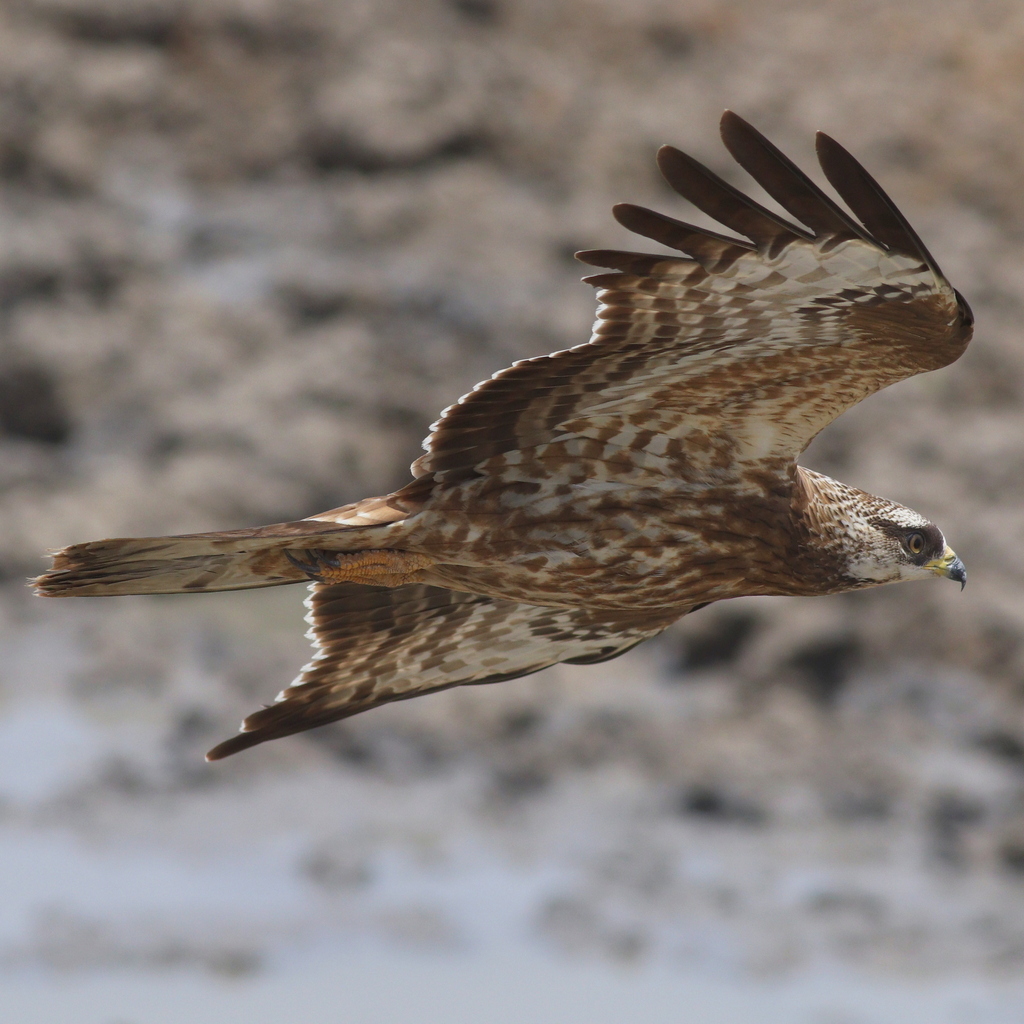
European Honey Buzzard
Photo © Jan Ebr & Ivana Ebrová
Photo © Jan Ebr & Ivana Ebrová — CC BY 4.0 — Source: iNaturalist #71505571Identification
The European honey buzzard is a distinctive raptor measuring 52–60 centimetres in length with a impressive wingspan of 135–150 centimetres, making it noticeably larger and longer-winged than the common buzzard. Its most recognizable features include a small head that protrudes forward with a slight kink downwards, a longer neck, and a longer tail with fewer bars than true buzzards—typically showing two narrow dark bars and a broad dark subterminal bar. When soaring, it holds its wings characteristically straight and flat, with wing tips held horizontally or slightly angled downwards, creating a distinctive silhouette quite different from other raptors.
Sexual dimorphism is unusually pronounced for a large bird of prey: males display a striking blue-grey head, while females are brown-headed and slightly larger and darker overall. The bird's jizz in direct flight can appear remarkably angular at the chest, somewhat resembling a sparrowhawk. Its clear, distinctive call is a peee-lu, which can aid identification in the field.
Range & Habitat
The European honey buzzard is a summer migrant across a relatively small area in the western Palearctic, breeding from most of Europe eastward to southwestern Siberia, with the exact eastern boundary still uncertain but thought to lie in the Tomsk–Novosibirsk–Barnaul region. The species shows a strong preference for woodland and exotic plantations, though it adapts to a wide range of habitats. It is a long-distance migrant, departing for tropical Africa during European winters.
This bird is an extraordinarily skilled navigator, relying on both magnetic orientation and visual memory of dramatic geographical landmarks such as mountain ranges and rivers. To conserve energy, it deliberately avoids large expanses of open water. Consequently, during migration periods, vast numbers of honey buzzards concentrate at narrow coastal crossings—the Gibraltar Strait, Messina Strait, Bosphorus, Lebanon, and Israel—where they can continue soaring on thermals across the sea.
Behaviour & Diet
In woodland habitats, honey buzzards typically fly low and perch in the midcanopy, holding their bodies nearly horizontal with drooping tails. They display characteristic restless behaviour, ruffling their wings frequently and shifting constantly on their perches whilst inspecting potential food sources. The bird often hops from branch to branch with a loud wing-clap, and frequently cocks its head inquisitively, behaviour reminiscent of a curious parrot. During spring breeding season, males perform dramatic wing-clapping displays and defend territories fiercely, nesting in woodland and typically laying clutches of two eggs, occasionally one or three.
The honey buzzard is a highly specialized feeder, living predominantly on wasp and hornet larvae and nests, spending considerable time excavating on the forest floor. Though it will occasionally take small mammals, reptiles, and birds, it is the only known predator of the invasive Asian hornet. Remarkably adapted to its chosen prey, the bird possesses long toes and claws for raking and digging, plus scale-like head feathering believed to defend against stings. Scientists theorize the species also possesses a chemical deterrent in its feathers that protects it from wasp attacks.
Best Time & Places to See It
The European honey buzzard is a summer visitor, making spring and summer the optimal seasons for observation across its breeding range in Europe and southwestern Siberia. Those seeking the species should focus on woodland habitats and exotic plantations where it hunts. For the most reliable sightings during migration, position yourself at major coastal bottlenecks such as the Gibraltar Strait, Messina Strait, or Bosphorus, where thousands funnel through during spring and autumn migration periods.
In the United Kingdom, where the species is increasingly present due to maturing upland conifer forests, sightings remain scarce, though the bird's occurrence is gradually increasing. The species is protected under the Wildlife and Countryside Act 1981 as a Schedule 1 species, with nesting sites kept confidential by authorities to prevent disturbance.
Photography Tips
Photographing European honey buzzards in flight rewards patience and an understanding of their distinctive soaring posture—shoot from below to capture their characteristic flat-winged profile and protruding head. The bird's sexual dimorphism offers excellent identification opportunities in images; prioritize shots showing the male's blue-grey head or the female's darker brown coloration. During migration periods at bottleneck sites, position yourself to backlight soaring birds against clear skies, which will accentuate their shape and wing pattern.
For ground-feeding behaviour, approach woodland areas cautiously and quietly, as the bird is inconspicuous outside the breeding season. The bird's restless, inquisitive perching behaviour provides opportunities for detailed plumage and facial studies, while the dramatic wing-clapping display during breeding season—if you can locate territorial males in spring—offers dynamic action sequences. Remember that the subtle two-bar tail pattern and long-necked posture are key field marks worth capturing in your photography.
12 Days Birds & Wine Programme in Portugal
Nothing matches these filters.
Bwindi Impenetrable National Park
Lake Mburo National Park
Mabamba Swamp
Murchison Falls National Park
Queen Elizabeth National Park
Aberdare National Park
Abijata-Shalla Lakes National Park
Abruzzo, Lazio and Molise National Park
Addo Elephant National Park
Nothing matches these filters.
No community photos yet. Log in to add the first one.
No community observations of this species yet.