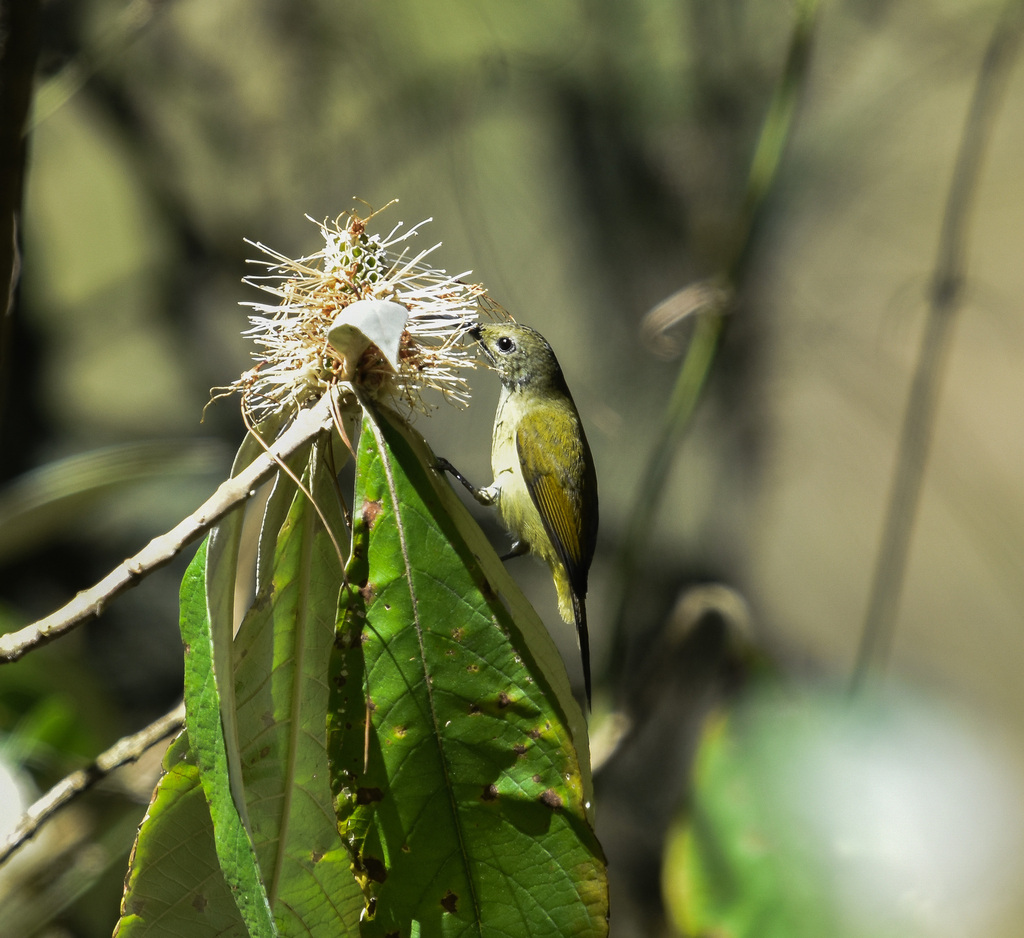
Fire-tailed Sunbird
Photo © Rejoice Gassah
Photo © Rejoice Gassah — CC BY 4.0 — Source: iNaturalist #234849270The fire-tailed sunbird (Aethopyga ignicauda) is a species of sunbird in the family Nectariniidae. It is found in the northern parts of the Indian subcontinent, primarily in the Himalayas, and also in some adjoining regions in Southeast Asia. The species occurs in Bangladesh, Bhutan, India, Myanmar, Nepal, Thailand and Tibet. Its natural habitats are temperate forests and subtropical or tropical moist montane forests. Breeding males have a scarlet nape and mantle, and a yellow-orange breast and an olive-green belly. They develop a long scarlet tail, and including the tail are about 15 cm long; females are about two-thirds that length. Females have a grey-olive head and throat, and a yellow belly. Females are differentiated from the similar female green-tailed sunbird by a straighter bill, squarer tail (lacking white tips and with trace of brownish orange on the sides) and mor noticeable olive-yellow on the rump. Eclipse males are similar to females but have brighter yellow bellies, scarlet uppertail coverts, and scarlet tail sides. They live in conifer forests at altitudes up to 4,000 meters, descending into the valleys during the cold season, wintering in broadleaved forests. They eat insects, and also nectar. They breed in rhododendron shrub. Both parents take…
Langtang National Park
Helambu, Nepal
+364 birds+14 mammals
Where the southern slopes of the Himalayan highlands descend toward the subtropical valleys of central Nepal, Langtang National Park sprawls across one of the subcontinent's most…
VIEW NATIONAL PARKSagarmatha National Park
Khumjung, Nepal
+219 birds+7 mammals
Soaring peaks and deep glacial valleys define this alpine wilderness in northeastern Nepal, where the terrain rises from forested foothills into a realm of high-altitude tundra…
VIEW NATIONAL PARKKhangchendzonga National Park
Sakkyong, India
+290 birds+1 mammals
Where the eastern Himalayas surge toward their crowning peaks, Khangchendzonga National Park embraces a landscape of almost overwhelming vertical drama. Rising from subtropical river valleys into…
VIEW NATIONAL PARKGiant Panda National Park
Mianyang, China
+447 birds+47 mammals
Where the eastern slopes of China's Sichuan plateau descend into cloud-wrapped valleys, one of Asia's most biodiverse landscapes unfolds across more than 350,000 square kilometres. This…
VIEW NATIONAL PARKGaoligong Mountain National Nature Reserve
Nujiang Lisu Autonomous Prefecture, China
+443 birds+13 mammals
VIEW NATURE RESERVEBaima Snow Mountain National Nature Reserve
Diqing Tibetan Autonomous Prefecture, China
+204 birds+3 mammals
High-altitude ridges and steep-sided valleys define this reserve in northwestern Yunnan, where elevations surge from around 3,000 metres to peaks above 4,100 metres. The terrain supports…
VIEW NATURE RESERVENo community photos yet. Log in to add the first one.
No community observations of this species yet.