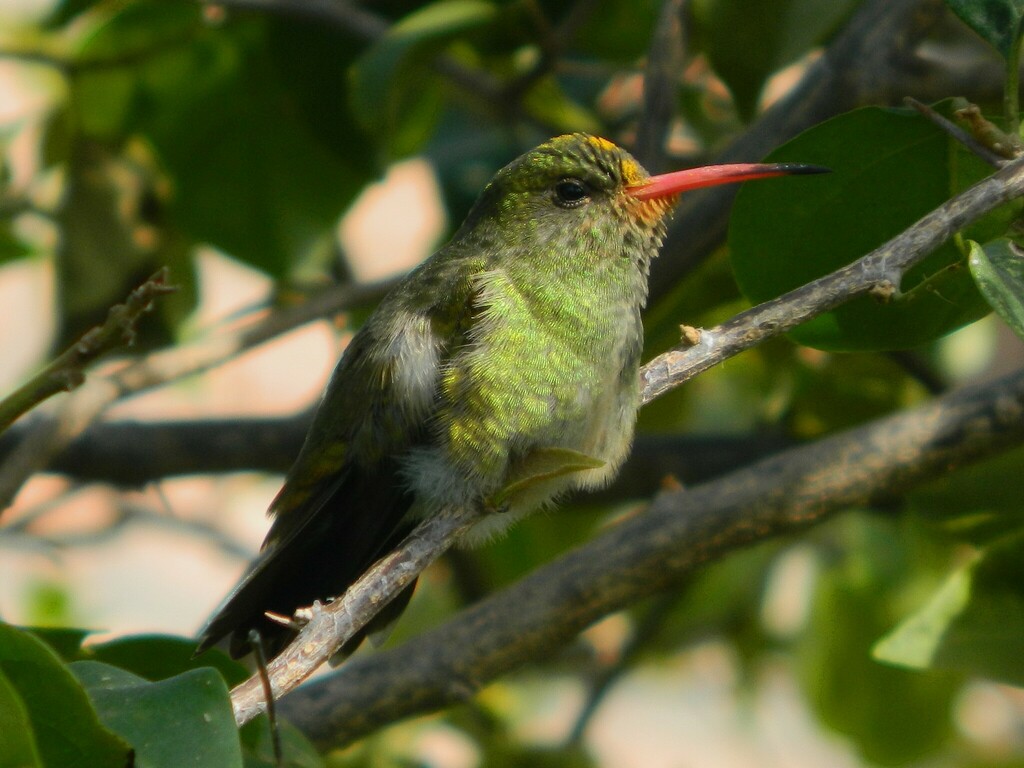
Gilded Sapphire
Photo © Eduardo Luis Beltrocco
Photo © Eduardo Luis Beltrocco — CC BY 4.0 — Source: iNaturalist photo #472640186Identification
The gilded sapphire is a small hummingbird, measuring 8 to 10 cm in length and weighing just 4 to 5 grams. Both males and females display a distinctive medium-length, straight bill that is coral red with a black tip. Adult males are predominantly iridescent golden-green with a pale rufous chin and a striking glittering golden-bronze tail that gives the species its common name. Females are similar in pattern but noticeably duller overall, with a grayish lower belly. Juveniles resemble adult females but bear buff fringes on their head feathers, making them distinguishable from older birds.
Range & Habitat
This species occupies a broad range across South America, found in northeastern to south-central Bolivia, essentially all of Paraguay and Uruguay, central and southeastern Brazil, and northern Argentina. The gilded sapphire favors open landscapes including savannahs with scattered trees, forest edges and clearings, plantations, and gardens. It is most numerous between 400 and 800 metres elevation, though it regularly occurs from 200 metres up to 1,000 metres, and locally even higher. The species readily adapts to human-modified habitats and shows a tendency toward range expansion.
Behaviour & Diet
The gilded sapphire appears generally sedentary throughout most of its range, though populations in Brazil and adjacent Bolivia undertake migrations; movements elsewhere remain poorly understood. This hummingbird forages for nectar at numerous native and introduced plants, shrubs, and trees at all levels of its habitat. Beyond nectar, it supplements its diet by hawking insects from a perch and gleaning spiders from their webs. Breeding in Brazil occurs from September to February. Females construct tiny cup nests from plant seed fibers and cobweb, decorated externally with lichen and leaf fragments, typically placing them on thin horizontal branches or in forks 4 to 6 metres above ground. The female incubates two eggs for 14 to 15 days, with fledging occurring 20 to 28 days after hatching. The species produces a distinctive high-pitched, cricket-like trilling song and a short dry rattle call.
Best Time & Places to See It
The gilded sapphire is considered very common throughout its range, making it a reliable species for observation across Argentina, Bolivia, Brazil, Paraguay, and Uruguay. Its preference for open, accessible habitats such as gardens, plantations, and savannah edges means it is often encountered near human settlements. The breeding season in Brazil (September to February) offers opportunities to observe nesting behaviour and territorial activity, though breeding seasons in other parts of its range remain undocumented.
Photography Tips
Photographers should focus on capturing the males' iridescent golden-green plumage and signature glittering golden-bronze tail, which are best rendered in bright, directional light. The species' small size and activity in open habitats make it accessible for photography. Patience near flowering plants, gardens, and plantations will yield opportunities to photograph feeding behaviour and perching birds. Early morning light is ideal for showcasing the metallic coloration that defines this species.
Emas National Park
Brazil
+333 birds+23 mammals
Across the high plateaux of central Brazil, where the cerrado grasslands roll toward distant horizons under an immense sky, Emas National Park anchors one of South…
VIEW NATIONAL PARKPeixe National Park Lagoon
Brazil
+293 birds+4 mammals
Where the coastal plains of Rio Grande do Sul meet the Atlantic, Peixe National Park Lagoon sprawls across nearly 2,200 square kilometres of shallow waters, reed…
VIEW NATIONAL PARKIguaçu National Park
Brazil
+387 birds+17 mammals
Where the Paraná Plateau plunges toward the Atlantic watershed, six thousand square kilometers of subtropical rainforest cling to steep gorges and river valleys in this corner…
VIEW NATIONAL PARKIlha Grande National Park
Brazil
+233 birds
Across the subtropical plateaus and Atlantic forest remnants of southern Brazil, a vast protected landscape spanning nearly 4,600 square kilometers safeguards one of the continent's most…
VIEW NATIONAL PARKChapada dos Guimarães National Park
Brazil
+450 birds+1 mammals
Where weathered sandstone plateaus rise above the cerrado grasslands of central Brazil, Chapada dos Guimarães National Park protects 624 square kilometres of ecological transition zone that…
VIEW NATIONAL PARKPantanal Matogrossense National Park
Brazil
+322 birds+17 mammals
Where the flooded forests of central Brazil meet vast seasonally inundated grasslands, Pantanal Matogrossense National Park sprawls across nearly 2,900 square kilometers of one of the…
VIEW NATIONAL PARKEl Palmar National Park
Distrito Sexto, Argentina
+244 birds+14 mammals
Across the Paraná River floodplain in northeastern Argentina, palms rise from wetland and grassland in a landscape shaped by water and time. El Palmar National Park…
VIEW NATIONAL PARKCampos del Tuyú National Park
Argentina
+169 birds+5 mammals
Subtropical forest graces the borderlands where Misiones Province meets Paraguay, a landscape shaped by the Paraná Plateau's weathered topography and the warm, humid climate of northeastern…
VIEW NATIONAL PARKRío Pilcomayo National Park
Argentina
+271 birds+13 mammals
Where the Río Pilcomayo cuts through northeastern Argentina's subtropical lowlands, a sprawling mosaic of wetlands, grasslands, and seasonally flooded forests creates one of South America's most…
VIEW NATIONAL PARKIguazú National Park
Puerto Iguazú, Argentina
+346 birds+15 mammals
Where the Paraná Plateau plunges toward the Atlantic watershed, nearly 800 square kilometers of subtropical rainforest drape across Misiones Province in a landscape carved by millennia…
VIEW NATIONAL PARKEl Rey National Park
Municipio de Las Lajitas, Argentina
+317 birds+4 mammals
Where the eastern slopes of the Andes descend into northwestern Argentina's subtropical transition zone, El Rey National Park unfolds across 841 square kilometers of dramatically varied…
VIEW NATIONAL PARKCalilegua National Park
Municipio de Calilegua, Argentina
+288 birds+8 mammals
Where the eastern Andean slopes plunge into northwestern Argentina's humid subtropics, nearly 2,645 square kilometers of steep terrain and luxuriant forest compose one of South America's…
VIEW NATIONAL PARKParque Provincial Pampa del Indio
Laguna Limpia, Argentina
+231 birds+4 mammals
Across the flat horizons of Chaco Province, where the Paraná River system spills into vast wetlands and grasslands, Parque Provincial Pampa del Indio protects one of…
VIEW NATURE RESERVEChaco National Park
Municipio de Presidencia de la Plaza, Argentina
+258 birds+7 mammals
Across the humid subtropical lowlands of northeastern Argentina, where the Paraná River basin feeds vast seasonal wetlands and gallery forests, Chaco National Park protects one of…
VIEW NATIONAL PARKNo community photos yet. Log in to add the first one.
No community observations of this species yet.