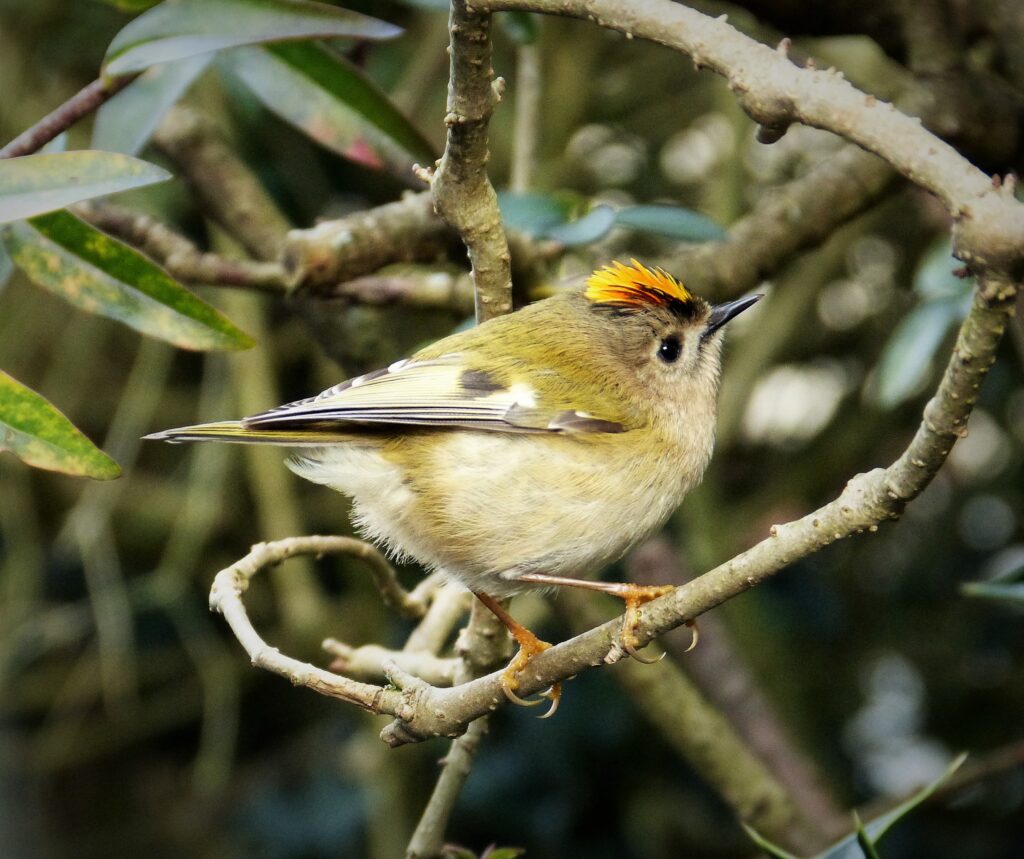
Goldcrest
Photo © gailhampshire from Cradley, Malvern, U.K
Photo © gailhampshire from Cradley, Malvern, U.K — CC BY 4.0 — Source: Wikimedia CommonsIdentification
The goldcrest is Europe's smallest bird, measuring just 8.5–9.5 cm in length with a wingspan of 13.5–15.5 cm and weighing a mere 4.5–7.0 g. Despite its diminutive size, it is usually easy to identify. Look for greenish upper-parts, whitish under-parts, and two distinctive white wing bars. The most striking feature is the bright head crest: orange and yellow in males, entirely yellow in females. Both sexes have a plain face with conspicuous black irises, black sides to the crown, and a thin black bill. The crest is typically raised during breeding displays, making the male's orange stripe particularly conspicuous.
The goldcrest can be confused with the common firecrest, which shares much of its European range, but the firecrest has distinctive bronze shoulders and a strong face pattern with a white eyebrow stripe and black eye-stripe. Juveniles lack the coloured crown and have duller upper-parts, but by their first winter they are nearly indistinguishable from adults in the field. In flight, watch for distinctive whirring wing-beats with occasional sudden changes of direction.
Range & Habitat
The goldcrest has a very large distribution across much of the Palearctic, including the islands of Macaronesia and Iceland, with several recognised subspecies. Birds from the northern and eastern parts of the breeding range migrate south to winter further away, while others remain resident throughout the year.
This kinglet breeds in coniferous woodland and gardens, where it builds a compact, three-layered nest on a tree branch. It favours evergreen habitats that provide both shelter and a steady supply of insects year-round.
Behaviour & Diet
The goldcrest is constantly on the move as it hunts for insects, creeping restlessly among foliage, regularly clinging to branches and trunk surfaces. Its flight is distinctive, mixing whirring wing-beats with dashing, fluttering movements and frequent hovering while feeding. In winter, goldcrests often join mixed flocks of tits, which may help increase foraging efficiency and survival chances.
Breeding males sing frequently, even while foraging, producing a very high, thin double-note song that lasts 3–4 seconds and is repeated 5–7 times per minute. The contact call is a thin, high-pitched zee given at intervals of 1–4 seconds. Females lay ten to twelve eggs, which they incubate alone, while both parents feed the chicks. Second broods are common. Though goldcrests may fall prey to birds of prey or carry parasites, their large range and healthy population mean they face no significant conservation concerns.
Best Time & Places to See It
Goldcrests can be heard singing in most months of the year, with territorial males often vocalising while foraging. Winter is an excellent time to find them, when they join mixed flocks of tits in coniferous woodland and gardens. Listen for their characteristic high-pitched calls and songs among evergreen trees, particularly in areas with dense conifer plantations or well-established gardens with mature conifers.
Photography Tips
The goldcrest's tiny size and restless, constantly-moving behaviour present considerable challenges for photographers. Position yourself near coniferous trees or mixed feeding flocks during winter, when birds are more concentrated. The bird's distinctive flight—with whirring wing-beats and sudden direction changes—requires fast shutter speeds. The bright head crest is most visible when the bird is perched and alert; try to capture it with the crest raised, which occurs during breeding season or when displaying. The plain face and black irises can be effectively photographed in good light, as can the bright orange-and-yellow crest in males. Patience and a long lens are essential for this tiny, mobile subject.
Private Full-Day Birdwatching Tour from Algarve to Southwest Spain
Nothing matches these filters.
Abruzzo, Lazio and Molise National Park
Aggtelek National Park
Alpilles Regional Nature Park
Alta Murgia National Park
Appennino Lucano Val d’Agri Lagonegrese National Park
Appennino Tosco-Emiliano National Park
Åsnens National Park
Aspromonte National Park
Avesnois Regional Nature Park
Nothing matches these filters.
No community photos yet. Log in to add the first one.
No community observations of this species yet.