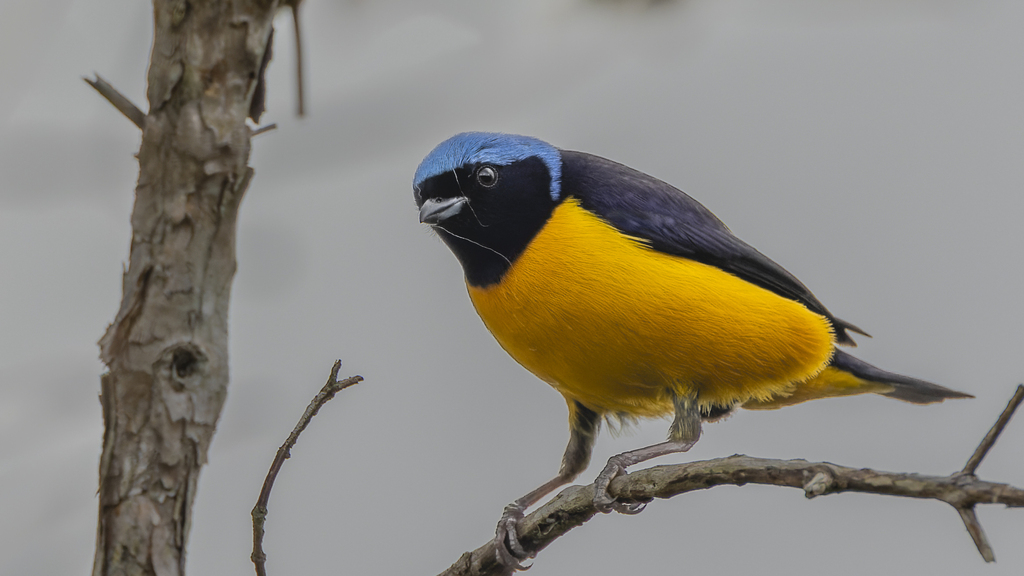
Golden-rumped Euphonia
Photo © Gary T. Leavens
Photo © Gary T. Leavens — CC BY-SA 4.0 — Source: iNaturalist photo #369628496Identification
The golden-rumped euphonia is a small finch, approximately 11 cm (4.3 in) long and weighing 15–16 g. This species is sexually dimorphic. Males of the nominate subspecies display a striking bright turquoise-blue crown and nape, with black face, head, and throat. Their backs are black with purplish-blue gloss, while the lower back and rump are golden-yellow to orange-yellow—the feature that gives this species its common name. The underparts are deep yellow. Females are more subdued, with tawny-buff foreheads and turquoise-blue crowns that curve forward, olive-green upperparts with a paler rump, and yellow-olive underparts. Both sexes have dark brown irises, blackish bills with blue-gray bases, and dusky gray legs.
Three subspecies are recognized, with regional variations. Males of C. c. pelzelni have paler rumps and underparts, while C. c. insignis males sport an orange-yellow forehead separated from the forecrown by a thin black line. Females of C. c. insignis have slightly greener backs. These subtle differences make subspecies identification rewarding for dedicated observers.
Range & Habitat
The golden-rumped euphonia is found throughout mainland South America except Chile, though its distribution is disjunct. The three subspecies occupy distinct ranges: C. c. pelzelni inhabits southern Colombia and western Ecuador; C. c. insignis occurs on the eastern slope of the Ecuadorian Andes; and C. c. cyanocephala is widespread from Venezuela through the Andes to Argentina, with additional populations in eastern and central Brazil, Paraguay, and Uruguay. The species was formerly present on Tobago but is now extirpated there. It is present in French Guiana and Suriname as non-breeding birds.
This euphonia prefers somewhat open landscapes including secondary forest, forest edges, disturbed areas, and shade coffee plantations. Elevation preferences vary by region: in Venezuela it typically occurs between 600–2,500 m north of the Orinoco River and 500–1,500 m to the south, occasionally reaching sea level. In the Andes, it generally occupies 1,200–3,000 m depending on the country, with lower elevations in Brazil.
Behaviour & Diet
Most populations are year-round residents, though many individuals undertake erratic movements likely linked to food availability. Localized movements to lowlands have been documented in Brazil, Ecuador, and Peru. The golden-rumped euphonia feeds almost entirely on fruits, with a particular preference for mistletoe (Loranthaceae) berries, making it an important seed disperser for these plants. Insects are believed to supplement its diet, though fruit dominates.
Socially, this species forages in pairs or small groups and only rarely joins mixed-species feeding flocks. Breeding seasons have not been precisely defined across its range, though in Venezuela activity occurs from January–February, and in Colombia breeding spans at least December to May. The species constructs distinctive side-entrance globe nests from grass and moss, typically hidden on earthen banks, tree branches, or among tree trunk epiphytes. Clutches consist of two cream-colored eggs with light reddish-brown markings.
Best Time & Places to See It
The golden-rumped euphonia's year-round residency in much of its range means it can be encountered throughout the year in appropriate habitat. For Venezuelan birdwatchers, the breeding season from January to February offers excellent opportunities in cloud forests and montane secondary growth between 600 and 2,500 m. In Colombia and Ecuador, the species is present year-round in foothill and montane forests, particularly in shade coffee plantations and forest edges where mistletoe berries are abundant.
Seek this species in humid montane areas with fruiting mistletoes and scattered trees. Early morning hours are productive for locating pairs or small groups foraging in the canopy. The species' relatively retiring nature means careful listening for calls and patient scanning of fruiting trees will yield better results than expecting it to join mixed flocks in open areas.
Photography Tips
The golden-rumped euphonia's small size and preference for foraging in canopy foliage present photographic challenges. Position yourself with good light behind you when scanning fruiting mistletoes and scattered trees in montane secondary forest. Males are far more conspicuous than females due to their brilliant blue and golden plumage, making them preferred subjects. The blue crown and golden rump are key field marks worth capturing clearly.
Use fast shutter speeds (1/1000 s or faster) to freeze this active feeder's movements. Forest edges and open shade plantations provide better lighting conditions than dense secondary forest. Early morning light will make the males' iridescent blue plumage particularly striking. Patience is essential—position yourself near fruiting trees and wait for birds to come to you rather than trying to pursue them through dense vegetation.
Tijuca National Park
Brazil
+317 birds+13 mammals
Where the Atlantic forest rises steeply from Rio de Janeiro's urban edge, Tijuca National Park encompasses a landscape of dramatic granite peaks, cascading waterfalls, and closed-canopy…
VIEW NATIONAL PARKSerra do Cipó National Park
Brazil
+379 birds+5 mammals
Where granite escarpments rise above the Atlantic Forest transition zone in southeastern Brazil, Serra do Cipó National Park unfolds across a landscape of dramatic ridges, cascading…
VIEW NATIONAL PARKPodocarpus National Park
Zamora, Ecuador
+496 birds+6 mammals
Where the Andes descend toward the Amazon basin, Podocarpus National Park sprawls across nearly 2,800 square kilometres of the most biodiverse terrain in Ecuador's southern highlands.…
VIEW NATIONAL PARKSumaco Napo-Galeras National Park
Loreto, Ecuador
+563 birds+4 mammals
Where Ecuador's Amazon transitions into cloud forest, a massive shield volcano rises from the emerald lowlands of Orellana Province, anchoring one of the continent's most biodiverse…
VIEW NATIONAL PARKAntisana National Park
Quijos, Ecuador
+432 birds+21 mammals
Where the eastern Andean slopes descend into the Amazon basin, Antisana National Park sprawls across roughly 2,500 square kilometers of some of South America's most dramatic…
VIEW NATIONAL PARKNatural Serranía de los Yariguíes National Park
El Carmen de Chucurí, Colombia
+320 birds+3 mammals
Where the northern cordilleras of Colombia rise toward cloud forest, the Serranía de los Yariguíes unfolds across nearly 1,820 square kilometers of some of the most…
VIEW NATIONAL PARKNatural Farallones de Cali National Park
Buenaventura, Colombia
+733 birds+27 mammals
Where the Pacific coastal plain meets the western slopes of the Andes, Farallones de Cali National Park sprawls across nearly 3,500 square kilometers of dramatic topography…
VIEW NATIONAL PARKNatural el Cocuy National Park
Güicán, Colombia
+313 birds+3 mammals
Where the Andes rise to their highest peaks in Colombia's eastern cordillera, El Cocuy National Park sprawls across more than 6,600 square kilometers of some of…
VIEW NATIONAL PARKPuracé National Natural Park
Puracé, Colombia
+327 birds+2 mammals
Where the Andes thrust upward across southwestern Colombia, Puracé National Natural Park spans nearly 2,631 square kilometers of some of South America's most dramatic montane terrain.…
VIEW NATIONAL PARKGuácharos Cave National Natural Park
Acevedo, Colombia
+359 birds
High in the Andean foothills of southern Huila, where mist-laden slopes rise above 1,600 metres, lies a landscape carved by underground rivers and crowned by karst…
VIEW NATIONAL PARKNatural Sumapaz National Park
Cubarral, Colombia
+368 birds+1 mammals
Where the Andes descend toward the Amazon basin, the high páramo grasslands of Sumapaz National Park sprawl across more than five thousand square kilometers of Meta…
VIEW NATIONAL PARKEl Tamá National Park
Toledo, Colombia
+435 birds
Where the Andes descend toward the Caribbean coastal lowlands of northern Colombia, El Tamá National Park sprawls across nearly 3,800 square kilometres of montane forest, cloud…
VIEW NATIONAL PARKItatiaia National Park
Brazil
+519 birds+12 mammals
Where granite peaks pierce the Atlantic rainforest canopy in southeastern Brazil, Itatiaia National Park rises as one of the country's oldest and most ecologically vital protected…
VIEW NATIONAL PARKSaint-Hilaire/Lange National Park
Brazil
+225 birds
Subtropical Atlantic forests rise and fall across the plateaus of inland Paraná, where Saint-Hilaire/Lange National Park protects nearly 578 square kilometres of Brazil's most biodiverse woodland…
VIEW NATIONAL PARKIguaçu National Park
Brazil
+387 birds+17 mammals
Where the Paraná Plateau plunges toward the Atlantic watershed, six thousand square kilometers of subtropical rainforest cling to steep gorges and river valleys in this corner…
VIEW NATIONAL PARKChapada Diamantina National Park
Brazil
+346 birds+5 mammals
Where granite peaks and sandstone cliffs rise abruptly from the Brazilian interior, Chapada Diamantina National Park sprawls across 4,215 square kilometers of some of Brazil's most…
VIEW NATIONAL PARKSerra do Gandarela National Park
Brazil
+333 birds+3 mammals
Where granite massifs rise through Atlantic Forest in southeastern Brazil's highlands, Serra do Gandarela National Park protects nearly 1,000 square kilometres of montane terrain that few…
VIEW NATIONAL PARKYanachaga–chemillén National Park
Palcazu, Peru
+639 birds+6 mammals
Where the eastern slopes of Peru's central cordillera plunge into cloud forest, Yanachaga–Chemillén National Park protects nearly three thousand square kilometres of montane wilderness that few…
VIEW NATIONAL PARKTingo Maria National Park
Mariano Dámaso Beraún, Peru
+423 birds
Where the eastern slopes of the Peruvian Andes descend toward the Amazon basin, the landscape fractures into a maze of limestone ridges, humid gorges, and cloud-wrapped…
VIEW NATIONAL PARKIguazú National Park
Puerto Iguazú, Argentina
+346 birds+15 mammals
Where the Paraná Plateau plunges toward the Atlantic watershed, nearly 800 square kilometers of subtropical rainforest drape across Misiones Province in a landscape carved by millennia…
VIEW NATIONAL PARKEl Rey National Park
Municipio de Las Lajitas, Argentina
+317 birds+4 mammals
Where the eastern slopes of the Andes descend into northwestern Argentina's subtropical transition zone, El Rey National Park unfolds across 841 square kilometers of dramatically varied…
VIEW NATIONAL PARKCalilegua National Park
Municipio de Calilegua, Argentina
+288 birds+8 mammals
Where the eastern Andean slopes plunge into northwestern Argentina's humid subtropics, nearly 2,645 square kilometers of steep terrain and luxuriant forest compose one of South America's…
VIEW NATIONAL PARKNo community photos yet. Log in to add the first one.
No community observations of this species yet.