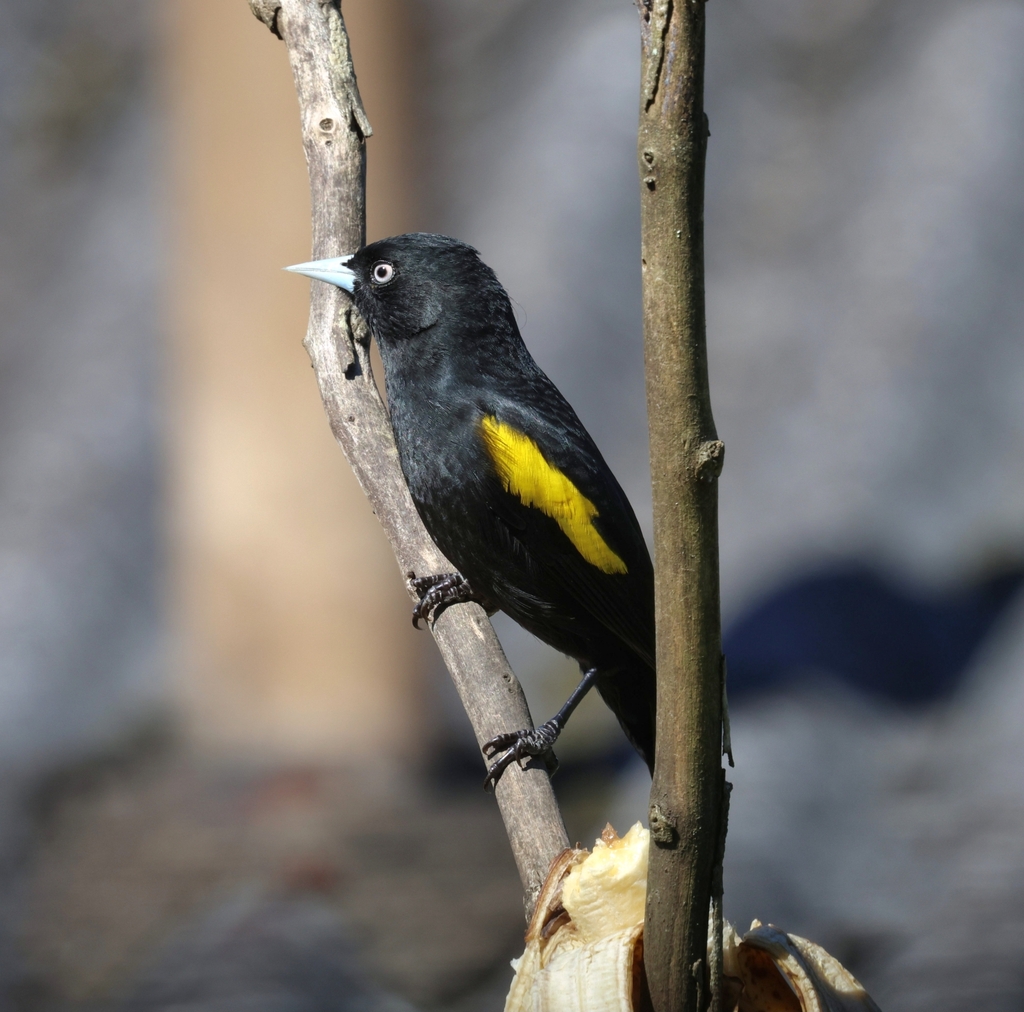
Golden-winged Cacique
Photo © Miguel
Photo © Miguel — CC BY-SA 4.0 — Source: iNaturalist #288640059Identification
The golden-winged cacique is a striking black bird of medium size, measuring approximately 21 cm in males and 19 cm in females. Both sexes share identical plumage: glossy black overall with brilliant yellow markings on the lower rump and median and inner greater wing coverts. Adults possess a distinctive pearly white to yellow iris and pale bluish-gray bill, contrasting sharply with their black legs and feet. Juveniles are noticeably duller with dark eyes, making them appear less conspicuous than their adult counterparts.
Range & Habitat
This species inhabits a large portion of south-central South America, with its range extending from central Bolivia southward to Tucumán Province in northwestern Argentina, across eastern Paraguay, northeastern Argentina, and the northern half of Uruguay, into Brazil south to a line roughly connecting western Mato Grosso do Sul to northern Paraná and western Rio de Janeiro state. In its western range, the golden-winged cacique favors Yungas forest along the eastern Andean slopes, while across its larger eastern range it occupies humid to mesic Chaco woodlands, gallery forests, Atlantic forest, and transitional forests between these zones. Elevations span from 2,800 m in the west to 2,000 m in Brazil.
Behaviour & Diet
Golden-winged caciques are primarily insectivorous, foraging for insects, invertebrates, and small vertebrates, though they also consume nectar and wild and cultivated fruits. They employ a distinctive feeding technique, probing bark, insect galls, and epiphytes while often gaping their beaks to expose hidden prey. These acrobatic birds frequently hang upside-down while feeding and typically forage in pairs or family groups, though non-breeding flocks may reach 30 individuals. They readily join mixed-species feeding flocks with other icterids. Breeding occurs between October and December in Argentina, with birds forming monogamous pairs that nest solitarily rather than colonially. Females construct distinctive long, purse-like nests woven from fungal material, typically suspended from branch tips over water. Clutches usually contain three eggs, with incubation lasting 14–15 days and fledging at 18–19 days post-hatch.
Best Time & Places to See It
The golden-winged cacique is rather abundant throughout much of its range, particularly in mesic subtropical forests and woodland habitats, though it becomes rare or local in the drier western Chaco regions. The breeding season from October to December in Argentina offers excellent opportunities for observation as birds are vocal and engaged in nesting activities. Several protected areas within its range provide reliable viewing opportunities. The species shows moderate tolerance for habitat disturbance, making it accessible in partially degraded as well as pristine forest environments.
Photography Tips
The golden-winged cacique's striking yellow and black plumage provides excellent contrast for photography. Focus on capturing the brilliant yellow wing coverts and lower rump against the glossy black body, as well as the distinctive pale iris and bill. The bird's acrobatic feeding behavior and frequent upside-down perching poses offer dynamic photographic opportunities. Early morning light best reveals the iridescent quality of adult plumage. Position yourself near fruiting or flowering trees where these birds forage, particularly in gallery forests and forest edges where lighting conditions are more favorable than in dense interior forest.
Araucárias National Park
Calilegua National Park
Carlos Botelho State Park
Chaco National Park
El Palmar National Park
El Rey National Park
Ibitipoca State Park
Iguaçu National Park
Iguazú National Park
Nothing matches these filters.
No community photos yet. Log in to add the first one.
No community observations of this species yet.