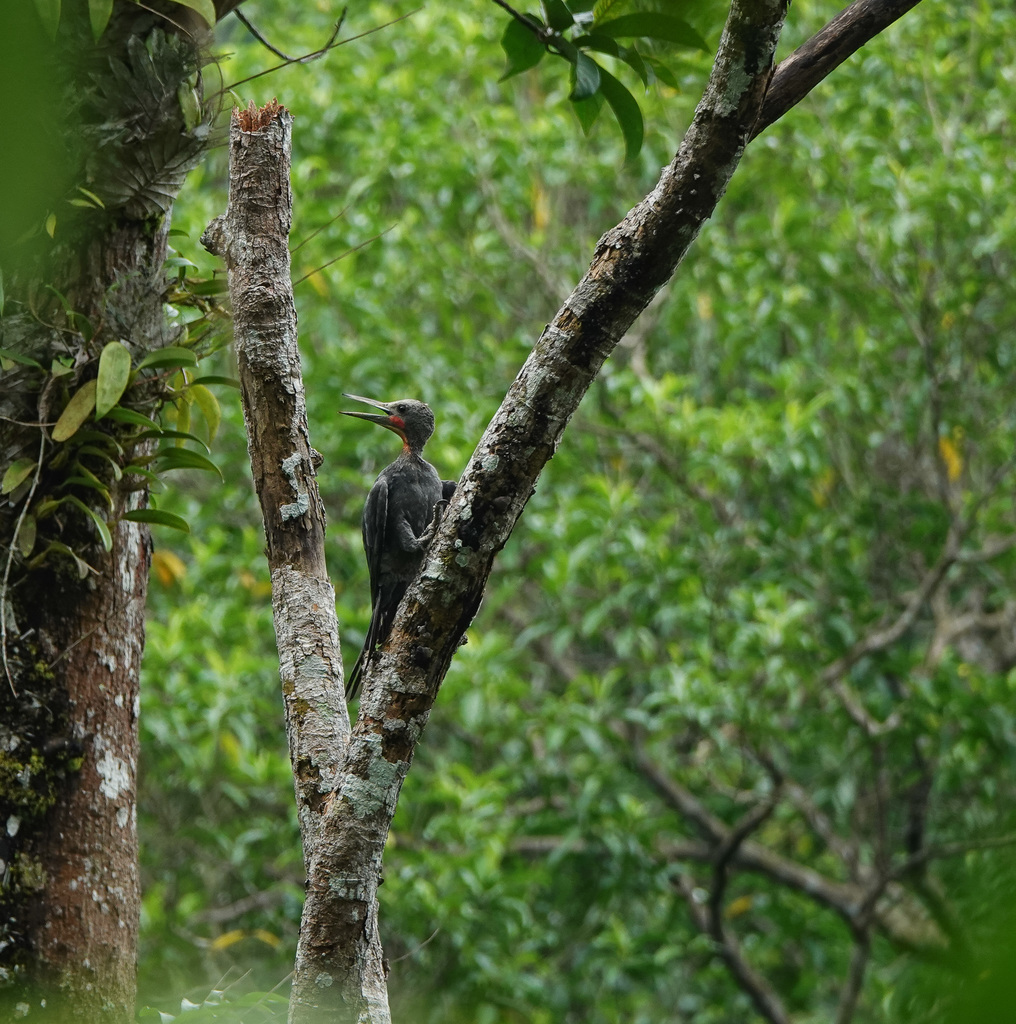
Great Slaty Woodpecker
Photo © Rejoice Gassah
Photo © Rejoice Gassah — CC BY 4.0 — Source: iNaturalist #62099615Identification
The great slaty woodpecker is unmistakable—the world's largest living woodpecker species at 45–55 cm long and weighing 360–563 g. It boasts a very long, strong chisel-tipped bill, an elongated neck, and an impressive tail, with a slight crest occasionally visible. The plumage is almost entirely dark grey or blackish slate-grey, overlaid with small white spots on the head and neck. The throat is paler grey to yellowish, and males display small red moustaches. Despite its size, this species has a surprisingly weak, quiet voice compared to other large woodpeckers, with a distinctive whinnying cackle of 2 to 5 notes, typically described as woikwoikwoikwoik.
Range & Habitat
This species ranges across the Indian subcontinent and Southeast Asia, found in Bangladesh, Bhutan, Brunei, Cambodia, India, Indonesia, Laos, Malaysia, Myanmar, Nepal, the Philippines, Singapore, Thailand, and Vietnam. It inhabits the Greater Sundas but notably avoids Bali. The great slaty woodpecker prefers primary semi-open, moist deciduous and tropical evergreen forests, with particular fondness for sprawling stands of dipterocarp and teak trees, mature sal forests, swamp forest, and mangroves containing tall, mature trees. While typically found below 600 m elevation, it occasionally occurs in montane areas up to 1,100 m, and has been recorded up to 2,000 m.
Behaviour & Diet
These woodpeckers are highly social, usually seen in groups of 3 to 6 individuals comprising a breeding pair and offspring from previous years. They forage collectively at shared feeding sites, primarily targeting nests of social insects including ants, termites, wood-boring beetles, and stingless bees, with ants forming the mainstay of their diet; larvae and small fruits occasionally supplement their intake. Females spend more time locating food sources while males, with slightly larger bills, spend more time opening them. The species forages by gleaning, probing, pecking, prising off bark, and hammering with powerful blows, with gleaning being the most important method—their long neck and bill allow them to reach deep into tree crevices. They typically work trees upward in slow, deliberate movements and travel considerable distances between feeding patches, maintaining large home ranges. They often fly high over the canopy and associate occasionally with white-bellied woodpeckers and greater flamebacks.
Best Time & Places to See It
The great slaty woodpecker is best encountered in protected primary forest reserves and national parks throughout its range, particularly in areas with extensive stands of mature dipterocarp, teak, and sal forests. Search remote forested regions of the Indian subcontinent, Myanmar, Thailand, Laos, Cambodia, Vietnam, Malaysia, Brunei, Indonesia (Sumatra, Java, Borneo, and Palawan), and the Philippines. Look for them in canopy and mid-story levels of large, living trees where they forage for insects. Early morning hours often provide the best viewing opportunities when foraging groups are most active.
Photography Tips
Photographing this species demands patience and long lenses due to its preference for large trees in dense forest canopy. Position yourself with a clear sight line to mature trees where feeding groups congregate, and use camouflage or blinds to minimize disturbance. The species' dark slate-grey plumage and white spots on the head and neck require careful exposure metering to avoid underexposure. Capturing males' distinctive red moustaches and the characteristic white throat demands close-range work. Take advantage of their relatively slow, deliberate foraging movements, which offer opportunities for sharp images despite the forest understory lighting challenges. Their noisy feather rustle in flight may alert you to approaching groups, allowing you to prepare for potential encounters.
Banke National Park
Bardiya National Park
Chitwan National Park
Doi Inthanon National Park
Gunung Mulu National Park
Gunung Palung National Park
Kaeng Krachan National Park
Khao Yai National Park
Shuklaphanta National Park
Nothing matches these filters.
No community photos yet. Log in to add the first one.
No community observations of this species yet.