Great Spotted Woodpecker
Dendrocopos major
Photo © Nikolay Volik
Photo © Nikolay Volik — CC0 1.0 — Source: iNaturalist photo #37921771ABOUT
Subspecies of Great Spotted Woodpecker
Central Great Spotted WoodpeckerTenerife Great Spotted WoodpeckerDendrocopos major japonicusIberian Great Spotted WoodpeckerNorthern Great Spotted WoodpeckerAlgerian great spotted woodpeckerGran Canaria Great Spotted WoodpeckerMoroccan great spotted woodpeckerGreat Spotted Woodpecker (Kamchatka)Dendrocopos major hartertiDendrocopos major brevirostrisDendrocopos major cabanisiDendrocopos major stresemanniCaspian great spotted woodpeckerDendrocopos major tenuirostris
Identification
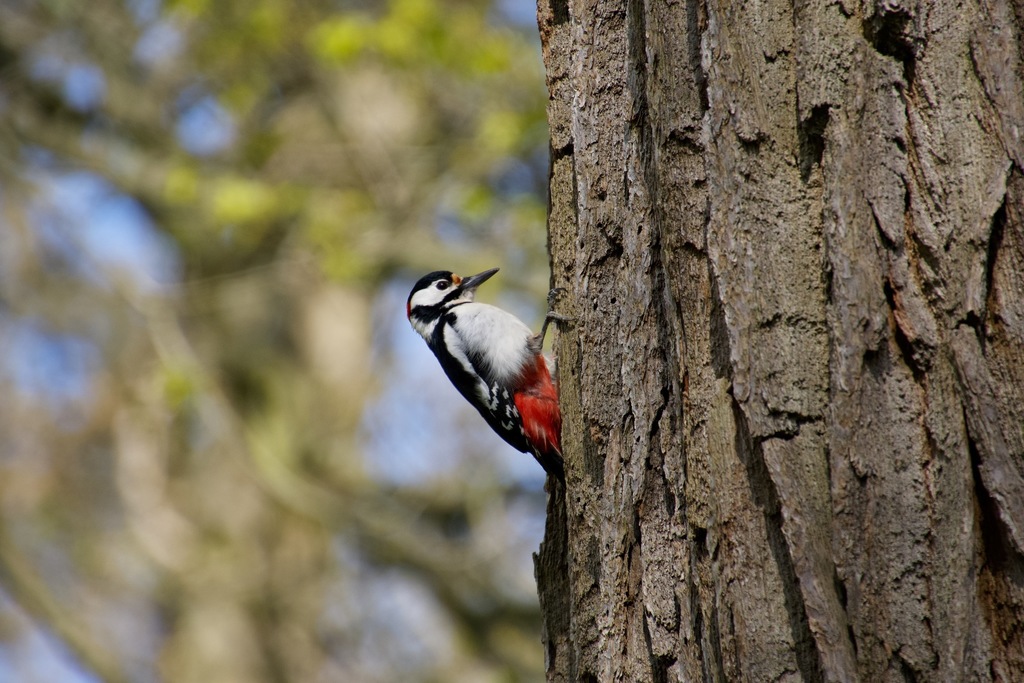
The great spotted woodpecker is a medium-sized woodpecker, measuring 20–24 cm long with a 34–39 cm wingspan. It has distinctive pied black and white plumage with glossy blue-black upperparts, white sides to the face and neck, and a striking large white shoulder patch. The flight feathers and tail are barred with black and white. The underparts are white except for a scarlet lower belly and undertail coverts. Males are distinguished by a crimson patch on the nape, which females lack. Both sexes have a slate-black bill, greenish-grey legs, and a characteristic deep red eye.
Juveniles are less glossy than adults, with a brown tinge to their upperparts and dirtier white underparts. The lower belly is pink rather than red in young birds, and their crown is red—more extensively so in males than females. Subspecies vary across the species' range, with northern forms generally larger and whiter beneath, while southern populations tend to be smaller and darker.
Range & Habitat
The great spotted woodpecker is found throughout the Palearctic region, including parts of North Africa. Across most of its range it is a resident species, though in the north some individuals migrate if the conifer cone crop fails. The species has shown a tendency to wander, leading to its recolonisation of Ireland in the first decade of the 21st century and occasional vagrancy to North America.
This woodpecker occurs in all types of woodlands, making it adaptable to diverse forest habitats across its extensive range. With a huge range and large population, it faces no widespread threats and is classified as a species of least concern by the IUCN.
Behaviour & Diet
Great spotted woodpeckers are versatile foragers, eating a variety of foods including seeds extracted from pine cones, insect larvae extracted from inside trees, and even eggs and chicks of other birds taken from their nests. Like all woodpeckers, they chisel into trees both to find food and to excavate nest holes, possessing anatomical adaptations that enable them to manage the physical stresses from this hammering action. They also drum on trees for contact and territorial advertisement.
This species breeds in holes that both parents excavate in living or dead trees, with clutches typically comprising four to six glossy white eggs. Both parents share incubation duties, feed the chicks, and maintain nest hygiene. After fledging, the young are fed by adults for approximately ten days, with each parent taking responsibility for feeding part of the brood.
Best Time & Places to See It
The great spotted woodpecker's resident status across most of its range means it can be encountered year-round in suitable woodland habitats throughout the Palearctic. Its presence in all woodland types—from coniferous to deciduous forests—makes it accessible to travellers across a wide geographical area. Its recent recolonisation of Ireland demonstrates the species' expanding presence in western Europe.
The bird's drumming behaviour and chiselling activities make it detectable even when not directly visible. Winter can be a productive season in northern regions where cone crops influence local movements and wandering behaviour.
Photography Tips
The great spotted woodpecker's striking pied plumage with bold black, white, and red markings makes it photogenic, though patience is required. Look for the distinctive white shoulder patch and watch for drumming activity on tree trunks, which often provides excellent photo opportunities. The deep red eye and contrasting facial pattern are key identifying features worth capturing.
Males' crimson nape patch distinguishes them from females and makes for compelling identification shots. When photographing juveniles, note their duller appearance and pink (rather than red) lower belly. The species' active behaviour—chiseling into bark and moving rapidly along trunks—demands fast shutter speeds and good tracking skills.
HIDES
Sort by
50 €/ person
Book now
75 €/ personfrom 65 €
Book now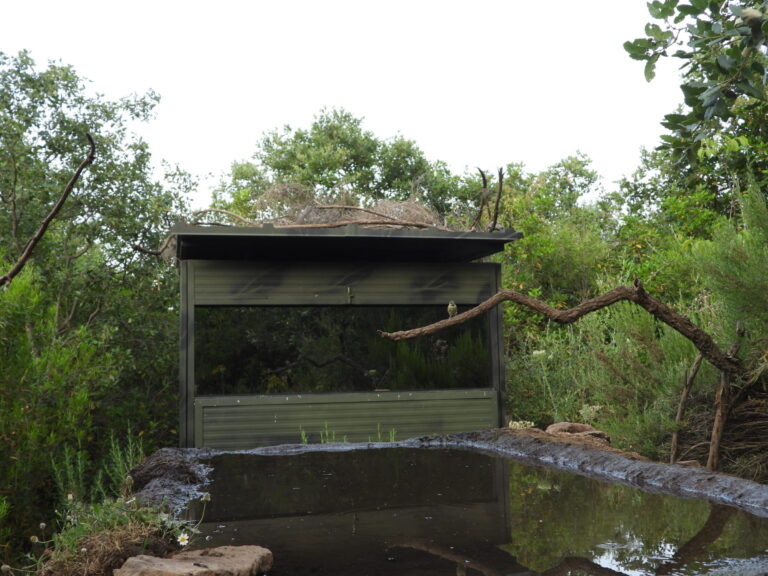
80 €/ person
Book nowNothing matches these filters.
HOTSPOTS
Country
Type
Sort by
National Park
Abruzzo, Lazio and Molise National Park
Pescasseroli·Italy
+139 birds+18 mammals
National Park
Aggtelek National Park
Szin·Hungary
+119 birds+13 mammals
Natural Park
Alpilles Regional Nature Park
Saint-Rémy-de-Provence·France
+219 birds+37 mammals
National Park
Alta Murgia National Park
Bari·Italy
+168 birds+6 mammals
National Park
Appennino Lucano Val d’Agri Lagonegrese National Park
Spinoso·Italy
+121 birds+3 mammals
National Park
Appennino Tosco-Emiliano National Park
Ventasso·Italy
+86 birds+8 mammals
National Park
Åsnens National Park
Kronoberg County·Sweden
+141 birds+8 mammals
National Park
Aspromonte National Park
Careri·Italy
+89 birds+5 mammals
Natural Park
Avesnois Regional Nature Park
Saint-Hilaire-sur-Helpe·France
+206 birds+40 mammals
Nothing matches these filters.
COMMUNITY
Share your photo of this species
Sort by
0
Observed by
0
Hotspots reported
0
Countries
No community observations of this species yet.