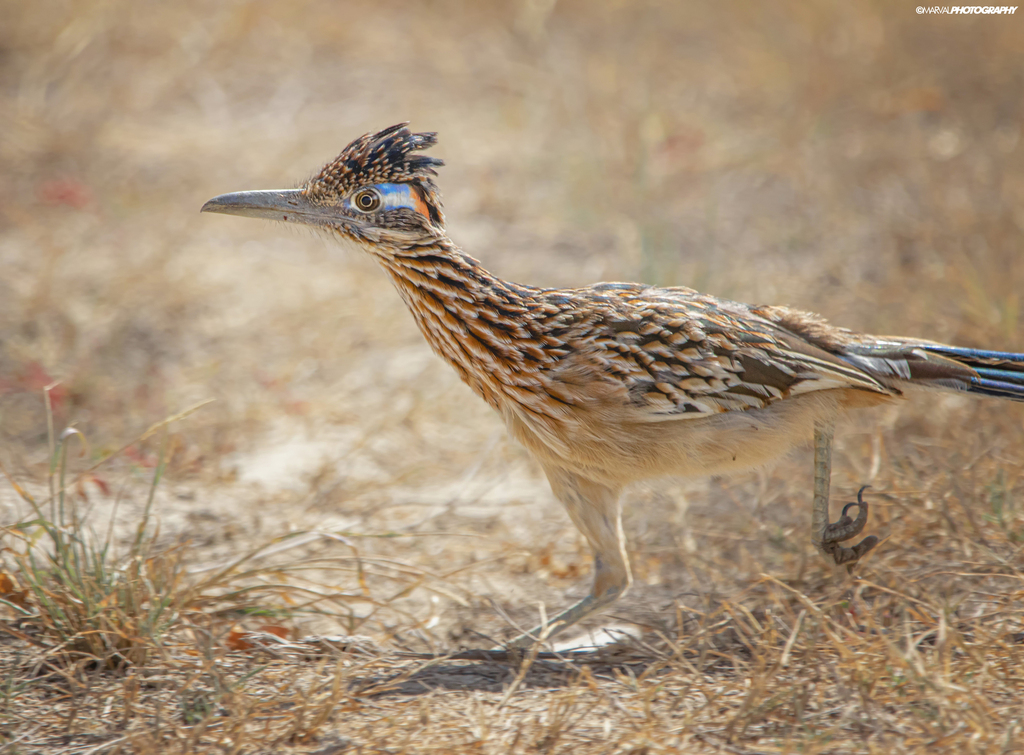
Greater Roadrunner
Photo © MarvalPhotography19
Photo © MarvalPhotography19 — CC BY 4.0 — Source: iNaturalist photo #243403713Identification
The greater roadrunner is the largest cuckoo in the Americas, measuring 20–24 inches long with a wingspan of 17–24 inches. This distinctive ground-dwelling bird is unmistakable in its desert habitat: it sports a prominent crest of brown feathers on its head, streaked brown and black upperparts, and a white belly. Look for the characteristic bare patches of orange and blue skin behind each eye—a striking field mark that distinguishes it from other desert birds. Males and females look identical, though females are slightly smaller on average.
The roadrunner's long, stout grayish-brown beak has a distinctive hooked tip, and its zygodactyl feet (with two toes facing forward and two backward) are adapted for running rather than perching. Despite belonging to the cuckoo family, the greater roadrunner is built for speed: it can run at speeds up to 20 mph, with recorded cases of bursts reaching 26 mph—the fastest running speed documented for any flying bird.
Range & Habitat
This non-migratory species is found throughout the Aridoamerica ecoregion of the Southwestern United States and northern Mexico. In the US, it is regularly seen in California, Texas, New Mexico, Arizona, Nevada, Oklahoma, Utah, and Colorado, with less frequent sightings in Kansas, Louisiana, Arkansas, and Missouri. In Mexico, its range extends across numerous states from Baja California and Sonora south to San Luis Potosí and Tamaulipas.
Greater roadrunners inhabit arid and semiarid scrubland with scattered, low vegetation—typically less than 50% ground cover and under 10 feet tall. They are found from 200 feet below sea level to 7,500 feet in elevation, rarely venturing above 9,800 feet. Interestingly, fossil evidence shows that until 8,000 years ago, the species inhabited sparse forests; it has since adapted to desert life and is now expanding its range northeastward into environments similar to prehistoric Southwestern scrublands.
Behaviour & Diet
Greater roadrunners are typically solitary until they find a mate, then form long-term monogamous pair bonds. Breeding season runs from mid-March through early September and begins with an elaborate courtship involving chasing, tail wagging, play-fighting, and vocalizations. Males present nesting materials or food to females, and uniquely, mated pairs continue their copulation rituals long after breeding is necessary—a behavior thought to strengthen their bond.
Pairs defend territories of 700–800 square meters year-round, with males more actively territorial and ready to physically evict intruders. Both partners build their nest, a compact platform of thorny branches lined with grasses, feathers, snakeskin, and roots, positioned 3–10 feet high in a cactus, bush, or man-made structure. Clutches of three to six eggs hatch in 20 days, with chicks fledging in another 18 days. Pairs may raise a second brood during rainy summers when food is abundant.
Best Time & Places to See It
The greater roadrunner is non-migratory and can be encountered year-round throughout its range. Early morning offers the best viewing opportunities, particularly during breeding season (mid-March through early September) when males are most vocal and visible. Listen for their distinctive seven different call types at dawn, especially the slow, descending sequence of low cooing sounds made by males from high perches like fence posts, dead trees, or cacti.
Desert scrubland habitats across California, Arizona, New Mexico, and Texas offer the most reliable sightings. Watch for these birds running along the ground with their characteristic rapid gait—they spend most of their time on foot rather than in flight. Early morning, when males call to defend territory, is prime time to encounter this charismatic species.
Photography Tips
Photograph the greater roadrunner in early morning light when males are actively calling from elevated perches, offering clear sightlines and excellent visibility. Position yourself to capture the bird's distinctive profile: the upright crest, long slender body, and characteristic running posture that defines this species.
Focus on close-ups of the bird's unique field marks—the bare patches of orange and blue skin behind the eye are particularly striking in good light. When photographing running birds, use a fast shutter speed to freeze their rapid movement. The open, sparse vegetation of their scrubland habitat provides relatively unobstructed photographic opportunities compared to more densely vegetated environments.
Big Bend National Park
Brewster County, United States
+345 birds+34 mammals
Where the Chisos Mountains rise abruptly from the Sonoran Desert floor, Big Bend National Park spans over 7,300 square kilometers of one of North America's most…
VIEW NATIONAL PARKSaguaro National Park
Rincon Valley, United States
+354 birds+40 mammals
Where the Sonoran Desert meets sky-island mountains, two geographically separated districts of Saguaro National Park sprawl across nearly two thousand square kilometers of Arizona's most iconic…
VIEW NATIONAL PARKPinnacles National Park
San Benito County, United States
+197 birds+33 mammals
Jagged volcanic spires thrust from chaparral-covered ridges across 222 square kilometers of central California's inner Coast Ranges, their pale stone crowns catching the afternoon light like…
VIEW NATIONAL PARKJoshua Tree National Park
Riverside County, United States
+221 birds+23 mammals
Across 5,610 square kilometers of Riverside County's high desert, a landscape of geological drama unfolds where granite monoliths pierce through bajadas of creosote scrub and Joshua…
VIEW NATIONAL PARKCarlsbad Caverns National Park
Eddy County, United States
+309 birds+18 mammals
Beneath the Chihuahuan Desert floor of southern New Mexico lies one of North America's most spectacular subterranean landscapes. Carlsbad Caverns National Park encompasses over 518 square…
VIEW NATIONAL PARKArches National Park
Grand County, United States
+185 birds+20 mammals
Where rust-red sandstone fins rise abruptly from high desert scrubland, Arches National Park spans 548 square kilometers of one of North America's most sculptural landscapes. The…
VIEW NATIONAL PARKZion National Park
Washington County, United States
+244 birds+30 mammals
Towering sandstone cliffs in shades of crimson, rust, and cream rise abruptly from the Virgin River's winding canyon floor, their sculpted faces bearing witness to millions…
VIEW NATIONAL PARKCapitol Reef National Park
Garfield County, United States
+196 birds+22 mammals
Wrinkled ridges of crimson and gold sandstone rise from the floor of south-central Utah, their weathered faces carved by the Fremont River into one of the…
VIEW NATIONAL PARKDeath Valley National Park
Inyo County, United States
+339 birds+25 mammals
Across nearly 3.5 million acres of southeastern California's Inyo County, vast salt flats meet sculpted badlands and alluvial fans in a landscape so extreme it defines…
VIEW NATIONAL PARKEl Vizcaíno
Laguna San Ignacio, Mexico
+317 birds+29 mammals
Where the Baja California peninsula thins into a tapestry of salt lagoons and coastal desert, one of Mexico's most biodiverse reserves sprawls across half a million…
VIEW BIOSPHERE RESERVESierra de Tamaulipas
El Porvenir, Mexico
+98 birds+19 mammals
Where limestone peaks thrust skyward through dense subtropical forest, Mexico's northeastern frontier reveals one of the continent's most biodiverse mountain ranges. Canyons carved by perennial rivers…
VIEW NATURE RESERVETutuaca
Tosanachi, Mexico
+147 birds+13 mammals
Where copper canyons plunge deeper than the Grand Canyon itself, Mexico's remote Sierra Madre Occidental unfolds in dramatic vertical relief. Tutuaca anchors this wilderness realm, a…
VIEW PROTECTED LANDSCAPEGrand Canyon National Park
United States
+277 birds+35 mammals
A mile-deep chasm of rust-red rock and purple shadow cuts through the high desert plateau of northern Arizona, revealing nearly two billion years of geological history…
VIEW NATIONAL PARKGuadalupe Mountains National Park
Culberson County, United States
+262 birds+14 mammals
Where fossil-laden limestone ridges thrust skyward above the Chihuahuan Desert floor, Guadalupe Mountains National Park reveals a landscape sculpted by ancient seas and relentless aridity. These…
VIEW NATIONAL PARKHot Springs National Park
Hot Springs, United States
+168 birds+8 mammals
Thermal waters rising from deep within the Ouachita Mountains have carved a landscape unlike anywhere else in the continental United States, where 47 natural hot springs…
VIEW NATIONAL PARKPetrified Forest National Park
Apache County, United States
+206 birds+23 mammals
Across the high desert plateau of northeastern Arizona, where the climate swings between scorching summer days and frost-laden winters, badlands of raw earth and timber-turned-to-stone dominate…
VIEW NATIONAL PARKWhite Sands National Park
Otero County, United States
+178 birds+6 mammals
Across the Tularosa Basin in south-central New Mexico sprawls an otherworldly landscape of gypsum dunes—the largest gypsum field on Earth and a stark desert playground shaped…
VIEW NATIONAL PARKBosque del Apache National Wildlife Refuge
Socorro County, United States
+345 birds+17 mammals
Where the Rio Grande emerges from its desert canyon in central New Mexico, a narrow ribbon of riparian woodland defies the arid landscape that surrounds it.…
VIEW WILDLIFE SANCTUARYWichita Mountains National Wildlife Refuge
Medicine Park, United States
+256 birds+17 mammals
Granite peaks rise abruptly from rolling prairie in southwestern Oklahoma, where the Wichita Mountains National Wildlife Refuge protects a rare collision of ecosystems. This sanctuary encompasses…
VIEW WILDLIFE SANCTUARYLaguna Atascosa National Wildlife Refuge
Cameron County, United States
+365 birds+19 mammals
Where coastal prairie meets shallow lagoon along the southernmost tip of Texas, Laguna Atascosa National Wildlife Sanctuary sprawls across a landscape sculpted by salt spray and…
VIEW WILDLIFE SANCTUARYSanta Ana National Wildlife Refuge
Hidalgo County, United States
+349 birds+12 mammals
Where the Rio Grande delta meets the semi-arid scrublands of South Texas, Santa Ana National Wildlife Sanctuary preserves a rare mosaic of wetland and thornforest habitat…
VIEW WILDLIFE SANCTUARYLower Rio Grande Valley National Wildlife Refuge
Starbase, United States
+311 birds+11 mammals
Where the Rio Grande delta spreads across the coastal plain of South Texas, a sanctuary of subtropical wetlands and riparian corridors creates a landscape that pulses…
VIEW WILDLIFE SANCTUARYCabeza Prieta National Wildlife Refuge
United States
+155 birds+6 mammals
Across southwestern Arizona's harshest terrain, where the Colorado River marks the border with Mexico, lies a sanctuary shaped entirely by heat and aridity. Cabeza Prieta National…
VIEW WILDLIFE SANCTUARYKofa National Wildlife Refuge
Yuma County, United States
+142 birds+10 mammals
Desert mountains rise in sculptured ridges across northwestern Arizona, where the Colorado River's distant influence fades into some of the most austere terrain in the American…
VIEW WILDLIFE SANCTUARYHavasu National Wildlife Refuge
Lake Havasu City, United States
+291 birds+8 mammals
Where the Colorado River widens into a vast reservoir in the Sonoran Desert, Havasu National Wildlife Sanctuary protects one of the most critical wetland ecosystems in…
VIEW WILDLIFE SANCTUARYImperial National Wildlife Refuge
La Paz County, United States
+222 birds+4 mammals
Where the Colorado River carves through the Sonoran Desert in southwestern Arizona, Imperial National Wildlife Sanctuary unfolds across a landscape shaped by water and aridity. The…
VIEW WILDLIFE SANCTUARYSacramento National Wildlife Refuge
Glenn County, United States
+247 birds+13 mammals
Across the flat expanse of Glenn County's Sacramento Valley, shallow pools and seasonal marshes create one of California's most vital wetland sanctuaries—a landscape shaped by water…
VIEW WILDLIFE SANCTUARYSan Luis National Wildlife Refuge
Merced County, United States
+219 birds+14 mammals
Across the floor of California's San Joaquin Valley, where semi-arid grasslands meet shallow seasonal wetlands, San Luis National Wildlife Sanctuary preserves a critical mosaic of habitats…
VIEW WILDLIFE SANCTUARYDon Edwards San Francisco Bay National Wildlife Refuge
Fremont, United States
+286 birds+20 mammals
Where the San Francisco Bay's shallow margins dissolve into tidal salt marshes and mudflats, this wildlife sanctuary preserves one of California's most ecologically vital estuarine systems.…
VIEW WILDLIFE SANCTUARYSalton Sea National Wildlife Refuge
Imperial County, United States
+289 birds+4 mammals
Across the floor of California's inland desert, where summer temperatures soar and rainfall is measured in tenths of inches, lies an improbable oasis of shallow water…
VIEW WILDLIFE SANCTUARYBitter Lake National Wildlife Refuge
Chaves County, United States
+284 birds+10 mammals
Across the high desert floor of southeastern New Mexico, where elevation and aridity shape every living thing, shallow alkaline lakes and marshes form an unexpected oasis…
VIEW WILDLIFE SANCTUARYNo community photos yet. Log in to add the first one.
No community observations of this species yet.