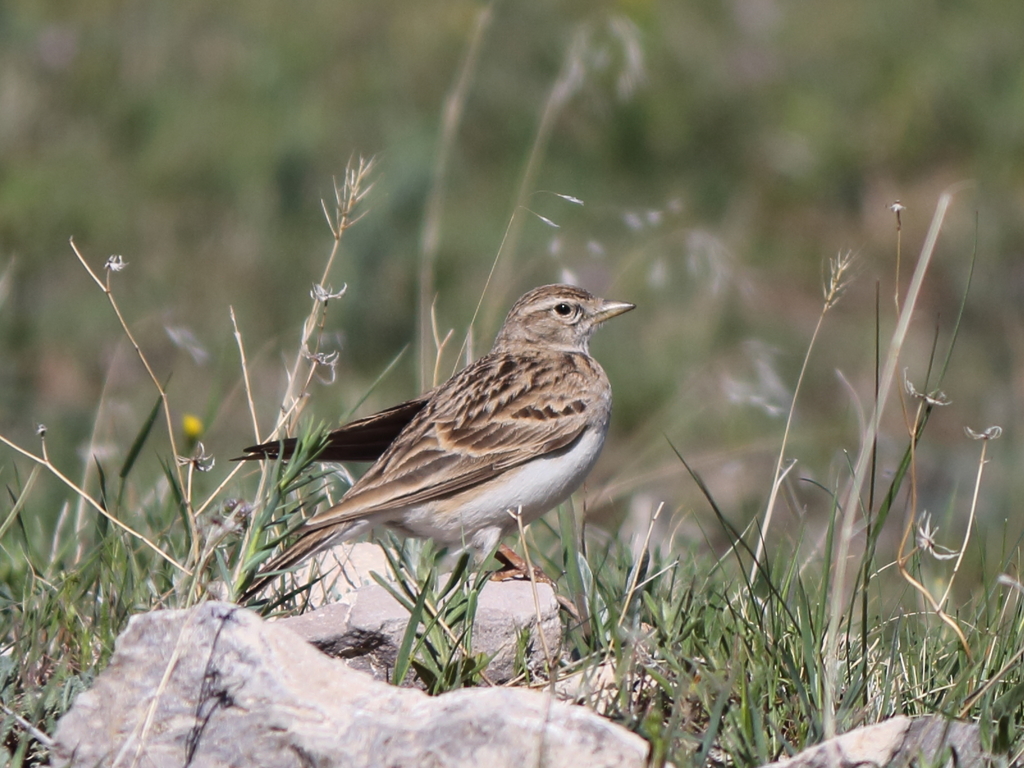
Greater Short-toed Lark
Photo © Ani Sarkisyan
Photo © Ani Sarkisyan — CC BY 4.0 — Source: iNaturalist photo #3608050Identification
The greater short-toed lark is a small passerine, smaller than the skylark, with a distinctive pale appearance. It is dark-streaked greyish-brown above and white below, featuring a strong pointed bill that is pinkish with a grey culmen. Look for a pale supercilium, dark patches on each side of the neck, and a dark tail. Some birds in the western parts of the range display a rufous crown. The sexes are similar in appearance. This species is noticeably paler than the closely related Mongolian short-toed lark, which also has a shorter bill. Care should be taken to distinguish this lark from other similar species, particularly the Mediterranean short-toed lark, as confusion is possible.
Range & Habitat
The greater short-toed lark breeds across a vast range spanning southern Europe, north-west Africa, and the Palearctic from Turkey and southern Russia to Mongolia. The nominate form breeds throughout Europe, including Iberia, France, Italy, the Balkans, and Romania. Most populations are migratory, wintering south to the southern edge of the Sahara and India, with populations from the Iberian Peninsula traveling particularly far south. The species is a fairly common wanderer to northern and western Europe during spring and autumn migration periods.
This is a common bird of dry open country and cultivation. In Africa, birds prefer crop land and dry pastures with short shrubs, while they also frequent short grass areas along aerodromes in South Asia during winter visits.
Behaviour & Diet
During migration, greater short-toed larks form large, tight flocks that move in unison, creating visually striking displays as they swing in synchrony through the air. At other times, they form looser flocks. Flocks often fly together to water in the mornings at favoured spots, and in the evenings they roost in open ground, with each bird squatting in a small depression made in the soil. The song varies between a dry twittering and a more varied and imitative melody.
This species nests on the ground, laying two to three eggs. Its diet consists of seeds and insects, with insects being especially important during the breeding season.
Best Time & Places to See It
The best opportunities to observe greater short-toed larks occur during migration periods in spring and autumn, particularly in northern and western Europe where they are fairly common wanderers. In winter, large flocks visit South Asia, making this an excellent season to see them in that region. European breeders can be found during the breeding season in areas including Iberia, France, Italy, the Balkans, and Romania.
Photography Tips
Photographing flocks in flight during migration offers spectacular opportunities to capture their coordinated, synchronized movements. Early mornings when flocks fly to water at favoured spots provide good shooting light and predictable behaviour. Ground-roosting birds in open country can be photographed in evening light as they settle into small soil depressions. The pale plumage and fine details of the supercilium and neck patches require careful exposure metering to preserve detail. Remember that distinguishing this species from the Mediterranean short-toed lark in the field requires careful attention to plumage details and bill proportions.
Private Full-Day Birdwatching Tour from Lisbon to the Tagus Estuary
Nothing matches these filters.
Alpilles Regional Nature Park
Alta Murgia National Park
Awash National Park
Bardenas Reales
Bardiya National Park
Butrint National Park
Cabañeros National Park
Cabo de Gata-Níjar Natural Park
Cabo Peñas
Nothing matches these filters.
No community photos yet. Log in to add the first one.
No community observations of this species yet.