Identification
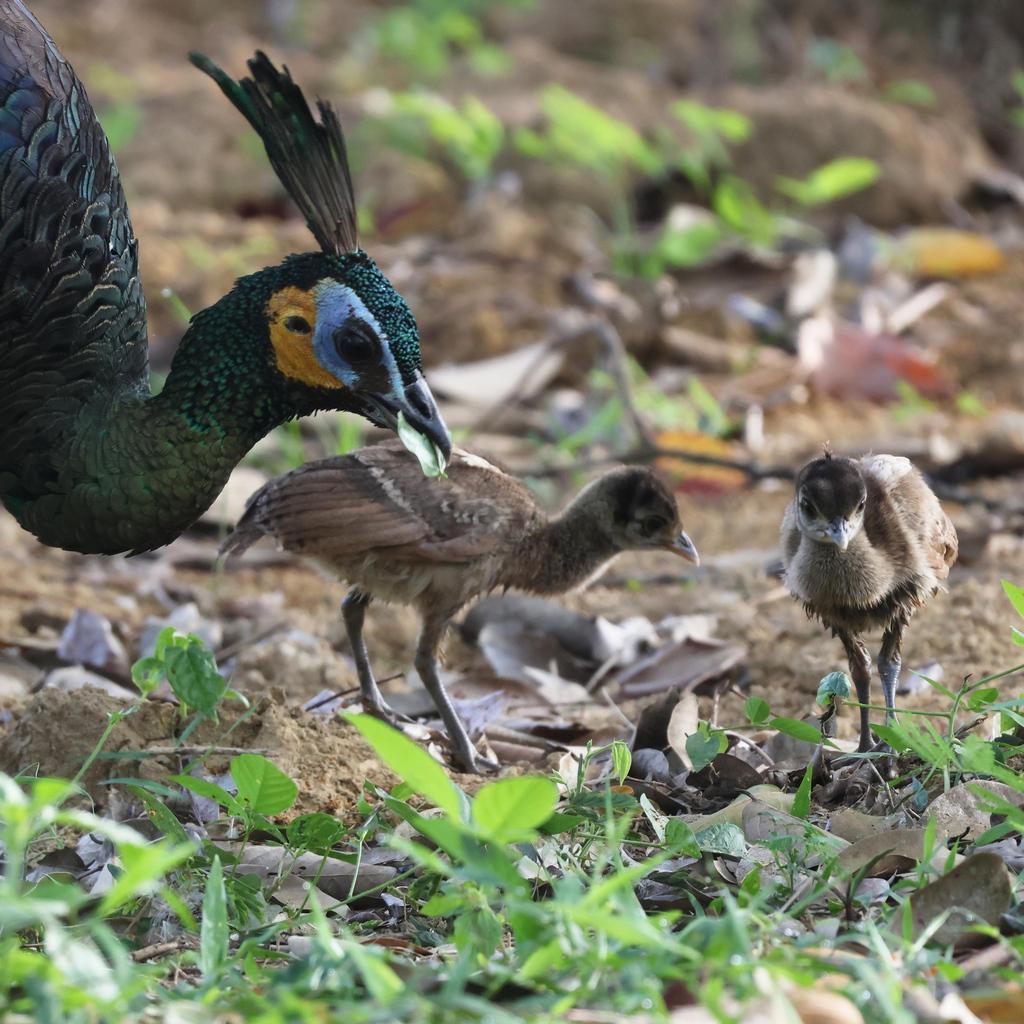
The green peafowl is a large and strikingly iridescent galliform, with dramatic sexual dimorphism. Males are substantially larger, reaching 1.8–3 m in total length when including their spectacular train of upper-tail covert feathers, which extend up to 2 m and are adorned with prominent eyespots. Females are roughly half the size of breeding males, at 1–1.1 m in length, with much shorter green tail coverts. Both sexes display highly iridescent, scale-like neck and breast feathers resembling Chinese dragon scales, creating a distinctive silhouette. Males show blue scapular and wing coverts with a green triangle of scaly shoulder feathers when the wing is closed; females lack this triangle but display copper-fringed neck scales. The facial skin of both sexes is double-striped whitish-blue, with a yellow-orange crescent beside the ear. When in flight, the pale vermilion or buff-coloured primaries are particularly visible against their otherwise dark plumage.
Both sexes possess long crest feathers, though the male's are thinner and taller while the female's are slightly wider. Outside the breeding season, males moult their impressive train, making field identification challenging without close observation. The birds are notably heavy-winged and long-tailed, and unlike many large birds, they are capable of sustained, if energy-intensive, flight and are frequently observed on the wing. Males vocalize at dawn and dusk with a loud, repeated "ki-wao" call, while females produce an equally loud "AOw-aa" call with emphasis on the first syllable.
Range & Habitat
The green peafowl is native to the tropical forests of Southeast Asia and southern China, and serves as the national bird of Myanmar. Historically widespread throughout the region from Yunnan in southern China through eastern and north-eastern India, southeastern Bangladesh, northern Myanmar, Laos, Thailand, Vietnam, Cambodia, Peninsular Malaysia, and the Indonesian island of Java, the species now survives only in a few isolated populations. Cambodia and adjacent areas of Vietnam represent the stronghold of remaining populations; Keo Seima Wildlife Sanctuary in Cambodia held approximately 745 individuals as of 2020.
Green peafowl inhabit a diverse range of forest types, including primary and secondary tropical and subtropical forests, as well as evergreen and deciduous woodlands. They also occur in bamboo thickets, grasslands, savannas, scrub, and farmland edges. Proximity to water is an important habitat requirement; in Vietnam, birds favour dry deciduous forest close to water sources and away from human disturbance. In Java, they are restricted to savanna habitat within protected areas such as Ujung Kulon and Baluran National Parks.
Behaviour & Diet
Green peafowl are vocal birds with distinct call repertoires. Males establish roost sites where they vocalize prominently at dawn and dusk, producing their characteristic loud "ki-wao" calls. Females respond with their own loud "AOw-aa" vocalizations. The birds are notably capable fliers for their size, frequently observed in sustained flight despite the energy demands of their heavy build and long tails. Their flight style is distinctive, characterized by true "flapping" flight lacking the gliding motion seen in many other birds, and their pale primary feathers are particularly conspicuous during flight.
Best Time & Places to See It
The green peafowl's endangered status and fragmented distribution make sightseeing challenging. Keo Seima Wildlife Sanctuary in Cambodia currently represents the most promising location, supporting a significant and increasing population. Java's protected areas, particularly Ujung Kulon and Baluran National Parks, offer additional opportunities, though populations there are confined to savanna habitats within these reserves. Early morning and dusk visits to suitable habitat near water sources offer the best chance of encountering these birds, as males are most vocally active during these periods.
Photography Tips
The green peafowl's iridescent plumage is best captured in good natural light that reveals the brilliant greens and blues of the neck, breast, and wing coverts. Males in breeding plumage, with their extended trains displaying eyespots, offer the most visually dramatic subjects. Photographers should be aware that outside breeding season, males lack their trains, substantially altering their appearance. The birds' preference for habitats near water and away from human disturbance demands patience and careful approach. Their capability for sustained flight means they are frequently airborne, presenting dynamic but challenging shooting opportunities—this is when the pale primary feathers become most visible. Early morning and dusk sessions will maximize both vocalization activity and the likelihood of encounters, while also providing favourable low-angle lighting for silhouette and iridescence photography.
Hat Noppharat Thara-Mu Ko Phi Phi National Park
Ao Nang, Thailand
+253 birds+9 mammals
Where limestone karsts rise dramatically from turquoise waters, Hat Noppharat Thara-Mu Ko Phi Phi National Park unfolds across a mosaic of beach, mangrove forest, and island…
VIEW NATIONAL PARKTaman Nasional Baluran
Situbondo, Indonesia
+189 birds+9 mammals
Across the northeastern tip of East Java, where monsoon winds sweep down from the Bali Strait, a landscape of contrasts unfolds within 374 square kilometres of…
VIEW NATIONAL PARKTaman Nasional Meru Betiri
Jember, Indonesia
+93 birds+1 mammals
Across East Java's southeastern coast, where the Indian Ocean meets a landscape of volcanic soils and monsoon-fed forests, sprawls a national park that epitomizes the ecological…
VIEW NATIONAL PARKNo community photos yet. Log in to add the first one.
No community observations of this species yet.