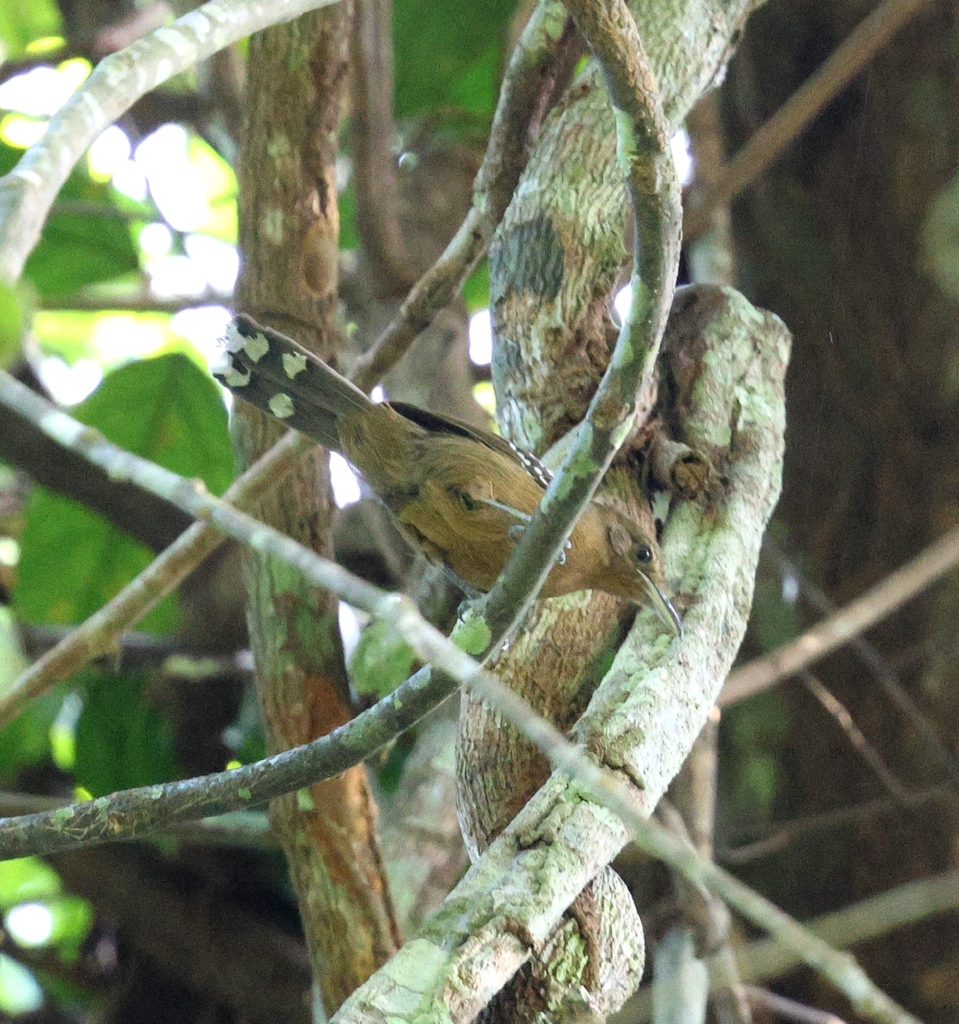
Grey Antbird
Photo © Miguel
Photo © Miguel — CC BY-SA 4.0 — Source: iNaturalist #330157613Identification
The grey antbird is a small passerine, measuring 13 to 15 cm in length and weighing 14 to 18 g. Males of the nominate subspecies are characterized by dark gray upperparts with a distinctive small white patch between the scapulars, a blackish-gray tail with wide white terminal spots, and brown-tinged wings with faint white coverts. Females present a markedly different appearance, featuring olive-brown crowns and upperparts with a minimal white interscapular patch, grayer rumps, and olive-yellow underparts with dusky flanks. Several subspecies show notable variation: C. c. immaculata males have minimal or absent interscapular patches; C. c. sclateri displays larger white patches and spots across both sexes; and C. c. iterata is generally paler, particularly in females.
Range & Habitat
The grey antbird is distributed across nine countries throughout the Amazon Basin, including Bolivia, Brazil, Colombia, Ecuador, French Guiana, Guyana, Peru, Suriname, and Venezuela. Different subspecies occupy distinct regions: C. c. cinerascens ranges from southeastern Colombia through Ecuador into northwestern Peru; C. c. immaculata inhabits eastern Venezuela and the Guianas; C. c. sclateri is found in eastern Peru and southwestern Amazonian Brazil; and C. c. iterata occurs in southeastern Amazonian Brazil and northeastern Bolivia. The species favors terra firme evergreen forest, particularly dense mid-storey and subcanopy vegetation abundant with vine tangles. Elevation ranges from near sea level to approximately 900 m throughout most of its range, though it reaches 1,150 m in Peru.
Behaviour & Diet
The grey antbird is a year-round resident throughout its range. Its diet consists primarily of insects and spiders, obtained through gleaning and lunging from perches as birds hop through vine tangles and dense vegetation. Foraging typically occurs at heights of 8 to 20 m, occasionally higher, with individuals, pairs, and family groups participating in this activity. The species sometimes joins mixed-species feeding flocks and has been observed following army ant swarms in Brazil. Breeding details remain largely undocumented, though nest constructions of vines or leaves and sticks have been recorded, with eggs varying in coloration by subspecies.
Best Time & Places to See It
The grey antbird is considered common throughout its extensive range, which encompasses numerous protected areas and vast tracts of suitable habitat unlikely to face near-term development. As a year-round resident, it can be encountered year-round within terra firme evergreen forests across its range. The species' preference for dense vine tangles in the mid-storey makes it most reliably encountered in undisturbed primary or mature secondary forest with complex vegetation structure. Protected areas and remote forest regions throughout the Amazon Basin, particularly where vine-rich vegetation persists, offer the best opportunities for observation.
Photography Tips
Photographing the grey antbird presents considerable challenges due to its preference for dense, shadowed mid-storey vegetation and vine tangles. Success requires patience and positioning near known foraging areas within suitable habitat. Fast film speeds or high ISO settings are essential to compensate for low light conditions typical of dense forest understory. Males offer superior photographic subjects due to their more contrasting plumage, particularly the striking white interscapular patch and tail terminal spots. Early morning hours often provide the best lighting and increased activity levels. A telephoto lens is advisable for maintaining distance while capturing details of this small, active species as it forages through vegetation.
Amacayacu National Park
Anavilhanas National Park
Bahuaja Sonene National Park
Campos Amazónicos National Park
Cordillera Azul National Park
Encontro das Águas State Park
French Guiana Amazonian Park
Guirá State Park
Ichigkat Muja – Cordillera del Cóndor National Park
Nothing matches these filters.
No community photos yet. Log in to add the first one.
No community observations of this species yet.