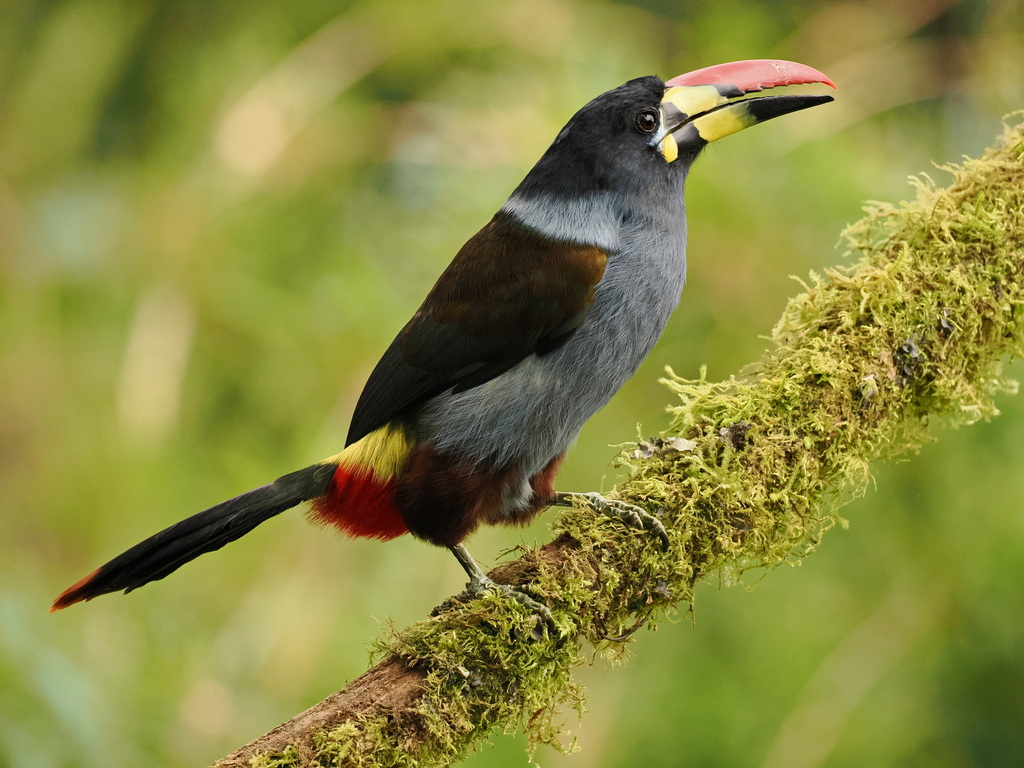
Grey-breasted Mountain Toucan
Photo © Peter Archdale
Photo © Peter Archdale — CC BY 4.0 — Source: iNaturalist photo #612902449Identification
The grey-breasted mountain toucan is a striking mid-sized toucan, measuring 41 to 48 cm in length and weighing 244 to 370 g. Both sexes within each subspecies share identical plumage. The bird's most distinctive feature is its large, colourful bill: the base is yellow to greenish with a black band, the outer two-thirds of the upper mandible is red meeting the yellow diagonally, while the outer half of the lower mandible is black. The head is predominantly black with a characteristic grey-blue band across the hindneck. The back is greenish-brown, while the underparts range from grey to grey-blue. The tail is blackish with chestnut tips on the central feathers. The nominate subspecies displays a bright yellow rump, pale grey-blue flanks, chestnut thighs, and red undertail coverts, with brown eyes surrounded by bare blue skin. The subspecies A. h. lateralis has a paler yellow rump, pale yellow to grey-white flanks, and yellow to green eyes.
Range & Habitat
This species is endemic to the northern Andes, with the nominate subspecies found from central and southern Colombia into eastern Ecuador, while A. h. lateralis ranges from eastern Ecuador south into Peru. The grey-breasted mountain toucan inhabits wet temperate montane forests, including cloud forest, elfin forest, and secondary growth, typically between 2,200 and 3,650 metres elevation, though it descends to 1,500 m in Peru and 1,700 m in Ecuador.
Behaviour & Diet
This is a social and active forager, moving through the canopy and mid-story levels singly, in pairs, or in small family groups, often joining mixed-species feeding flocks. The species feeds primarily on fruit and berries, with some vertebrates likely comprising part of its diet. Its vocalizations include a distinctive low 'gweeeeeeeat' song, sharp 'wek' notes delivered singly or in series, and aggressive 'kek' calls, often accompanied by dramatic bill-whacking. Breeding occurs from December to February in Colombia and June or July to November in Ecuador and Peru, though little else is known about its reproductive biology.
Best Time & Places to See It
The grey-breasted mountain toucan is thought to be locally common within its range and occurs in several protected areas across Colombia, Ecuador, and Peru. Since the species shows no documented pattern of movement, it can be encountered year-round, though breeding season months (December–February in Colombia; June–November in Ecuador and Peru) may offer heightened activity and visibility. The species' very large range (over 1,070,000 km²) and estimated population of 25,000 to 77,000 mature individuals mean that dedicated high-altitude montane forest exploration offers reasonable chances of encounter.
Photography Tips
The striking plumage and large, colourful bill make this species visually rewarding to photograph. Look for birds foraging in the mid-canopy and lower branches of wet montane forests at dawn and dusk, when they are most active. Small feeding flocks offer opportunities for multiple subjects in a single frame. The bird's black head and pale underparts create strong contrast; expose carefully to preserve detail in both dark plumage and the vibrant bill colours. Patient positioning near fruiting trees can yield excellent opportunities, and listening for the distinctive 'gweeeeeeeat' call will help locate birds moving through dense canopy.
Sangay National Park
Cebadas, Ecuador
+320 birds+10 mammals
High in Ecuador's Andean spine, where the Western Cordillera rises to touch perpetual snow, a landscape of volcanic drama and ecological intensity unfolds across Sangay National…
VIEW NATIONAL PARKPodocarpus National Park
Zamora, Ecuador
+496 birds+6 mammals
Where the Andes descend toward the Amazon basin, Podocarpus National Park sprawls across nearly 2,800 square kilometres of the most biodiverse terrain in Ecuador's southern highlands.…
VIEW NATIONAL PARKYacuri National Park
Las Juntas, Ecuador
+166 birds+1 mammals
Where the eastern slopes of the Andes descend into Ecuador's southern frontier, Yacuri National Park unfolds across nearly 1,300 square kilometers of montane cloud forest and…
VIEW NATIONAL PARKSumaco Napo-Galeras National Park
Loreto, Ecuador
+563 birds+4 mammals
Where Ecuador's Amazon transitions into cloud forest, a massive shield volcano rises from the emerald lowlands of Orellana Province, anchoring one of the continent's most biodiverse…
VIEW NATIONAL PARKAntisana National Park
Quijos, Ecuador
+432 birds+21 mammals
Where the eastern Andean slopes descend into the Amazon basin, Antisana National Park sprawls across roughly 2,500 square kilometers of some of South America's most dramatic…
VIEW NATIONAL PARKCajas National Park
Cuenca, Ecuador
+190 birds+7 mammals
High in the Andes above Cuenca, where elevation ranges from 3,100 to 4,200 metres, the páramo landscape dominates—a windswept realm of cushion plants, alpine grasses, and…
VIEW NATIONAL PARKPuracé National Natural Park
Puracé, Colombia
+327 birds+2 mammals
Where the Andes thrust upward across southwestern Colombia, Puracé National Natural Park spans nearly 2,631 square kilometers of some of South America's most dramatic montane terrain.…
VIEW NATIONAL PARKYanachaga–chemillén National Park
Palcazu, Peru
+639 birds+6 mammals
Where the eastern slopes of Peru's central cordillera plunge into cloud forest, Yanachaga–Chemillén National Park protects nearly three thousand square kilometres of montane wilderness that few…
VIEW NATIONAL PARKManu National Park
Manu, Peru
+892 birds+26 mammals
Across the eastern slopes of the Peruvian Andes, tropical rainforest descends into the Amazon basin with a complexity that few terrestrial ecosystems match. Manu National Park…
VIEW NATIONAL PARKNo community photos yet. Log in to add the first one.
No community observations of this species yet.