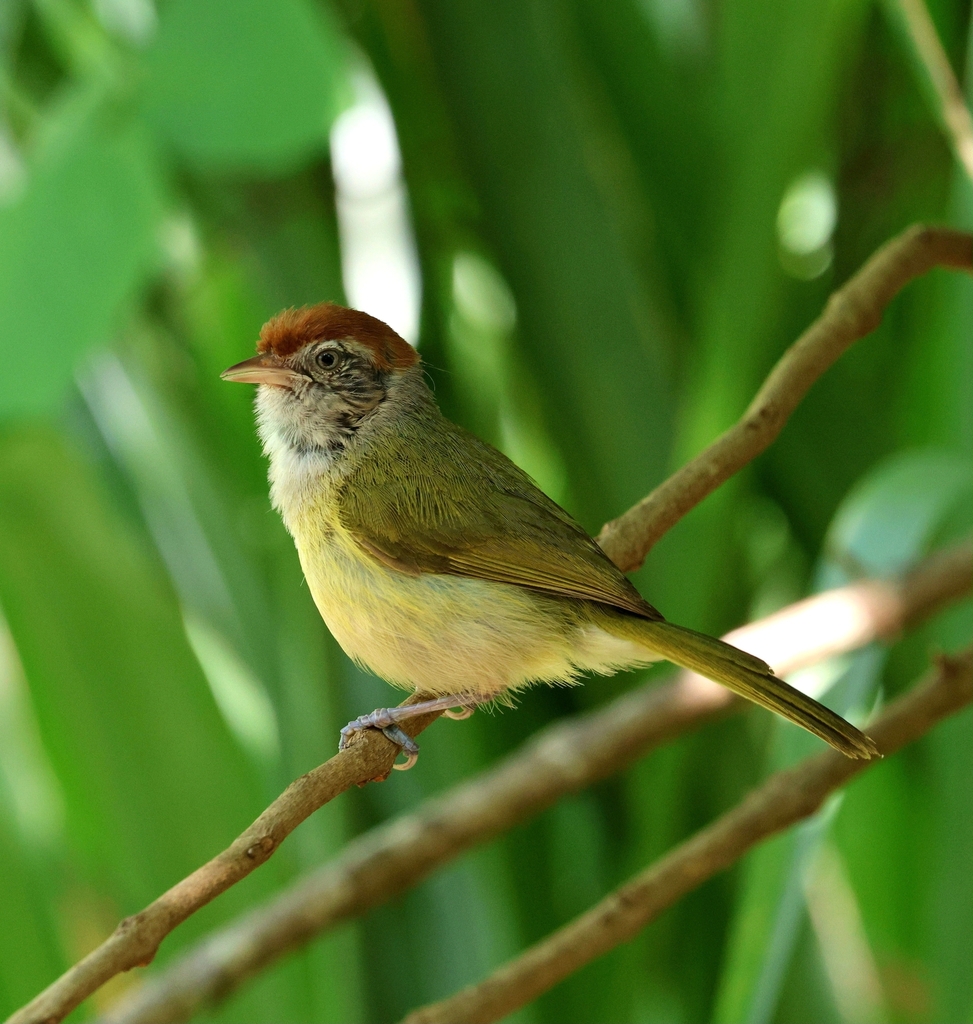
Grey-eyed Greenlet
Photo © Miguel
Photo © Miguel — CC BY-SA 4.0 — Source: iNaturalist photo #469814201The grey-eyed greenlet (Hylophilus amaurocephalus) is a species of bird in the family Vireonidae, the vireos, greenlets, and shrike-babblers. It is found in Brazil and possibly Bolivia. == Taxonomy and systematics == The grey-eyed greenlet was originally described in 1835 as Sylvia amaurocephala, mistakenly placing it among what were then the "Old World warblers". For much of the twentieth century it was treated as a subspecies of the rufous-crowned greenlet (Hyophilus poicilotis) but by the 1990s was generally recognized as a full species. The grey-eyed greenlet is monotypic. == Description == The grey-eyed greenlet is 12.5 to 13 cm (4.9 to 5.1 in) long. The sexes have the same plumage. Adults have a chestnut-brown forehead and crown and a pale grayish supercilium, and is mottled gray-white around the eye and on the ear coverts. Their nape and upper back are dull gray-brown and their lower back, shoulders, and rump are green-tinged gray-brown. Their wings are gray-brown with thin greenish edges on the outer webs of the primaries and secondaries. Their tail is gray-green with brighter edges on the feathers' outer webs. Their chin is dull whitish, their throat dull grayish, their flanks yellowish, and the rest of their underparts brownish…
Tijuca National Park
Brazil
+317 birds+13 mammals
Where the Atlantic forest rises steeply from Rio de Janeiro's urban edge, Tijuca National Park encompasses a landscape of dramatic granite peaks, cascading waterfalls, and closed-canopy…
VIEW NATIONAL PARKSerra do Cipó National Park
Brazil
+379 birds+5 mammals
Where granite escarpments rise above the Atlantic Forest transition zone in southeastern Brazil, Serra do Cipó National Park unfolds across a landscape of dramatic ridges, cascading…
VIEW NATIONAL PARKItatiaia National Park
Brazil
+519 birds+12 mammals
Where granite peaks pierce the Atlantic rainforest canopy in southeastern Brazil, Itatiaia National Park rises as one of the country's oldest and most ecologically vital protected…
VIEW NATIONAL PARKSerra do Teixeira National Park
Brazil
+160 birds+5 mammals
Rugged plateaus and deep escarpments define this 3,112-square-kilometre sweep of the Brazilian Northeast, where the crystalline bedrock of the Borborema Plateau rises abruptly from the surrounding…
VIEW NATIONAL PARKSerra da Capivara National Park
Brazil
+156 birds+6 mammals
Across the semi-arid plateaus and deeply incised canyons of northeastern Brazil, where Piauí's ancient sandstone formations rise and fall in weathered waves, Serra da Capivara National…
VIEW NATIONAL PARKSerra dos Órgãos National Park
Brazil
+446 birds+13 mammals
Granite peaks thrust skyward through the Atlantic Forest canopy in the mountains immediately north of Rio de Janeiro, their bare rock faces rising above a landscape…
VIEW NATIONAL PARKChapada Diamantina National Park
Brazil
+346 birds+5 mammals
Where granite peaks and sandstone cliffs rise abruptly from the Brazilian interior, Chapada Diamantina National Park sprawls across 4,215 square kilometers of some of Brazil's most…
VIEW NATIONAL PARKSerra do Gandarela National Park
Brazil
+333 birds+3 mammals
Where granite massifs rise through Atlantic Forest in southeastern Brazil's highlands, Serra do Gandarela National Park protects nearly 1,000 square kilometres of montane terrain that few…
VIEW NATIONAL PARKCatimbau National Park
Brazil
+118 birds+6 mammals
Where sandstone plateaus rise from the semi-arid scrublands of northeastern Brazil, Catimbau National Park unfolds across more than 1,000 square kilometres of geological drama and surprising…
VIEW NATIONAL PARKNo community photos yet. Log in to add the first one.
No community observations of this species yet.