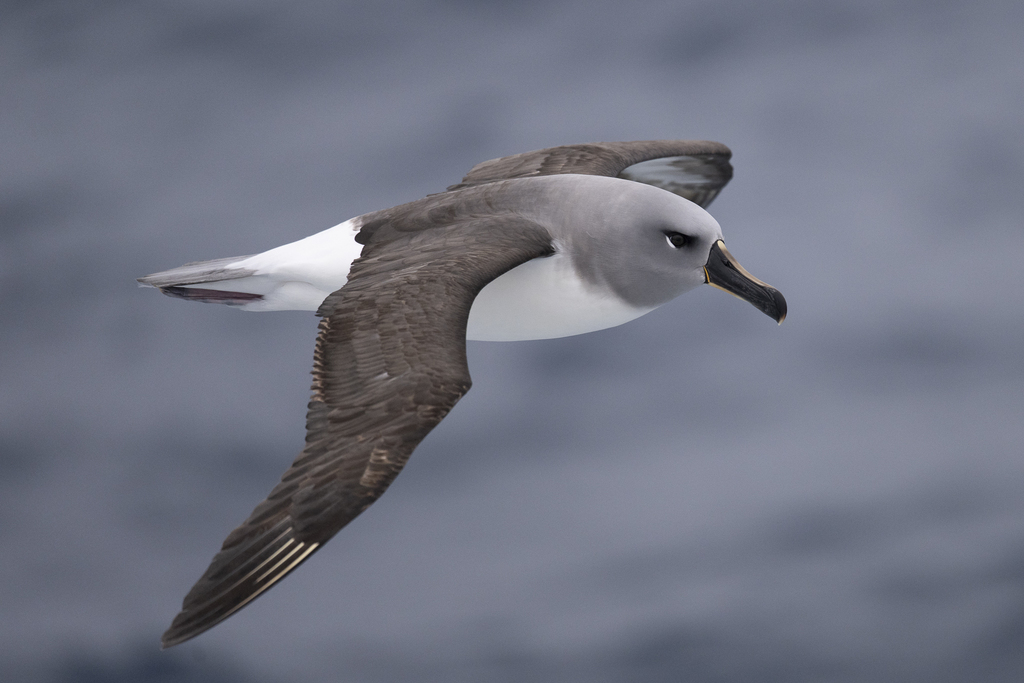
Grey-headed Albatross
Photo © Charlotte Kirchner
Photo © Charlotte Kirchner — CC BY 4.0 — Source: iNaturalist photo #594148156Identification
The grey-headed albatross is a large seabird averaging 81 cm in length with a wingspan of 2.2 m and weighing between 2.8 and 4.4 kg. Its most distinctive features are its ashy-grey head, throat, and upper neck, contrasting sharply with an almost-black mantle, upper wings, and tail. Look for a white rump and underparts, along with a striking white crescent behind each eye. The bill is characteristically black with bright yellow upper and lower ridges that shade to pink-orange at the tip. In flight, the underwings appear predominantly white with heavy black markings on the leading edge. Juveniles are darker overall, with black bills and heads, an indistinct eye crescent, and almost completely dark underwings.
Range & Habitat
This species has a circumpolar distribution throughout the Southern Ocean, nesting in colonies on several isolated islands including South Georgia (which holds around half the world's population), the Diego Ramírez Islands, Kerguelen Islands, Crozet Islands, Marion Island, Prince Edward Islands, Campbell Island, and Macquarie Island. While breeding, birds forage within or south of the Antarctic Polar Frontal Zone, though those roosting near Marion Island venture into subtropical waters. Non-breeding birds and juveniles range freely across all southern oceans, reaching as far north as 35°S.
Behaviour & Diet
The grey-headed albatross is highly pelagic, feeding in open oceans rather than over continental shelves—a distinction that sets it apart from other mollymawks. Its diet consists predominantly of squid, supplemented by fish, crustaceans, cephalopods, lampreys, and carrion, with krill playing a minor role. The species can dive to depths of 7 m to pursue prey, though this occurs infrequently. Breeding pairs lay a single egg in large nests built on steep slopes or cliff faces with tussock grass, incubating it for 72 days. Chicks are fed approximately 616 g of food every 1.2 days and fledge after 141 days. Young birds typically do not return to the colony for 6–7 years, delaying first breeding for several years thereafter. Successfully breeding pairs take a year off from breeding. During non-breeding periods, adults exhibit remarkable migration strategies, including circumnavigating the globe—the fastest recorded circumnavigation took just 46 days.
Best Time & Places to See It
South Georgia in the South Atlantic offers the most reliable viewing opportunities, hosting the largest colonies. The Kerguelen Islands, Crozet Islands, Marion Island, Prince Edward Islands, and Campbell Island—all in the Southern Ocean—provide additional viewing locations. Campbell Island and Macquarie Island, both World Heritage Sites, offer protected viewing experiences. Travellers should note that this species feeds at higher southern latitudes than other mollymawks, so sightings at sea are most likely in polar waters south of the Antarctic Polar Frontal Zone during breeding season or in more northern latitudes during non-breeding periods.
Photography Tips
The grey-headed albatross's striking head colouration and bold bill markings make it distinctive in photographs. The white crescent behind the eye and the contrast between the dark head and pale underparts provide excellent compositional elements. Capture the bright yellow bill ridges and pink-orange tip in good light to highlight the species' elegant field marks. The white underwing with heavy black leading-edge markings is particularly striking in flight photography. Given the species' highly pelagic nature, photographing birds at their nesting colonies on remote Southern Ocean islands—especially South Georgia—provides the most accessible opportunities for close-range shots and behavioural documentation.
Sea Lion Island
Sealion Island Settlement, Falkland Islands
+74 birds+3 mammals
Windswept tussock grasslands roll across volcanic terrain where Southern Ocean swells crash against rocky shores, creating one of the Falkland Islands' most dramatic wildlife theatres. This…
VIEW ISLAND & ARCHIPELAGOKidney Island
Stanley, Falkland Islands
+47 birds
Wind-scoured tussock grassland sweeps across this remote South Atlantic outcrop, where peaty soils and exposed rock formations create a landscape as austere as it is vital.…
VIEW ISLAND & ARCHIPELAGOWest Point Island
West Point, Falkland Islands
+67 birds+3 mammals
Windswept cliffs plunge dramatically into the South Atlantic, their rust-coloured rock faces sculpted by millennia of gales and spray. This northwestern outpost of the Falkland Islands…
VIEW ISLAND & ARCHIPELAGOCabo de Hornos National Park
Cape Horn, Chile
+88 birds+9 mammals
Where the Andes plunge into the Southern Ocean and the Drake Passage churns between two continents, Cabo de Hornos National Park sprawls across one of Earth's…
VIEW NATIONAL PARKDeception Island
Gabriel de Castilla Base, Antarctica
+26 birds+10 mammals
Steaming geothermal vents pierce a landscape of blackened volcanic sand and ice, where the earth's raw power still trembles beneath your feet. This horseshoe-shaped caldera, flooded…
VIEW ISLAND & ARCHIPELAGOCuverville Island
Cuverville Island, Antarctica
+19 birds+10 mammals
Granite peaks and sculpted ice define this windswept archipelago off the Antarctic Peninsula, where steep rocky shores plunge into waters thick with drifting brash ice. Cuverville…
VIEW ISLAND & ARCHIPELAGOParadise Bay
Brown Station, Antarctica
+18 birds+9 mammals
Where the Antarctic Peninsula's rugged coastline meets the Southern Ocean, Brown Station stands sentinel over Paradise Bay—a protected landscape of ice-carved inlets, towering glacial faces, and…
VIEW PROTECTED LANDSCAPEBrown Bluff
Brown Bluff, Antarctica
+23 birds+9 mammals
Where rust-colored volcanic peaks pierce the Antarctic Peninsula's icy realm, a geologist's dreamscape unfolds beneath towering cliffs of iron oxide and ancient lava. Brown Bluff rises…
VIEW PROTECTED LANDSCAPEHalf Moon Island
Cámara Base, Antarctica
+25 birds+8 mammals
Jagged volcanic peaks rise from the cobalt waters of the South Shetland Islands, their slopes carpeted in moss and lichen where hardy vegetation clings to windswept…
VIEW ISLAND & ARCHIPELAGOWilhelmina Bay
Wilhelmina Bay, Antarctica
+20 birds+10 mammals
Sheer cliffs of black volcanic rock plunge into waters so pristine they reflect the Antarctic sky like polished obsidian. This remote western Antarctic inlet, ringed by…
VIEW PROTECTED LANDSCAPELemaire Channel
Orne Harbour, Antarctica
+25 birds+13 mammals
Where granite peaks plunge into steel-grey waters, the Lemaire Channel carves one of Antarctica's most dramatic passages. This narrow strait, squeezed between the Antarctic Peninsula and…
VIEW PROTECTED LANDSCAPESalisbury Plain
South Georgia, South Georgia and the South Sandwich Islands
+33 birds+4 mammals
Where tussock grasses bow to relentless Antarctic winds and glacial meltwater carves braided channels through obsidian volcanic soil, one of Earth's most remote wildlife sanctuaries reveals…
VIEW PROTECTED LANDSCAPESt. Andrews Bay
South Georgia, South Georgia and the South Sandwich Islands
+34 birds+6 mammals
Where windswept tundra dissolves into obsidian beaches, one of the planet's most extraordinary wildlife theaters unfolds across St. Andrews Bay. This remote corner of South Georgia…
VIEW PROTECTED LANDSCAPEFortuna Bay
Stromness, South Georgia and the South Sandwich Islands
+37 birds+5 mammals
Where tussock grasslands sweep down to black-sand beaches and elephant seals haul out in thunderous colonies, the raw sub-Antarctic landscape reveals itself in its most dramatic…
VIEW PROTECTED LANDSCAPEPrion Island
Prince Olav Harbour, South Georgia and the South Sandwich Islands
+36 birds+2 mammals
Windswept tussock grasslands rise sharply from boulder-strewn beaches where the Southern Ocean hurls its grey swells against black volcanic rock. This remote speck in South Georgia's…
VIEW ISLAND & ARCHIPELAGOCooper Bay
Cooper Bay, South Georgia and the South Sandwich Islands
+28 birds+5 mammals
Where black-sand beaches meet towering cliffs striped with cascading meltwater, one of the Southern Ocean's most dramatic amphitheaters reveals itself. Cooper Bay cuts a deep indent…
VIEW PROTECTED LANDSCAPEElsehul Bay
Bird Island Station, South Georgia and the South Sandwich Islands
+33 birds+4 mammals
Granite peaks rise sheer from the Southern Ocean, their weathered faces streaked with cascading meltwater and cloaked in tussock grass that bends beneath relentless winds. This…
VIEW PROTECTED LANDSCAPENo community photos yet. Log in to add the first one.
No community observations of this species yet.