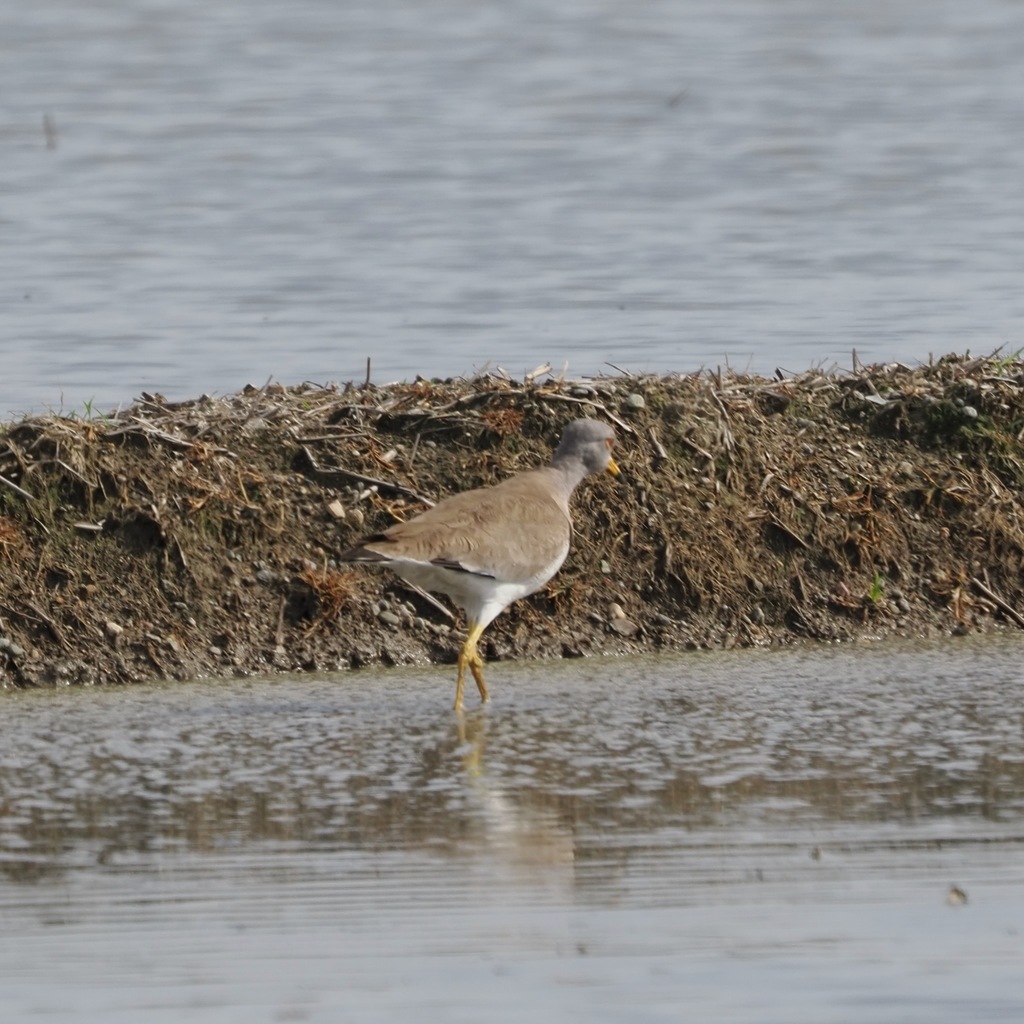
Grey-headed Lapwing
Photo © ITÔ, Hiroki
Photo © ITÔ, Hiroki — CC BY 4.0 — Source: iNaturalist #354198617Identification
The grey-headed lapwing is a medium-sized plover measuring 34–37 cm in length, instantly recognizable by its distinctive grey head and neck contrasting sharply with a darker grey breast band and white belly. The back is warm brown, while the rump is white and the tail is black. In flight, this species is particularly striking, displaying black primaries, white underwings and upper wing secondaries, and brown upper wing coverts—a combination that makes it unmistakable even at distance.
Both male and female adults are similarly plumaged, though males are slightly larger. Younger birds are duller, with white plumage tinged grey, a less distinct breast band, and pale fringes to their upperpart and wing covert feathers. The species has a sharp, distinctive call described as a chee-it, which can help with identification in the field.
Range & Habitat
The grey-headed lapwing breeds in northeast China and Japan, with migratory populations moving to quite different regions seasonally. The mainland breeding population winters in northern Southeast Asia, ranging from northeastern India eastward to Cambodia. The Japanese population winters at least partially in southern Honshū, making parts of Japan accessible year-round for dedicated birdwatchers.
The species occasionally appears as a vagrant across a wide geographical range, having been recorded in Russia, the Philippines, Indonesia, New South Wales in Australia, and even as far afield as Telangana and Sri Lanka in the Indian subcontinent, plus rare European records in Sweden and England. These records highlight the species' capacity for occasional long-distance dispersal.
Behaviour & Diet
During breeding season from April to July, grey-headed lapwings nest in wet grassland, rice fields, and marshland edges—habitats that provide both nesting cover and abundant food resources. Outside the breeding season, they occupy similar wetland habitats and become notably gregarious, gathering in flocks rather than remaining solitary or in pairs.
Their diet consists of invertebrates hunted in shallow water, including insects, worms, and molluscs. They feed in the characteristic lapwing manner, moving through shallow wetlands to pick or probe for prey, making them relatively easy to observe and photograph during feeding sessions.
Best Time & Places to See It
For breeding birds, the northeast China and Japan regions offer opportunities from April through July. Winter observers should focus on northern Southeast Asia, particularly from northeastern India through Cambodia, where the mainland population gathers. Southern Honshū in Japan holds wintering birds from the Japanese breeding population, making it the most accessible location for European and North American travellers.
Within their range, wetland habitats are key—look for rice paddies, marshes, and wet grasslands where the birds feed in shallow water. Winter flocking behaviour means birds are more concentrated and easier to locate during this season, making it potentially the best time for seeing multiple individuals.
Photography Tips
The grey-headed lapwing's striking plumage and high-contrast grey-and-white pattern photograph exceptionally well, particularly in good light. The bird's habit of feeding in shallow water offers excellent opportunities for clean, unobstructed shots. Winter flocking provides chances to capture multiple birds and behavioural interactions.
In-flight photography is particularly rewarding, as the combination of black primaries, white underwings, and brown coverts creates a distinctive and attractive pattern. The sharp chee-it call can help locate birds, and their relative tameness in wetland habitats allows for close approach with appropriate fieldcraft. Early morning light on wet grasslands and rice fields will bring out the subtle grey tones of the head and breast band.
Orang National Park
Rangagarapathar, India
+298 birds+1 mammals
Where the Brahmaputra's floodplains meet the foothills of Assam, Orang National Park unfolds across a mosaic of riverine grasslands, forests and wetlands that pulse with the…
VIEW NATIONAL PARKKhao Yai National Park
Prachantakham District, Thailand
+377 birds+46 mammals
Evergreen dipterocarp forest blankets the rolling terrain of this national park in eastern Thailand, where limestone hills rise abruptly from the forest floor and seasonal streams…
VIEW NATIONAL PARKWulingyuan
Jundiping, China
+97 birds+3 mammals
Sandstone peaks erupting from forested valleys define this sprawling 993-square-kilometre national park in Hunan Province, where vertical cliffs rise dramatically above lush subtropical woodland. The landscape—a…
VIEW NATURAL MONUMENTGiant Panda National Park
Mianyang, China
+447 birds+47 mammals
Where the eastern slopes of China's Sichuan plateau descend into cloud-wrapped valleys, one of Asia's most biodiverse landscapes unfolds across more than 350,000 square kilometres. This…
VIEW NATIONAL PARKTadoba National Park
Palasgaon Singru, India
+270 birds+20 mammals
Where sal forests meet open grasslands and rocky outcrops rise from red laterite soil, central India's landscape unfolds in raw, untamed beauty. Ancient teak woodlands and…
VIEW NATIONAL PARKKaziranga National Park
Kohora, India
+422 birds+26 mammals
Dawn breaks over the floodplains of the Brahmaputra, where tall grasslands stretch endlessly beneath monsoon-heavy skies. This sprawling wilderness of northeastern Assam is a mosaic of…
VIEW NATIONAL PARKKeoladeo National Park
Shreenagar Rural, India
+326 birds+14 mammals
Where shallow wetlands shimmer beneath vast Rajasthani skies, one of Asia's finest bird sanctuaries pulses with extraordinary life. This former maharaja's hunting reserve, now spanning 29…
VIEW NATIONAL PARKNortheast China Tiger and Leopard National Park
Mu Dan Jiang Shi, China
+202 birds+19 mammals
Across the temperate forests of northeastern China, where winters grip the landscape in subzero silence and summers remain cool and brief, the Mudanjiang region supports a…
VIEW NATIONAL PARKWuyishan National Park
Yanshan County, China
+141 birds+2 mammals
Where subtropical monsoon rains sustain a perpetually humid landscape, Wuyishan National Park rises from Fujian's eastern plateau as a realm of forested ridges, cascading streams, and…
VIEW NATIONAL PARKWolong National Nature Reserve
Wenchuan County, China
+333 birds+17 mammals
Where the Qingyi River cuts through the eastern flanks of the Minshan Range, a temperate montane forest cloaks steep valleys in dense canopy that thins dramatically…
VIEW NATURE RESERVEYancheng National Nature Reserve
Yancheng, China
+208 birds+4 mammals
Where the East China Sea's tidal rhythms sculpt the Jiangsu coast, Yancheng National Nature Reserve sprawls across one of Asia's most dynamic wetland complexes. This vast…
VIEW NATURE RESERVEZhalong National Nature Reserve
Qiqihar, China
+78 birds
Across the wetlands of northeastern China, where the Heilongjiang climate swings between brutal winters and warm summers, lies one of East Asia's most vital refuges for…
VIEW NATURE RESERVEPoyang Lake National Nature Reserve
Shangrao, China
+270 birds+7 mammals
Where the Yangtze River's massive floodplain spreads across central China, Poyang Lake National Nature Reserve encompasses one of the continent's most dynamic and water-rich wetland systems.…
VIEW NATURE RESERVECaohai National Nature Reserve
Bijie, China
+93 birds
At roughly 1,900 metres elevation on Guizhou's high plateau, Caohai sprawls across a temperate landscape shaped by pronounced seasonal extremes. Winters here are dry and cool,…
VIEW NATURE RESERVEQinghai Lake National Nature Reserve
Hainan Tibetan Autonomous Prefecture, China
+243 birds+11 mammals
At 3,200 metres above sea level on the Tibetan plateau, where winter temperatures plunge far below freezing and snow blankets the landscape for half the year,…
VIEW NATURE RESERVEGaoligong Mountain National Nature Reserve
Nujiang Lisu Autonomous Prefecture, China
+443 birds+13 mammals
VIEW NATURE RESERVENo community photos yet. Log in to add the first one.
No community observations of this species yet.