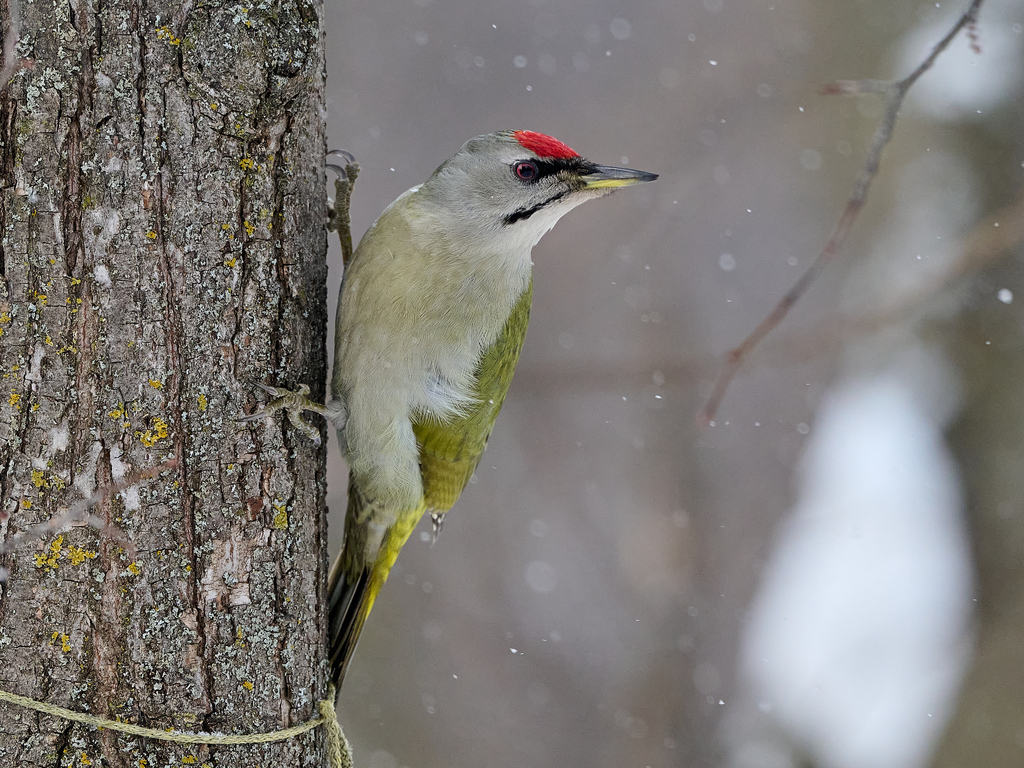
Grey-headed Woodpecker
Photo © Сергей Неклюдов
Photo © Сергей Неклюдов — CC BY 4.0 — Source: iNaturalist photo #618961818Identification
The grey-headed woodpecker is a medium-sized woodpecker measuring 25–26 cm in length with a wingspan of 38–40 cm and weighing around 125 g. It is somewhat smaller and lighter than the European green woodpecker, with a size approximately equivalent to a Eurasian collared dove. The species is characterized by uniformly olive-green upperparts that transition to light grey across the neck and head. Males of the nominate subspecies display a distinctive grey head with a red forecrown, a black line across the lores, and a narrow black moustache stripe. Females lack the red forecrown but have fine black streaks on the crown instead. The breast and underbody are pale grey, while the folded primaries are barred brown-black on grey-white. Compared to the green woodpecker, the grey-headed woodpecker has a shorter neck, slimmer bill, and slightly rounder head, with typically small and inconspicuous woodpecker markings.
Range & Habitat
The grey-headed woodpecker is a Eurasian species with a vast distribution stretching from Europe across the central and eastern Palaearctic all the way to the Pacific Ocean, and south to the Himalaya and the Malay Peninsula. Eleven subspecies are recognized, divided into two groups: two northern subspecies with grey napes found from north and central Europe to Siberia and northeast Asia, and nine southeastern subspecies with black napes occurring from central China south to the Malay Peninsula. This species is more demanding in its habitat requirements than the European green woodpecker, preferring deciduous forests with a high proportion of dead trees. It typically excavates its nest into dead or severely damaged trees.
Behaviour & Diet
The grey-headed woodpecker feeds primarily on ants, though it is not as exclusively dependent on this food source as the European green woodpecker. The species produces a far-carrying territorial song that is more melodic and cleaner than the explosive "laughter" of the green woodpecker. The song consists of ten to fifteen utterances of declining pitch and gradual slowing, often appearing melancholic and "dying" in character. Female territorial song is similar but somewhat quieter, less melodious, more croaky, and often shorter. Both sexes produce aggressive noises, though males do so more frequently, including sharp kuek sounds.
Best Time & Places to See It
The grey-headed woodpecker's extensive range across Europe and Asia provides numerous opportunities for observation, particularly in deciduous forests with abundant dead wood. The species is in decline in the majority of areas for which population numbers are available, so locating suitable habitat with sufficient dead trees remains important for finding this species. Its melodic territorial song makes it identifiable by ear during breeding season, offering an additional way to locate birds in forested areas.
Photography Tips
Photographers should look for this species in deciduous forests where dead and damaged trees are present, as these provide both feeding and nesting habitat. The grey-headed woodpecker's subtle plumage requires careful attention to light conditions to capture the distinction between its grey head and olive-green back. The red forecrown of males provides a useful focal point for composition. Its relatively small and inconspicuous markings mean that frame-filling shots or close-ups will be most effective in revealing field marks and distinguishing this species from the similar European green woodpecker.
Aggtelek National Park
Baikal National Park
Banke National Park
Bardiya National Park
Bavarian Forest National Park
Belluno Dolomites National Park
Białowieża National Park
Biebrza National Park
Bieszczady National Park
Nothing matches these filters.
No community photos yet. Log in to add the first one.
No community observations of this species yet.