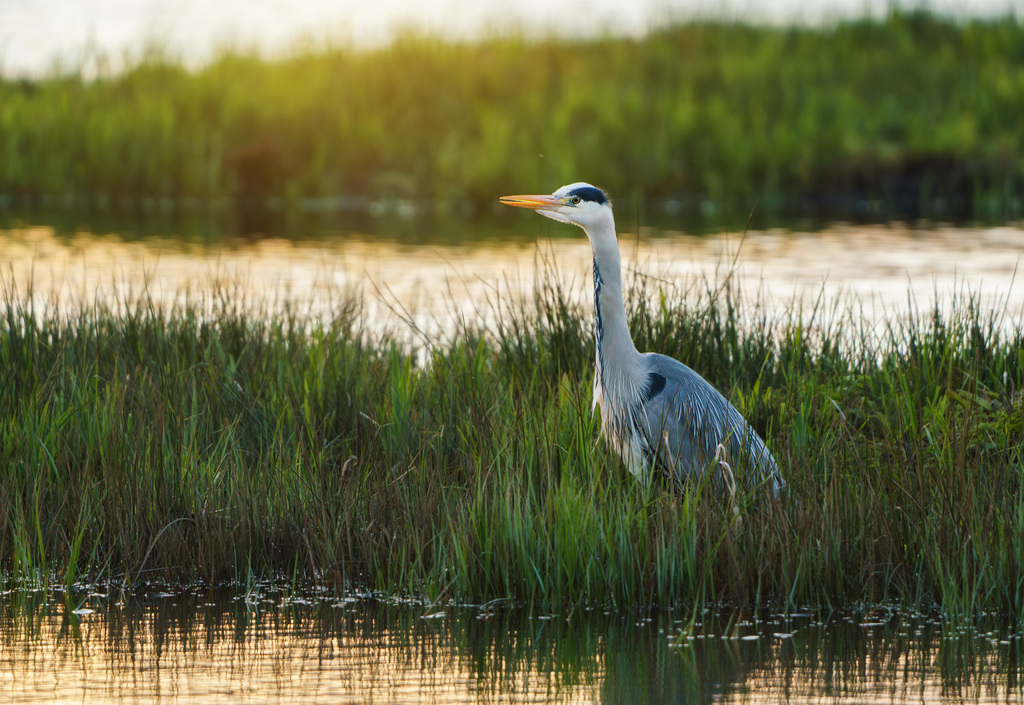
Grey Heron
Photo © Sara Nowak
Photo © Sara Nowak — CC0 1.0 — Source: iNaturalist photo #424762771Identification
The grey heron is a large, unmistakable wading bird standing up to 1 metre tall with a wingspan of 155–195 cm. Adults are predominantly ashy-grey above with greyish-white underparts and black markings on the flanks. The most distinctive feature is the head: a white face and neck are crossed by a broad black stripe running from the eye to a slender, dangling crest. The long, straight beak is pinkish-yellow, brighter in breeding birds, and the legs are brown and notably long. Immature birds are duller, with a grey rather than black head stripe and only a small dark crest, making them less striking than adults. The yellow iris is visible at close range.
Range & Habitat
Grey herons are native throughout temperate Europe and Asia, with populations also found in Africa. Four subspecies are recognised, with the nominate subspecies occurring from Norway and Sweden south to northern Spain, the Mediterranean, and across to Iraq, Iran, and India. The species is largely resident across much of its range, though northern populations migrate southwards in autumn, with some reaching Africa south of the Sahara. Occasional vagrants have been recorded in Iceland, Greenland, the Caribbean, and North America.
These birds inhabit wetland areas of all kinds, from lakes, rivers, and ponds to marshes and coastal waters. They are equally at home in freshwater and brackish environments, making them adaptable to diverse wetland habitats.
Behaviour & Diet
Grey herons are patient hunters, feeding mostly on aquatic creatures caught either by standing motionless beside or in the water, or by stalking slowly through the shallows. They breed colonially in spring, building nests high in trees within heronries. A clutch of three to five bluish-green eggs is laid, and both parents share incubation duties for around 25 days. Young birds fledge when 7–8 weeks old, though many do not survive their first winter; those that do can expect a lifespan of approximately 5 years.
The main call is a loud croaking "fraaank," with various guttural and raucous calls heard throughout the breeding colony. Males use advertisement calls to attract females and driving calls to defend nest territories.
Best Time & Places to See It
Grey herons can be seen year-round throughout much of temperate Europe and Asia. Resident populations make them reliable sightings, while migratory birds from the north arrive in autumn. Any wetland habitat offers potential viewing opportunities—search around lakes, rivers, ponds, marshes, and coastal areas. Early morning and dusk are typically productive times. During spring, heronries offer the best chances to observe breeding behaviour and multiple birds, though colonies can be noisy and bustling with activity.
Photography Tips
Photograph grey herons at wetland margins where they hunt; approach slowly and use a long lens to avoid flushing them. Their static hunting posture allows patient photographers to capture intimate portraits. The striking head pattern—black crest and eye-stripe against white—is a key feature to emphasise. Breeding birds at heronries offer dynamic shots of courtship displays, nest-building, and chick-feeding, though maintain distance to avoid disturbance. Early morning light often provides soft, flattering illumination, while overcast days eliminate harsh shadows across the grey plumage.
Private Full-Day Birdwatching Tour from Algarve to Southwest Spain
Nothing matches these filters.
Delta de l’Ebre Natural Park
Parque del Centenario
Bwindi Impenetrable National Park
Kanha Tiger Reserve
Lake Mburo National Park
Mabamba Swamp
Minneriya National Park
Murchison Falls National Park
Queen Elizabeth National Park
Nothing matches these filters.