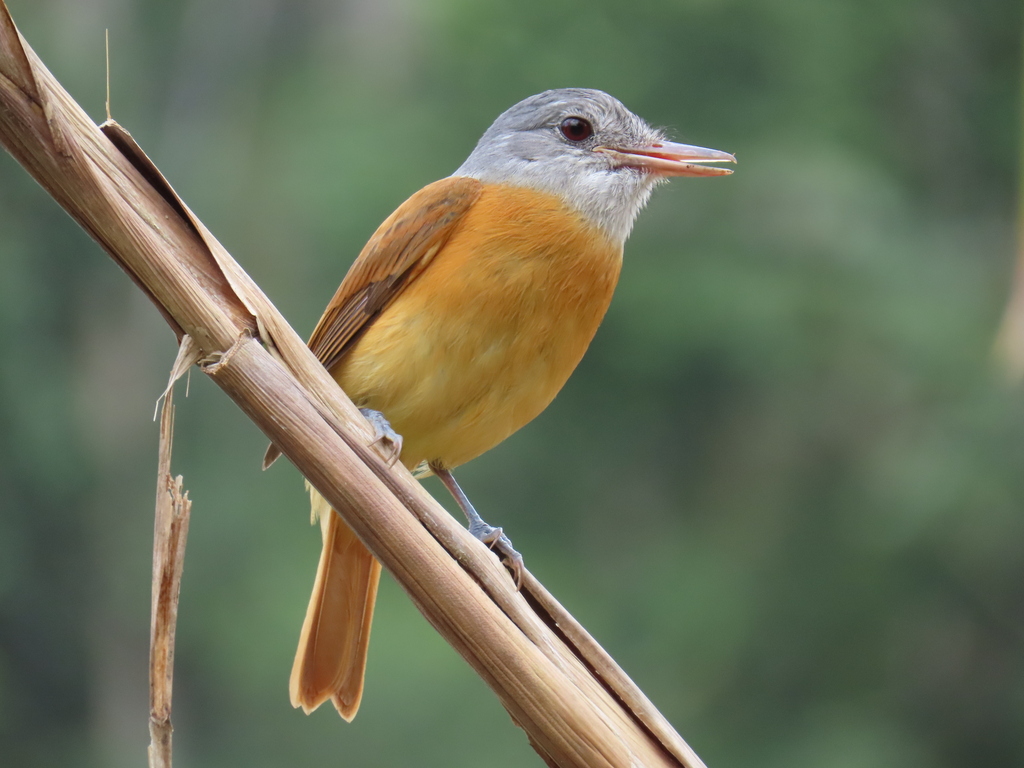
Grey-hooded Attila
Photo © Jonathan Lorencetti Ehlert
Photo © Jonathan Lorencetti Ehlert — CC BY-SA 4.0 — Source: iNaturalist photo #559832418Identification
The grey-hooded attila is a medium-sized tyrant flycatcher, measuring 20 to 21 cm in length and weighing 36.5 to 51.5 g. Adults are unmistakable with their distinctive grey head and nape contrasting sharply with deep rufous upperparts. The rump and tail are paler cinnamon-rufous, while the wings are mostly deep rufous with blackish primaries. The chin is grey with white streaks, the breast rufous, and the belly paler yellowish-rufous. Both sexes share identical plumage. The bird has a longish bill with a dark upper mandible and whitish to greyish lower mandible, dark iris, and grey legs. Two subspecies occur: the nominate A. r. rufus and the more northerly A. r. hellmayri, which has a whitish chin and rufous throat. Juveniles can be distinguished by their all-black bill.
Range & Habitat
The grey-hooded attila is endemic to Brazil, found exclusively in the eastern and southeastern portions of the country. Subspecies A. r. hellmayri inhabits central and southern Bahia, while the nominate subspecies ranges from Minas Gerais and Espírito Santo southward to northeastern Rio Grande do Sul. The species favours humid forests and scrublands, occurring from sea level to 1,500 m elevation across its range.
Behaviour & Diet
This attila is believed to be a year-round resident throughout its range. It primarily feeds on large arthropods, supplementing its diet with fruit. The bird typically forages singly or in pairs, though it occasionally joins mixed-species feeding flocks. It searches for prey and fruit at all levels of the forest, from the canopy to the ground, employing a characteristic hunting technique of perching quietly before taking items from foliage and branches with brief hovering sallies.
The grey-hooded attila produces a distinctive slow series of 4-7 emphasized, fluted 'whee' notes that gradually rise in pitch and strength before the final note, which fades out. It also utters softer shorter whistles and an 'éé-ew' whistle. Breeding information is limited; nests have been documented in tree trunks, tree ferns, and cavities in earthen banks, but little else is known about its reproductive biology.
Best Time & Places to See It
As a year-round resident, the grey-hooded attila can be encountered throughout the year in suitable habitat within its Brazilian range. The species is considered uncommon to fairly common and occurs in several protected areas, making these reserves the best locations for finding this endemic species. Patient observers searching humid forests and scrublands in eastern and southeastern Brazil, particularly in Bahia, Minas Gerais, Espírito Santo, and Rio Grande do Sul, should listen for its distinctive fluted song as a guide to locating this quiet forager.
Photography Tips
The grey-hooded attila's habit of perching quietly while foraging provides opportunities for patient photographers. The contrasting grey head and rufous upperparts offer good compositional potential, and the bird's tendency to forage at all levels means shooting opportunities range from ground level to mid-canopy. Early morning is optimal for capturing singing birds when they are more vocal and active. The subtle plumage details—particularly the streaked grey chin and the distinction between the deep rufous and paler cinnamon-rufous tones—reward close-focus photography. Be prepared for subdued forest lighting typical of humid forest habitat.
Carlos Botelho State Park
Ibitipoca State Park
Ilha do Cardoso State Park
Intervales State Park
Itatiaia National Park
Pau Brasil National Park
Rio Doce State Park
Saint-Hilaire/Lange National Park
Serra da Bocaina National Park
Nothing matches these filters.
No community photos yet. Log in to add the first one.
No community observations of this species yet.