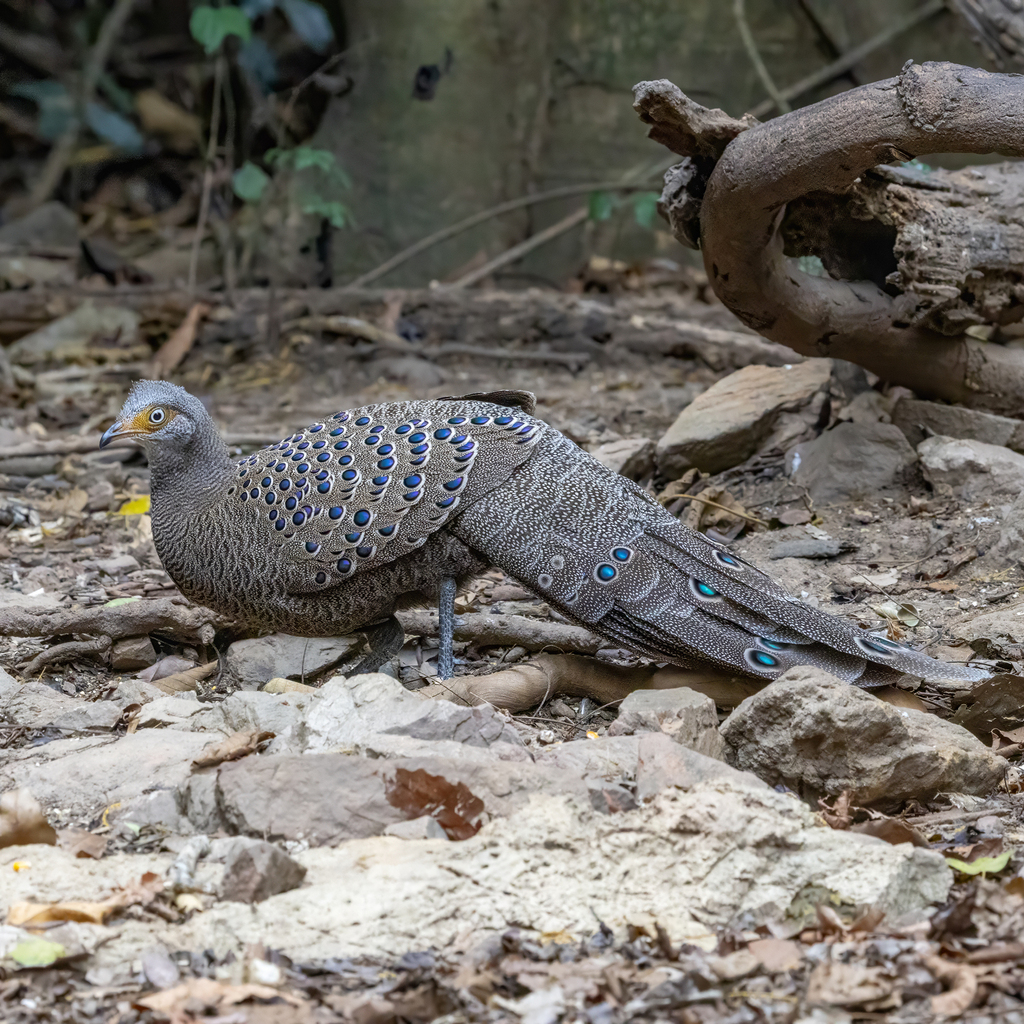
Grey Peacock-Pheasant
Photo © Dan Vickers
Photo © Dan Vickers — CC BY 4.0 — Source: iNaturalist #344771055Identification
The grey peacock-pheasant is a large pheasant reaching up to 76 cm in length, with a distinctive greyish-brown plumage adorned with finely spotted green eyespots that give it an ornate appearance. It features an elongated, bushy crest on its head, bare pink or yellow facial skin, a white throat, and grey iris, bill, and legs. The males are more ornamented and vibrant than females, which are smaller, darker, and less decorative. Juveniles resemble females in their more subdued appearance.
Range & habitat
The grey peacock-pheasant, also known as the Burmese peacock-pheasant, inhabits lowland and hill forests across Bangladesh, Northeast India, and Southeast Asia. Its range excludes most of Indochina and the entire Malayan Peninsula. The species is widespread throughout this large range and has adapted well to forested environments at various elevations within its distribution.
Behaviour & diet
Like other pheasants, the grey peacock-pheasant is a ground-dwelling bird with a diverse diet consisting mainly of seeds, termites, fruits, and invertebrates. The species is known to forage on the forest floor, using its strong legs and scratching behaviour typical of galliformes to uncover food. Reproductive behaviour includes females laying typically two eggs, suggesting a modest breeding output compared to some other pheasant species.
Best time & places to see it
Observers seeking the grey peacock-pheasant should focus on lowland and hill forest regions throughout Bangladesh, Northeast India, and Southeast Asia, avoiding the Malayan Peninsula and most of Indochina. The species' widespread distribution across its large range and stable population status make it a realistic target for dedicated birdwatchers and wildlife enthusiasts exploring Asian forests. Early mornings when birds are most active in foraging are typically the best time to encounter this species in its natural habitat.
Photography tips
Photographing the grey peacock-pheasant requires patience and an understanding of its ground-dwelling habits. The bird's intricate eyespots and finely spotted plumage demand good resolution to capture fine detail, making a telephoto lens essential for distant subjects. The bare facial skin in pink or yellow provides striking colour contrast against the greyish-brown plumage, and the elongated crest offers distinctive silhouettes. Early morning light in forest settings will help reveal the subtle green iridescence of the eyespots, while the bird's natural wariness means approaching quietly and remaining still for extended periods will improve your chances of obtaining quality shots.
Phou Khao Khouay National Protected Area
Thaphabath District, Thailand
+113 birds
Where the Annamite Mountains descend into central Thailand's monsoon forests, Phou Khao Khouay National Protected Area sprawls across rugged limestone terrain interlaced with river valleys and…
VIEW NATIONAL PARKGaoligong Mountain National Nature Reserve
Nujiang Lisu Autonomous Prefecture, China
+443 birds+13 mammals
VIEW NATURE RESERVENo community photos yet. Log in to add the first one.
No community observations of this species yet.