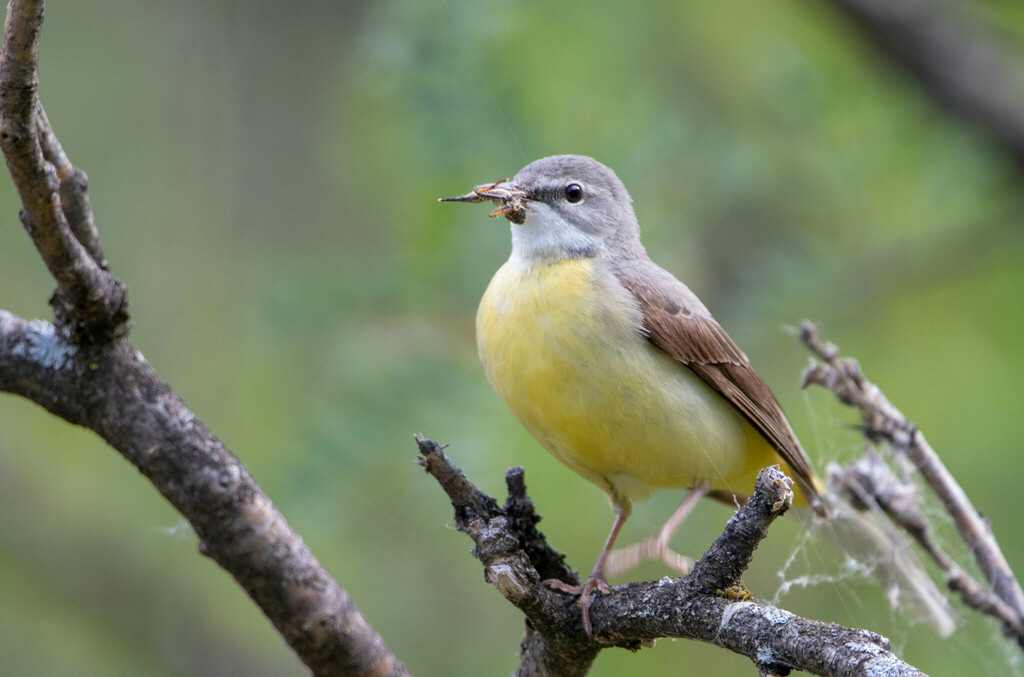
Grey Wagtail
Motacilla cinerea
Photo © Юрий Носков
Photo © Юрий Носков — CC0 1.0 — Source: iNaturalist photo #295044066ABOUT
Subspecies of Grey Wagtail
Common Grey WagtailAzores Grey WagtailMadeiran Grey Wagtail
Identification
The grey wagtail is a slim, elegant bird measuring around 18–19 cm in length. Its most distinctive features are its ash-grey upperparts, narrow white supercilium, and broken eye ring. Unlike the similar yellow wagtail, the grey wagtail's yellow plumage is confined to the throat and vent, with whitish underparts in between. Breeding males are particularly striking, displaying a bold black throat edged by whitish moustachial stripes. Like all wagtails, this species is notably active, frequently wagging its tail and often perching on rocks, trees, and other elevated spots while foraging.
Range & Habitat
The grey wagtail is widely distributed across the Palearctic region, with several distinct populations. The nominate subspecies ranges from western Europe, including the British Isles, Scandinavia, and the Mediterranean, extending to northwest Africa. Eastern populations breed along the mountain chains of the Urals, Tien Shan, and Himalayas, while northeastern Siberian populations extend to Korea and Japan. Island subspecies inhabit the Azores, Madeira, and Canary Islands. The species is highly specialised for breeding, always associating with running water such as fast-flowing streams and rivers, though it will nest in holes within man-made structures near waterways. Outside the breeding season, birds are more flexible, using lakes, coasts, and other watery habitats. Some populations winter in Africa and Asia, while others remain resident.
Behaviour & Diet
Grey wagtails breed from April to July, with males performing distinctive courtship displays—short flights into the air followed by slow descents with fluttering wingbeats and rapid high-pitched chipping calls. Nests are placed in embankments between stones and roots near running water. Clutches typically consist of 3–6 speckled eggs, with breeding success around 80 percent in some populations. Multiple broods may be raised in a season, though subsequent clutches tend to be smaller. Incubation lasts approximately two weeks, with chicks fledging within a fortnight. These birds forage singly or in pairs on meadows and shallow marshes, feeding on a variety of aquatic invertebrates including flies, mayflies, beetles, crustaceans, and molluscs. In winter, they often forage along roadsides and roost in small groups, with wintering birds faithfully returning to the same locations year after year.
Best Time & Places to See It
Grey wagtails are best observed during the breeding season from April to July when they are active along fast-flowing streams and rivers throughout their Palearctic range. In Europe, look along suitable waterways in the British Isles, Scandinavia, and the Mediterranean region. During winter, they become more dispersed and may be found in unexpected locations such as small urban gardens and coastal areas. Wintering birds show remarkable site fidelity, making particular locations reliable for repeated sightings if you discover a favourite haunt.
Photography Tips
The grey wagtail's active behaviour and preference for open habitats near water make it an engaging photographic subject. Photograph during the breeding season to capture males with their striking black throats and bright yellow vents. Position yourself near fast-flowing streams where birds naturally perch on rocks and low vegetation. Early morning light will illuminate their sleek form and enhance the contrast between grey, black, and yellow plumage. Be prepared for quick movements—the wagtail's characteristic tail-wagging and low, undulating flight require a fast shutter speed. Patient observation of favoured roost sites in winter can yield rewarding images of birds in urban or garden settings.
HIDES
HOTSPOTS
Country
Type
Sort by
5,0 (1)
National Park
Bwindi Impenetrable National Park
Kanyashogi·Uganda
+603 birds+26 mammals
5,0 (1)
National Park
Kanha Tiger Reserve
Kanha Kisli F.V.·India
+321 birds+23 mammals
5,0 (1)
Nature Reserve
Mabamba Swamp
Memere·Uganda
+464 birds+2 mammals
5,0 (1)
National Park
Murchison Falls National Park
Uganda
+608 birds+33 mammals
5,0 (1)
National Park
Queen Elizabeth National Park
Uganda
+672 birds+30 mammals
National Park
Aberdare National Park
Mweiga ward·Kenya
+394 birds+30 mammals
National Park
Abijata-Shalla Lakes National Park
Ethiopia
+438 birds+7 mammals
National Park
Abruzzo, Lazio and Molise National Park
Pescasseroli·Italy
+139 birds+18 mammals
National Park
Aggtelek National Park
Szin·Hungary
+119 birds+13 mammals
Nothing matches these filters.
COMMUNITY
Share your photo of this species
Sort by
No community photos yet. Log in to add the first one.
0
Observed by
0
Hotspots reported
0
Countries
No community observations of this species yet.