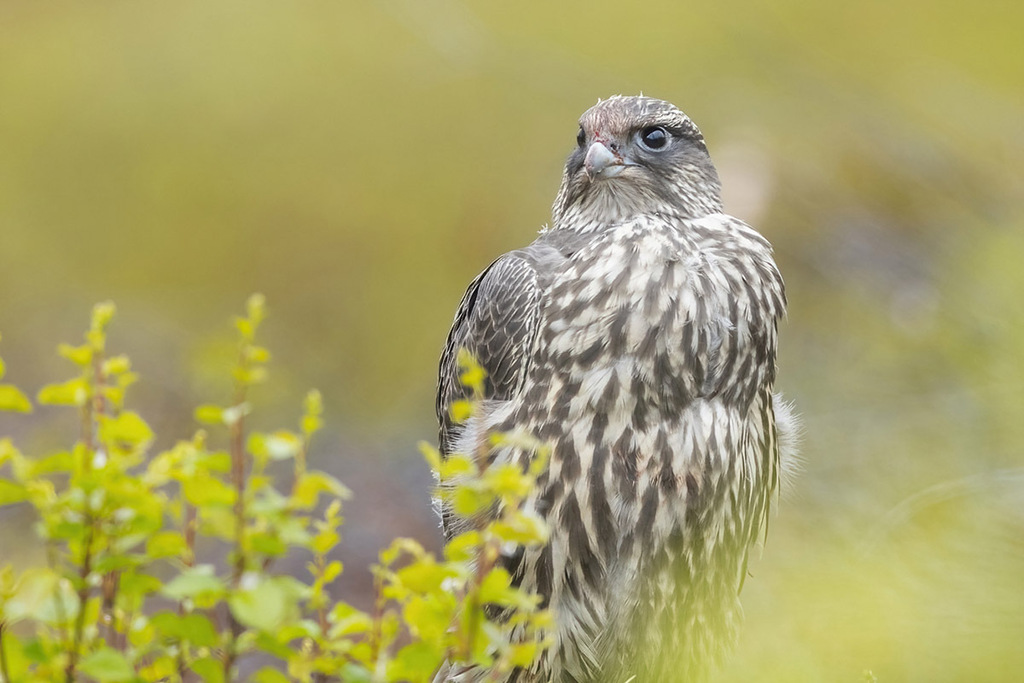
Gyrfalcon
Photo © egorbirder
Photo © egorbirder — CC BY 4.0 — Source: iNaturalist photo #548442812Identification
The gyrfalcon is the largest falcon in the world, commanding attention with its impressive size and powerful build. Males measure 48 to 61 centimetres long with wingspans of 110 to 130 centimetres, while females are noticeably larger at 51 to 65 centimetres in length with wingspans reaching 124 to 134 centimetres. The most striking feature is the gyrfalcon's remarkable plumage polymorphism—birds vary dramatically across a spectrum from all-white to very dark grey-brown, with intermediate "silver" and "brown" morphs in between. White form gyrfalcons are unique among falcons for their predominantly white appearance. The brown morph is distinguished from the similar peregrine falcon by cream streaking on the nape and crown, and by the absence of a well-defined facial stripe. The gyrfalcon has broader wings and a longer tail than the peregrine, giving it a distinctly different silhouette. Like other falcons, females are considerably bulkier than males—a key identifying feature when observing pairs.
Range & Habitat
This high-latitude species breeds on the Arctic coasts and tundra of northern North America and Siberia, where it is mainly a resident. Some gyrfalcons disperse more widely after the breeding season or in winter, and individual birds can travel remarkably long distances as vagrants. Colour morph distribution varies geographically: Greenland birds are notably the lightest, typically showing white plumage flecked with grey on the back and wings, while Icelandic populations tend toward pale plumage. In contrast, Eurasian populations are considerably darker, typically incorporating no white birds at all. Rather than forming distinct regional subspecies, gyrfalcons' habit of flying long distances while exchanging genes between subpopulations creates colour clines across their range.
Behaviour & Diet
For centuries, the gyrfalcon has been prized as a hunting bird, valued for its prowess and power. In the wild, typical prey includes ptarmigan and waterfowl, which the gyrfalcon may attack in flight with characteristic falcon speed and agility. The species also hunts fish and small mammals, demonstrating dietary flexibility across its Arctic range. Like other falcons, the gyrfalcon is known to compete with the peregrine falcon—and occasionally to hunt it—reflecting its position as the apex predator within the falcon family.
Best Time & Places to See It
The gyrfalcon's Arctic breeding range makes it challenging to encounter, though dedicated northern travellers may glimpse breeding birds during the summer months on tundra and Arctic coasts. Winter dispersals and individual vagrancy offer occasional opportunities at lower latitudes, though sightings remain unpredictable. Greenland, Iceland, and northern Siberia offer the most reliable viewing opportunities for those equipped to travel to remote Arctic regions.
Photography Tips
The gyrfalcon's impressive size and varied plumage morphs present excellent photographic subjects for patient observers. The dramatic colour range—particularly white and silver morphs against Arctic terrain—offers striking compositional opportunities. The species' broad-winged silhouette and powerful build are best captured during soaring or hunting flights. Be prepared for harsh Arctic lighting and weather conditions; the gyrfalcon's size and relatively open habitat can reward long-lens work when birds are spotted perching or patrolling their territories.
Dovrefjell-Sunndalsfjella National Park
Trøndelag, Norway
+127 birds+17 mammals
Granite peaks and deep valleys carved by ancient glaciers define this vast mountain wilderness straddling the spine of central Norway. Dovrefjell-Sunndalsfjella National Park rises where subalpine…
VIEW NATIONAL PARKSchleswig-Holsteinisches Wattenmeer National Park
Germany
+378 birds+49 mammals
Where the North Sea ebbs and flows across a vast expanse of exposed mud and sand, the Schleswig-Holsteinisches Wattenmeer National Park reveals one of Europe's most…
VIEW NATIONAL PARKDenali National Park
Denali Borough, United States
+144 birds+18 mammals
Across nearly 31,000 square kilometres of interior Alaska, subarctic boreal forest gives way to alpine tundra, where the raw architecture of mountains—including the continent's tallest peak—shapes…
VIEW NATIONAL PARKTuktut Nogait National Park
Inuvik Region, Canada
+38 birds+3 mammals
Arctic tundra stretches across the Inuvik Region of the Northwest Territories in an endless tapestry of low-lying vegetation, exposed permafrost, and wind-carved terrain where the boreal…
VIEW NATIONAL PARKVaranger National Park
Båtsfjord, Norway
+157 birds+9 mammals
Where the Arctic tundra meets the Barents Sea, vast plateaus of birch woodland and dwarf shrub heath roll across northeastern Norway's most remote corner. Varanger's landscape…
VIEW NATIONAL PARKDisko Bay
Kitsissuarsuit, Greenland
+46 birds+9 mammals
Where Arctic fjords carve deep into Greenland's western coast, Disko Bay creates a protected landscape of extraordinary ecological complexity. The waters here merge temperate Atlantic currents…
VIEW PROTECTED LANDSCAPEScoresby Sund
Vandreblok, Greenland
+43 birds+9 mammals
Where granite peaks pierce an Arctic sky and the world's largest fjord system carves deep into northeastern Greenland, a primordial landscape unfolds in shades of ice-blue…
VIEW PROTECTED LANDSCAPENortheast Greenland National Park
Northeast Greenland National Park, Greenland
+34 birds+10 mammals
Where granite peaks plunge into the Arctic Ocean and pack ice dominates a landscape of incomparable vastness, one of Earth's most remote wildernesses reveals itself. Spanning…
VIEW NATIONAL PARKAlaska Maritime National Wildlife Refuge
Alaska, United States
+391 birds+58 mammals
Where the North Pacific collides with Alaska's rugged coastline, a sprawling archipelago of islands, rocky outcrops, and coastal headlands forms one of North America's most remote…
VIEW WILDLIFE SANCTUARYNo community photos yet. Log in to add the first one.
No community observations of this species yet.