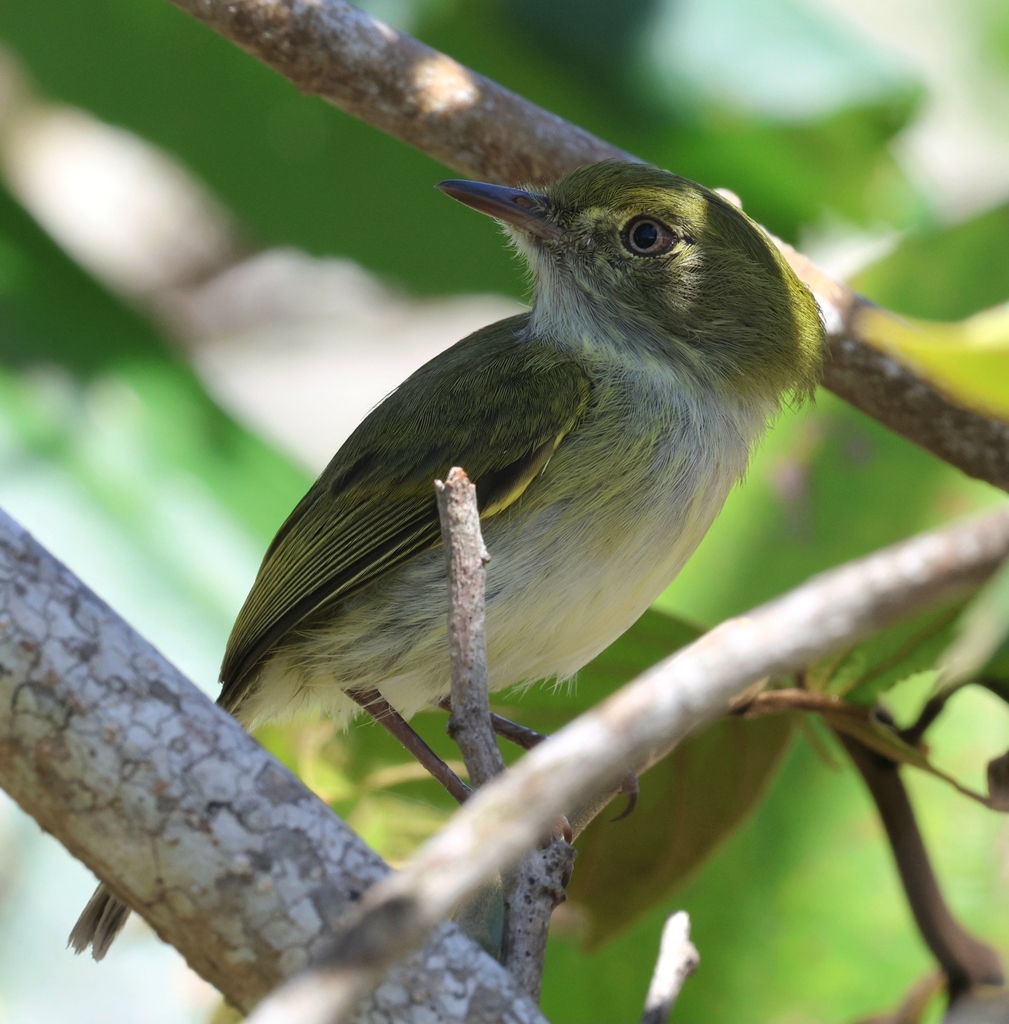
Hangnest Tody-Tyrant
Photo © Miguel
Photo © Miguel — CC BY-SA 4.0 — Source: iNaturalist #315200145Identification
The hangnest tody-tyrant is a tiny flycatcher, measuring just 9.5 to 10 cm in length and weighing less than 8 grams—among the smallest tyrant flycatchers. Both sexes are identical in plumage. This species is characterized by its bright olive-green crown, back, and rump, with yellowish-olive lores and an olive-green face. The wings are olive with yellow edges on the flight feathers and coverts, while the tail remains olive. The underparts are mostly white with faint grayish-olive streaking on the breast and flanks. Notably, all birds possess a creamy white iris, brown bill with a grayish-pink base to the mandible, and pale gray legs and feet. The nominate subspecies (H. n. nidipendulus) is slightly smaller than H. n. paulistus, which also shows a proportionally longer tail.
Range & Habitat
The hangnest tody-tyrant is endemic to Brazil, with a disjunct distribution in the southeastern Atlantic Forest region. The nominate subspecies occupies a small range in Sergipe and northeastern Bahia states, while the more widespread H. n. paulistus ranges from southern Minas Gerais and Espírito Santo south to northeastern Paraná. The species inhabits humid restinga broadleaf and evergreen forests, showing a preference for dense woodlands, secondary forest, and thickets dominated by the fern Pteridium aquilinum. It occurs from sea level to 900 meters elevation.
Behaviour & Diet
The hangnest tody-tyrant is a year-round resident that feeds exclusively on insects. It typically forages singly or occasionally in pairs, notably avoiding mixed-species feeding flocks. Foraging occurs primarily in the forest understory within thickets and tangles, where the bird employs a characteristic hunting technique: short upward sallies from a perch to snatch prey from the underside of leaves. The bird's distinctive song is a very high, fast, rolling call rendered as 'tidr-de-tidr-de-dir' or 'tiréé-téélili téélili téélili'. Breeding occurs at least in October, with birds constructing pear-shaped domed nests from grass, plant fibers, stems, and rootlets lined with hair. These nests are often suspended from twigs approximately 1.5 meters above streams, and clutches consist of two eggs.
Best Time & Places to See It
The hangnest tody-tyrant is considered uncommon to common throughout its range and occurs in several protected areas. Its year-round residency means it can be encountered in any season, though the breeding season (including October) may offer opportunities to observe nesting behavior and increased vocal activity. Searchers should focus on humid Atlantic Forest habitats, particularly dense secondary forests, thickets, and restinga broadleaf evergreen forests within its southeastern Brazilian range. Lower elevations near streams are particularly productive.
Photography Tips
Photographing this diminutive tyrant flycatcher presents challenges inherent to small forest birds. The hangnest tody-tyrant's preference for dense understory thickets and its tendency to forage among leafy tangles demands patience and strategic positioning. Listen for its distinctive high-pitched rolling song to locate individuals. Early morning, when the bird is most vocal and active, offers the best light and activity levels. A telephoto lens (at least 400–600mm) is essential given the species' small size and typical working distances in dense forest. When the bird performs its characteristic upward sallies to snatch prey, these dynamic feeding moments can yield striking action shots. Overcast days in the forest understory require fast film speeds or higher ISO settings to compensate for limited light filtering through the canopy.
Carlos Botelho State Park
Chapada Diamantina National Park
Ibitipoca State Park
Intervales State Park
Itatiaia National Park
Saint-Hilaire/Lange National Park
Serra da Bocaina National Park
Serra do Cipó National Park
Serra do Gandarela National Park
Nothing matches these filters.
No community photos yet. Log in to add the first one.
No community observations of this species yet.