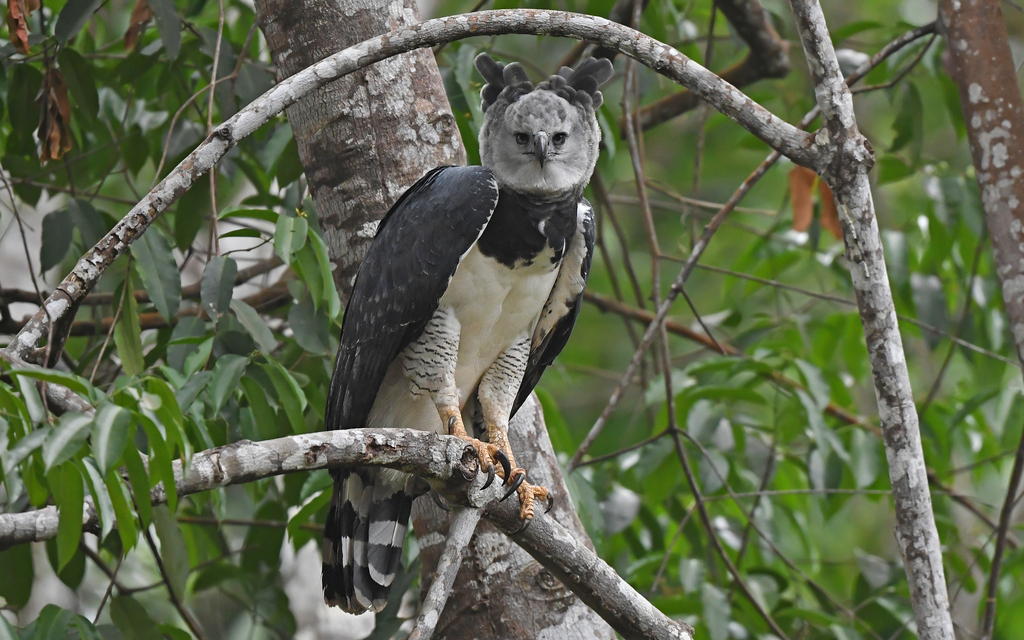
Harpy Eagle
Photo © Christoph Moning
Photo © Christoph Moning — CC BY 4.0 — Source: iNaturalist photo #447085421Identification
The harpy eagle is the largest bird of prey throughout its range and among the largest extant species of eagles in the world. It displays striking plumage: slate-black upperparts contrast sharply with a white underside, separated by a broad black band across the upper breast. The pale grey head is crowned with a distinctive double crest. The tail is black with three grey bands on the upperside and three white bands below. Yellow tarsi and toes, combined with a black bill and cere, complete this powerful raptor's appearance. Females are notably larger than males, typically weighing 6 to 9 kg compared to males' 4 to 6 kg, though females can occasionally reach 10 kg or more. Harpy eagles measure 86.5 to 107 cm in length with an impressive wingspan of 176 to 224 cm. The plumage of males and females is otherwise identical.
Range & Habitat
The harpy eagle ranges from southern Mexico through Central America into South America, extending as far south as Argentina. It is most common in Brazil, where it is found across the entire country. However, the species is nearly extinct in much of Central America due to logging and rainforest destruction, though it can still be seen in parts of Costa Rica and Panama. These eagles are relatively rare and elusive, preferring tropical lowland rainforests where they nest and hunt in the emergent canopy layer. They typically occur below 900 metres elevation but have been recorded at up to 2,000 metres. While they avoid disturbed areas and humans, harpy eagles occasionally visit semi-open forest mosaics, cerrados, and cultivated fields during hunting forays, and have recently been found in areas where high-grade forestry is practiced.
Behaviour & Diet
Harpy eagles hunt primarily within the forest canopy, perching on emergent trees to scout for prey, though they rarely hunt on the ground. As the apex predator of the rainforest, they are superbly adapted for their role, with formidable talons averaging 8.6 cm in males and 12.3 cm in females. Their habitat continues to face threats from climate change and ongoing deforestation across their range.
Best Time & Places to See It
Travellers seeking harpy eagles should focus on remaining intact rainforests, particularly in Brazil where populations remain relatively stable. Costa Rica and Panama offer some of the best opportunities in Central America, though sightings require patience and luck given the species' elusive nature and preference for remote forest interiors. The best viewing strategy involves visiting pristine tropical lowland rainforests and watching emergent canopy trees where these eagles perch to hunt.
Photography Tips
Photographing harpy eagles demands significant dedication and access to undisturbed rainforest habitat. Position yourself near emergent trees where these raptors are known to perch. A powerful telephoto lens is essential given the eagles' height advantage and wariness of humans. Early morning light is ideal for capturing the contrast between their dark upperparts and pale underside. Remember that harpy eagles actively avoid humans, so patience, silence, and respectful distance from known nesting or hunting territories are crucial for successful photography and for protecting these magnificent but vulnerable birds.
Yasuní National Park
Aguarico, Ecuador
+601 birds+43 mammals
Where the western Amazon basin converges with Ecuador's Orellana Province, lowland rainforest reaches toward the horizon in an unbroken canopy of staggering botanical density. Yasuní National…
VIEW NATIONAL PARKNatural Sierra de Chiribiquete National Park
Solano, Colombia
+359 birds+27 mammals
Massive table-top mountains rise abruptly from the lowland rainforest of southeastern Colombia, their sheer sandstone cliffs and isolated summits creating some of the most dramatic topography…
VIEW NATIONAL PARKNatural la Paya National Park
Puerto Leguízamo, Colombia
+262 birds+4 mammals
Where the Amazon's western reaches fold into the Andes foothills, La Paya National Park sprawls across more than 8,500 square kilometers of pristine Amazonian rainforest in…
VIEW NATIONAL PARKNatural Sierra de la Macarena National Park
Vista Hermosa, Colombia
+566 birds+15 mammals
Across nearly 20,000 square kilometres of Colombia's Meta Department, the terrain rises from lowland savanna into Andean foothills through a mosaic of gallery forests, palm-fringed wetlands,…
VIEW NATIONAL PARKAmacayacu National Park
Leticia, Colombia
+567 birds+25 mammals
Where the Rio Amazonas curves through the tri-border region where Colombia, Peru, and Brazil converge, Amacayacu National Park sprawls across more than 5,250 square kilometres of…
VIEW NATIONAL PARKChapada dos Guimarães National Park
Brazil
+450 birds+1 mammals
Where weathered sandstone plateaus rise above the cerrado grasslands of central Brazil, Chapada dos Guimarães National Park protects 624 square kilometres of ecological transition zone that…
VIEW NATIONAL PARKPantanal Matogrossense National Park
Brazil
+322 birds+17 mammals
Where the flooded forests of central Brazil meet vast seasonally inundated grasslands, Pantanal Matogrossense National Park sprawls across nearly 2,900 square kilometers of one of the…
VIEW NATIONAL PARKAmazônia National Park
Brazil
+439 birds+6 mammals
Where the Rio Amazonas and its tributaries weave through the heart of Pará state, a vast tapestry of rainforest stretches across 23,611 square kilometers of unbroken…
VIEW NATIONAL PARKJaú National Park
Brazil
+354 birds+3 mammals
Vast floodplain forests and blackwater rivers define this remote corner of western Amazonas, where the Rio Negro and its tributaries have carved an intricate mosaic of…
VIEW NATIONAL PARKAnavilhanas National Park
Brazil
+468 birds+8 mammals
Across the Rio Negro in central Amazonas, an archipelago of over a thousand islands rises from the world's largest rainforest river system, creating a labyrinth of…
VIEW NATIONAL PARKManu National Park
Manu, Peru
+892 birds+26 mammals
Across the eastern slopes of the Peruvian Andes, tropical rainforest descends into the Amazon basin with a complexity that few terrestrial ecosystems match. Manu National Park…
VIEW NATIONAL PARKBahuaja Sonene National Park
San Pedro de Putina Punco, Peru
+602 birds+8 mammals
Where the Madre de Dios and Heath rivers converge in southeastern Peru rises one of South America's most biodiverse wilderness regions: a vast protected realm of…
VIEW NATIONAL PARKSoberanía National Park
Cristóbal, Panama
+495 birds+34 mammals
Rainforest and riverine woodland blanket the rolling terrain of this 714-square-kilometre national park in Colón Province, where the Caribbean watershed feeds a maze of streams and…
VIEW NATIONAL PARKChagres National Park
Caimitillo, Panama
+486 birds+19 mammals
Where the Chagres River carves through the humid tropics of central Panama, a vast montane and lowland forest sprawls across more than 2,300 square kilometers, anchoring…
VIEW NATIONAL PARKDarién National Park
Tucutí, Panama
+534 birds+13 mammals
Where the spine of Central America crumbles into wetland and rainforest, Darién National Park sprawls across more than 20,000 square kilometres of some of the tropics'…
VIEW NATIONAL PARKPortobelo National Park
Portobelo, Panama
+366 birds+9 mammals
Where the Caribbean's turquoise waters meet the Darién's verdant shore, Portobelo National Park sprawls across 570 square kilometers of coastal forest, mangrove wetland, and coral-fringed islands…
VIEW NATIONAL PARKCalilegua National Park
Municipio de Calilegua, Argentina
+288 birds+8 mammals
Where the eastern Andean slopes plunge into northwestern Argentina's humid subtropics, nearly 2,645 square kilometers of steep terrain and luxuriant forest compose one of South America's…
VIEW NATIONAL PARKNo community photos yet. Log in to add the first one.
No community observations of this species yet.