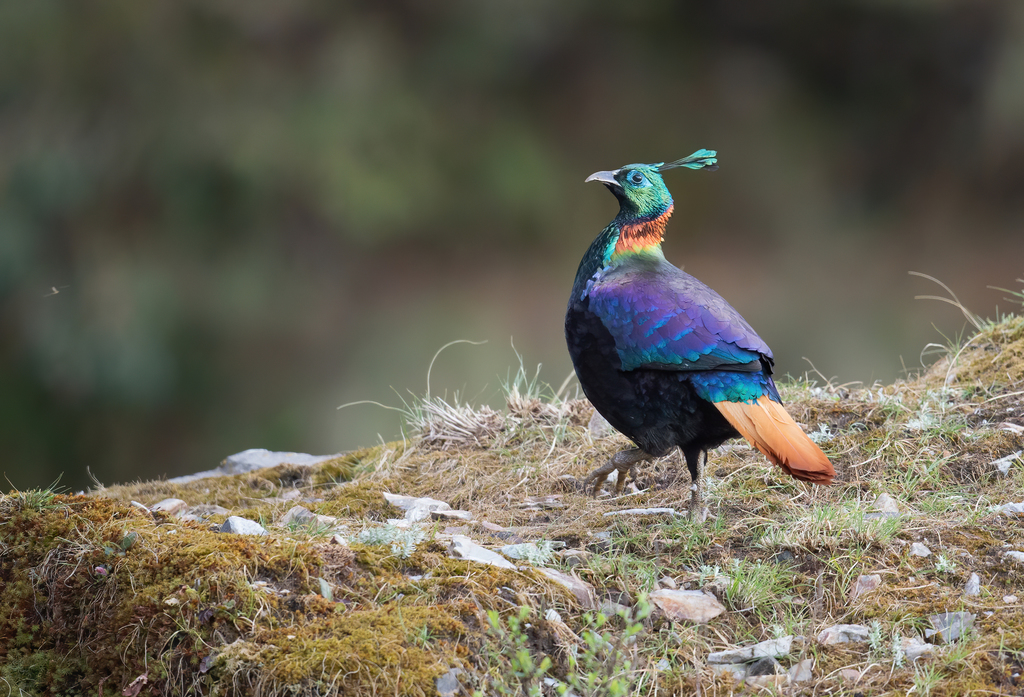
Himalayan Monal
Photo © Morten Ross
Photo © Morten Ross — CC BY 4.0 — Source: iNaturalist photo #110500322Identification
The Himalayan monal is a striking, relatively large landfowl measuring 24–30 inches (61–76 cm) in length and weighing 3–5 pounds (1.4–2.3 kg). The adult male is unmistakable, adorned with multicoloured plumage that makes it one of the Himalayas' most visually spectacular birds. Key field marks include a long, metallic green crest, coppery feathers on the back and neck, uniformly rufous tail feathers that darken toward the tips, and a prominent white rump that is especially conspicuous in flight.
The female is considerably more subdued in coloration, featuring a white patch on the throat, white lower tail coverts barred with black and red, and a white stripe on the tail. First-year males resemble females but are noticeably larger, while juveniles are less distinctly marked overall. These differences make age and sex determination possible with careful observation.
Range & Habitat
Native to the Himalayan region, the Himalayan monal's range extends from Afghanistan and Pakistan eastward through the Himalayas in Nepal, India, southern Tibet, and Bhutan. In Pakistan, it is common in Khyber Pakhtunkhwa province and has been recorded in Kaghan, Palas Valley, and Azad Kashmir. Across India, the species occurs throughout the Indian Himalayan Region from Jammu and Kashmir to Arunachal Pradesh.
This species inhabits upper temperate oak-conifer forests interspersed with open grassy slopes, cliffs, and alpine meadows, typically between 2,400 and 4,500 meters (7,900 and 14,800 feet), with the greatest densities occurring between 2,700 and 3,700 meters (8,900 and 12,100 feet). In winter, birds descend to 2,000 meters (6,600 feet). Remarkably hardy, the Himalayan monal tolerates snow and actively digs through it to access plant roots and invertebrate prey.
Behaviour & Diet
The Himalayan monal feeds primarily on tubers, nuts, tender leaves, and shoots, supplemented by insects and other invertebrates. The species is an active forager, digging in soil and snow to obtain its food. Plant matter comprises the largest portion of its diet, with invertebrates present in lower percentages, though their importance likely varies seasonally.
Best Time & Places to See It
The Himalayan monal is the national bird of Nepal, known locally as the danphe or danfe, and the state bird of Uttarakhand, India. In some areas, population densities reach as high as five pairs per square mile. The species is not considered endangered in Pakistan and can be readily located there. Travellers seeking this species should focus on suitable alpine and subalpine habitats within its range, particularly in protected areas and less disturbed regions of the central and eastern Himalayas.
Photography Tips
The male's spectacular multicoloured plumage and metallic green crest offer excellent photographic subjects, especially when the bird is in flight and the white rump is fully visible. Early morning or late afternoon light will enhance the iridescent qualities of the male's coppery and metallic feathers. Photographers should be prepared for high-altitude conditions and challenging terrain typical of alpine meadows and forest edges. Patience and a long lens are essential for approaching these birds without causing disturbance.
Langtang National Park
Helambu, Nepal
+364 birds+14 mammals
Where the southern slopes of the Himalayan highlands descend toward the subtropical valleys of central Nepal, Langtang National Park sprawls across one of the subcontinent's most…
VIEW NATIONAL PARKGangotri National Park
Bhatwari, India
+119 birds+1 mammals
Where the Bhagirathi River carves through the western Himalayas in northern Uttarakhand, Gangotri National Park rises across steep alpine terrain that defines the boundary between temperate…
VIEW NATIONAL PARKSagarmatha National Park
Khumjung, Nepal
+219 birds+7 mammals
Soaring peaks and deep glacial valleys define this alpine wilderness in northeastern Nepal, where the terrain rises from forested foothills into a realm of high-altitude tundra…
VIEW NATIONAL PARKKhangchendzonga National Park
Sakkyong, India
+290 birds+1 mammals
Where the eastern Himalayas surge toward their crowning peaks, Khangchendzonga National Park embraces a landscape of almost overwhelming vertical drama. Rising from subtropical river valleys into…
VIEW NATIONAL PARKNanda Devi National Park
Garpak, India
+218 birds+5 mammals
Where the Himalayas surge into their most dramatic alpine amphitheater, a wilderness of raw geological power unfolds across 624 square kilometers of pristine terrain. Nanda Devi,…
VIEW NATIONAL PARKValley of Flowers National Park
Ghangaria, India
+117 birds+1 mammals
Where alpine meadows explode with color each monsoon season, the Himalayan slopes of Uttarakhand rise to create one of Earth's most extraordinary floral displays. Perched between…
VIEW NATIONAL PARKNo community photos yet. Log in to add the first one.
No community observations of this species yet.