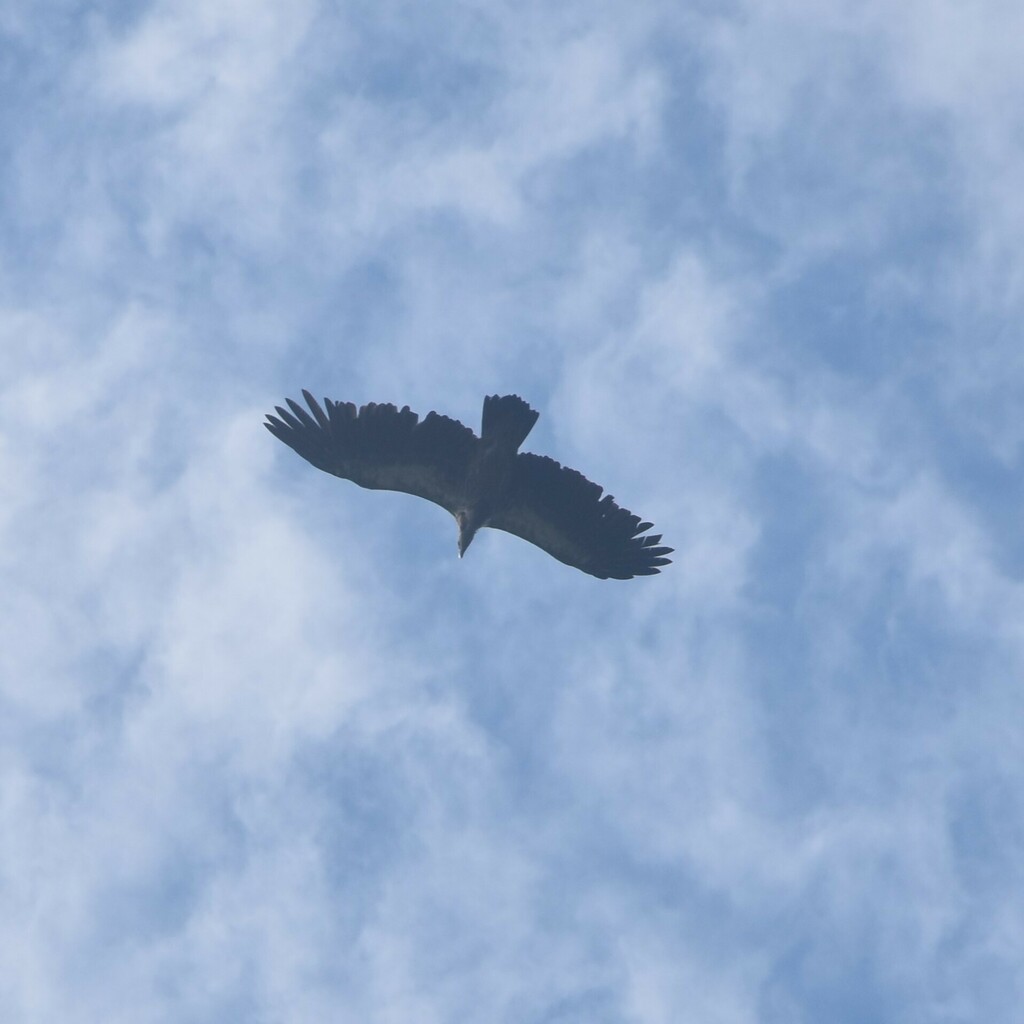
Himalayan Vulture
Photo © Name
Photo © Name — CC BY 4.0 — Source: iNaturalist #125004134Identification
The Himalayan vulture is the largest of the Gyps species and among the world's largest true raptors, second only to the cinereous vulture. Adults display distinctive plumage: dark brown wing and tail feathers contrasting sharply with pale buff uppersides and almost-white underparts. The head features a long, pale brown ruff with white streaks and yellowish coloring in adults, while immatures show whitish down that yellows with age. The pale blue facial skin and yellowish bill distinguish it from the similar Eurasian griffon vulture, which has darker blue facial skin. In flight, the long splayed wing fingers and pale patagial stripe on the underwing are diagnostic features.
Weights range from 6 to 12.5 kilograms, with an average around 9 kilograms. Wingspan measurements vary from 2.56 to 3.1 meters depending on measurement method. The bird's large, robust bill and pale shaft streaks on body feathers are additional identifying characteristics that help separate it from the similarly colored Indian vulture.
Range & Habitat
The Himalayan vulture inhabits the higher regions of the Himalayas and Tibetan Plateau, typically at elevations between 1,200 and 5,500 meters. Its range extends across Kazakhstan, Uzbekistan, Kyrgyzstan, Tajikistan, Afghanistan, Iran, Pakistan, India, Nepal, Bhutan, western China, and Mongolia. Juvenile birds may disperse further south, with vagrant records from Thailand, Burma, Singapore, and Cambodia.
Behaviour & Diet
Himalayan vultures are highly social birds found in large flocks, perching on cliff crags marked white from regular defecation. They soar in thermals and are incapable of sustained flapping flight. These birds make rattling sounds when descending on carcasses and produce grunts, hisses, and cackling calls while feeding or at roosts. They often follow grazing animals up mountains in search of carrion and bask in the sun on rocks. A large party can strip a carcass of all tissue in approximately 30 minutes, or a yak carcass in roughly 120 minutes.
The vulture feeds exclusively on carrion, including putrid flesh, with 64% of their diet on the Tibetan Plateau consisting of deceased domestic yak. Unlike other vulture species, Himalayan vultures typically disdain offal and prefer only fleshy tissue. Historically, they regularly fed on human corpses at Celestial burial grounds. They are fairly defensive around other scavengers and typically dominate meat-eaters at carcasses, though they are subservient to gray wolves, snow leopards, and cinereous vultures. An unexplained behavior involves feeding on pine needles, possibly for digestive or immunity benefits.
Best Time & Places to See It
Breeding season begins in January, making this period a good time to observe nesting behavior. The birds are most reliably found in the high Himalayan regions and Tibetan Plateau, particularly near cliff faces where they nest in colonies of five to seven pairs. Look for them soaring over mountainous terrain above 1,200 meters elevation, especially in areas with accessible carrion or near grazing herds moving through mountain passes.
Photography Tips
The dramatic contrast between dark flight feathers and pale body plumage makes the Himalayan vulture visually striking in photographs. Capture them in flight from below to showcase the pale patagial stripe and splayed wing fingers against the sky. Early morning basking behavior on rocks provides excellent opportunities for portrait photography showing the pale blue facial skin and yellowish bill. The bird's massive wingspan—up to 3.1 meters—is best demonstrated through wide-angle shots of birds soaring in thermals. Photograph them at cliff nesting sites during breeding season, but maintain respectful distance to avoid disturbance from vehicular traffic or human interference.
Langtang National Park
Helambu, Nepal
+364 birds+14 mammals
Where the southern slopes of the Himalayan highlands descend toward the subtropical valleys of central Nepal, Langtang National Park sprawls across one of the subcontinent's most…
VIEW NATIONAL PARKOrang National Park
Rangagarapathar, India
+298 birds+1 mammals
Where the Brahmaputra's floodplains meet the foothills of Assam, Orang National Park unfolds across a mosaic of riverine grasslands, forests and wetlands that pulse with the…
VIEW NATIONAL PARKGangotri National Park
Bhatwari, India
+119 birds+1 mammals
Where the Bhagirathi River carves through the western Himalayas in northern Uttarakhand, Gangotri National Park rises across steep alpine terrain that defines the boundary between temperate…
VIEW NATIONAL PARKRanthambhore National Park
Sawai Madhopur, India
+294 birds+20 mammals
Granite ridges and ravines carved through the Aravalli Range frame this protected landscape in eastern Rajasthan, where deciduous forest mingles with open scrubland and seasonal water…
VIEW NATIONAL PARKSagarmatha National Park
Khumjung, Nepal
+219 birds+7 mammals
Soaring peaks and deep glacial valleys define this alpine wilderness in northeastern Nepal, where the terrain rises from forested foothills into a realm of high-altitude tundra…
VIEW NATIONAL PARKKhangchendzonga National Park
Sakkyong, India
+290 birds+1 mammals
Where the eastern Himalayas surge toward their crowning peaks, Khangchendzonga National Park embraces a landscape of almost overwhelming vertical drama. Rising from subtropical river valleys into…
VIEW NATIONAL PARKKhao Yai National Park
Prachantakham District, Thailand
+377 birds+46 mammals
Evergreen dipterocarp forest blankets the rolling terrain of this national park in eastern Thailand, where limestone hills rise abruptly from the forest floor and seasonal streams…
VIEW NATIONAL PARKGiant Panda National Park
Mianyang, China
+447 birds+47 mammals
Where the eastern slopes of China's Sichuan plateau descend into cloud-wrapped valleys, one of Asia's most biodiverse landscapes unfolds across more than 350,000 square kilometres. This…
VIEW NATIONAL PARKJiuzhai Valley
Jiuzhaigou County, China
+226 birds+7 mammals
Where crystalline alpine streams cascade through limestone gorges and karst terrain rises in dramatic vertical walls, Jiuzhai Valley unfolds across nearly 1,300 square kilometers of southwestern…
VIEW NATURAL MONUMENTHuanglong Scenic and Historic Interest Area
Ngawa Tibetan and Qiang Autonomous Prefecture, China
+194 birds+7 mammals
Across the high plateau of northwestern Sichuan, a geological wonder unfolds where limestone terraces and mineral-rich springs have sculpted one of China's most distinctive natural monuments.…
VIEW NATURAL MONUMENTKanha Tiger Reserve
Kanha Kisli F.V., India
+321 birds+23 mammals
Where sal forests give way to emerald meadows and crystalline streams carve through ancient valleys, one of India's finest wilderness reserves unfolds across the Maikal Range.…
VIEW NATIONAL PARKBandhavgarh National Park
Garhpuri, India
+285 birds+17 mammals
Where granite ridges rise dramatically above sal and bamboo forests, one of India's most pristine tiger reserves unfolds across the Vindhyan plateau. Ancient rock formations tower…
VIEW NATIONAL PARKPanna National Park
Badgadi Kalan, India
+271 birds+17 mammals
Where granite gorges slice through central India's Vindhyan plateau, a landscape of stark beauty unfolds across nearly six hundred square kilometers. The Ken River carves through…
VIEW NATIONAL PARKKaziranga National Park
Kohora, India
+422 birds+26 mammals
Dawn breaks over the floodplains of the Brahmaputra, where tall grasslands stretch endlessly beneath monsoon-heavy skies. This sprawling wilderness of northeastern Assam is a mosaic of…
VIEW NATIONAL PARKNanda Devi National Park
Garpak, India
+218 birds+5 mammals
Where the Himalayas surge into their most dramatic alpine amphitheater, a wilderness of raw geological power unfolds across 624 square kilometers of pristine terrain. Nanda Devi,…
VIEW NATIONAL PARKValley of Flowers National Park
Ghangaria, India
+117 birds+1 mammals
Where alpine meadows explode with color each monsoon season, the Himalayan slopes of Uttarakhand rise to create one of Earth's most extraordinary floral displays. Perched between…
VIEW NATIONAL PARKHemis National Park
Raigahar Dhar, India
+131 birds+13 mammals
Where granite gorges cleave through the Himalayas at dizzying altitudes, a vast wilderness of alpine desert unfolds across the rain shadow of Ladakh. Hemis sprawls across…
VIEW NATIONAL PARKKeoladeo National Park
Shreenagar Rural, India
+326 birds+14 mammals
Where shallow wetlands shimmer beneath vast Rajasthani skies, one of Asia's finest bird sanctuaries pulses with extraordinary life. This former maharaja's hunting reserve, now spanning 29…
VIEW NATIONAL PARKKhangai Nuruu National Park
Erdenetsogt, Mongolia
+136 birds+7 mammals
Where granite ridges pierce Mongolia's central steppe, alpine meadows give way to dense coniferous forests that climb toward windswept summits. Khangai Nuruu sweeps across 1.2 million…
VIEW NATIONAL PARKAltai Tavan Bogd National Park
Tsengel, Mongolia
+146 birds+3 mammals
Where the Altai Mountains rise in jagged defiance along Mongolia's western frontier, the terrain transforms into a realm of alpine tundra, rocky plateaus, and glacier-carved valleys…
VIEW NATIONAL PARKHustai National Park
Altanbulag, Mongolia
+198 birds+16 mammals
Where the steppe rolls endlessly beneath vast Mongolian skies, Hustai National Park preserves one of Central Asia's most dynamic grassland ecosystems. Rolling hills and open prairie…
VIEW NATIONAL PARKGobi Gurvan Saikhan National Park
Tsagaan Subarga Hural, Mongolia
+183 birds+23 mammals
Where rust-coloured badlands rise from the southern Gobi steppe, the terrain transforms into a landscape of geological drama that few visitors expect to find in Mongolia's…
VIEW NATIONAL PARKSanjiangyuan National Park
Nagqu, China
+187 birds+25 mammals
Where the headwaters of three great Asian rivers emerge from a high alpine plateau, the landscape unfolds in tundra and dwarf shrubland—a world of austere beauty…
VIEW NATIONAL PARKWolong National Nature Reserve
Wenchuan County, China
+333 birds+17 mammals
Where the Qingyi River cuts through the eastern flanks of the Minshan Range, a temperate montane forest cloaks steep valleys in dense canopy that thins dramatically…
VIEW NATURE RESERVEQiangtang National Nature Reserve
Ngari Prefecture, China
+34 birds+5 mammals
Across the high Tibetan plateau north of Nagqu sprawls one of Earth's most extreme alpine tundra ecosystems, where vast expanses of sparse grassland and barren terrain…
VIEW NATURE RESERVEAltun Mountain National Nature Reserve
Jiuquan, China
+32 birds
Where the Altun Mountains rise across the high desert basin of northwestern China, one encounters a landscape shaped by extremes—cold, aridity, and relentless altitude. Spanning over…
VIEW NATURE RESERVEQinghai Lake National Nature Reserve
Hainan Tibetan Autonomous Prefecture, China
+243 birds+11 mammals
At 3,200 metres above sea level on the Tibetan plateau, where winter temperatures plunge far below freezing and snow blankets the landscape for half the year,…
VIEW NATURE RESERVEGaoligong Mountain National Nature Reserve
Nujiang Lisu Autonomous Prefecture, China
+443 birds+13 mammals
VIEW NATURE RESERVEBaima Snow Mountain National Nature Reserve
Diqing Tibetan Autonomous Prefecture, China
+204 birds+3 mammals
High-altitude ridges and steep-sided valleys define this reserve in northwestern Yunnan, where elevations surge from around 3,000 metres to peaks above 4,100 metres. The terrain supports…
VIEW NATURE RESERVENo community photos yet. Log in to add the first one.
No community observations of this species yet.