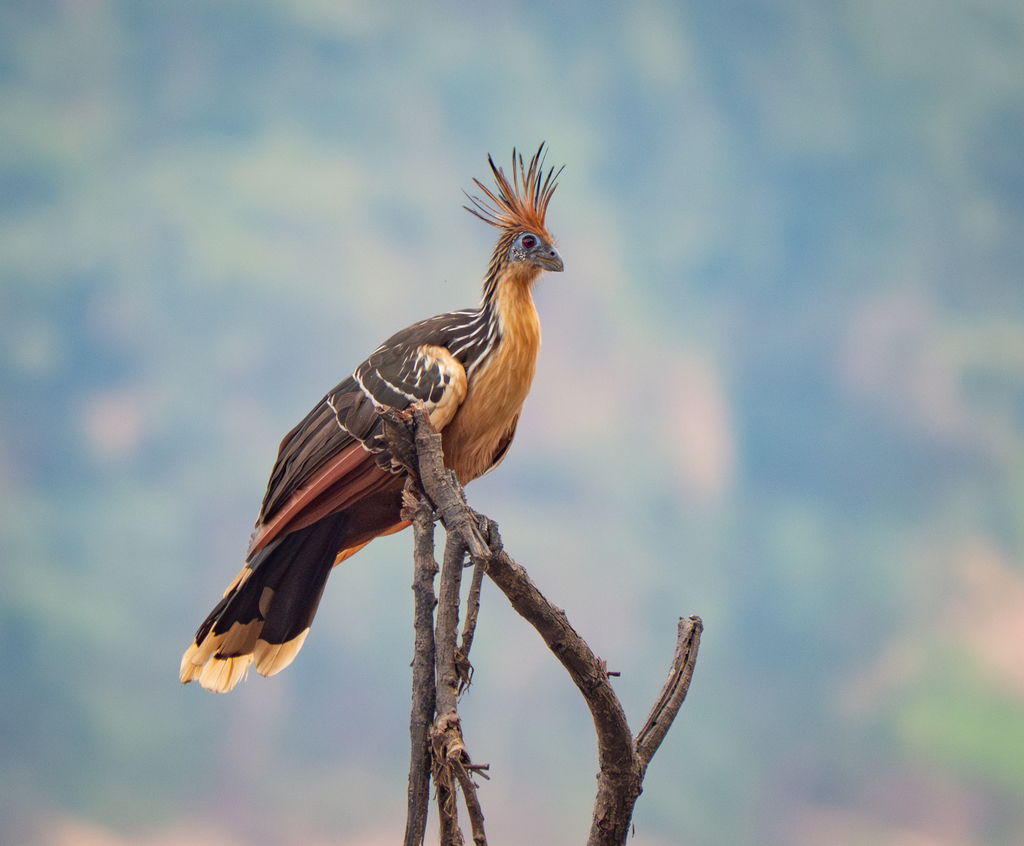
Hoatzin
Photo © Philipp Hoenle
Photo © Philipp Hoenle — CC0 1.0 — Source: iNaturalist #191380473Identification
The hoatzin is a pheasant-sized bird approximately 65 cm in length, with a distinctive long neck and small head. Its most striking features include an unfeathered blue face with maroon eyes, topped by a spiky rufous crest. The long tail is sooty brown with bronze-green tips and a broad whitish or buff band at the end. The upper parts are dark sooty brown with buff-edged wing coverts and streaked buff on the mantle and nape. The underparts are buff, while the crissum, primaries, underwing coverts, and flanks display rich rufous-chestnut coloring, particularly visible when the bird spreads its wings.
The hoatzin is highly vocal, making a variety of hoarse calls including groans, croaks, hisses, and grunts, often accompanied by distinctive body movements such as wing spreading. These vocal displays and the bird's unusual appearance make it unmistakable in the field.
Range & Habitat
The hoatzin is found exclusively in South America, inhabiting the swamps, riparian forests, and mangroves of the Amazon and Orinoco Basins. It is the national bird of Guyana, where it is known locally as the Canje pheasant. The species' preference for wetland habitats and dense waterside vegetation makes it a characteristic bird of lowland Amazonian and Orinoquian wetlands.
Behaviour & Diet
The hoatzin possesses a unique digestive system among birds, featuring fermentation capabilities that enable effective breakdown of plant matter—a trait otherwise typical of herbivorous ungulate-ruminants and some primates. This specialized physiology reflects its herbivorous diet adapted to wetland plant communities.
One of the hoatzin's most remarkable adaptations is found in its chicks, which uniquely possess two functional claws on each wing. Newly hatched chicks use these claws and their oversized feet to scramble along tree branches and navigate dense vines without falling into the water. When threatened by predators such as the great black hawk, chicks can drop into the water and swim beneath the surface to escape, later using their clawed wings to climb back to the nest. Adult birds respond to nest predation by flying noisily around the colony in an attempt to distract the predator's attention.
Best Time & Places to See It
The hoatzin is found year-round throughout the Amazon and Orinoco Basins in South America. Look for them in wetland habitats including swamps, riparian forests, and mangrove areas. Their loud calls and conspicuous behavior make them relatively easy to locate once you know where to search. Boat-based wildlife tours through Amazonian wetlands offer excellent opportunities for encounters.
Photography Tips
The hoatzin's distinctive coloring and unusual appearance make it a rewarding photographic subject. The unfeathered blue face with maroon eyes and spiky crest provide striking detail at close range. Capture the rufous-chestnut underwing coloring by photographing birds with wings spread, which they display frequently during their vocal and behavioral displays. Early morning hours when these birds are most vocal offer the best light and activity levels. Boat-based approaches in their wetland habitats allow for relatively close and unobstructed views.
Yasuní National Park
Aguarico, Ecuador
+601 birds+43 mammals
Where the western Amazon basin converges with Ecuador's Orellana Province, lowland rainforest reaches toward the horizon in an unbroken canopy of staggering botanical density. Yasuní National…
VIEW NATIONAL PARKNatural Sierra de Chiribiquete National Park
Solano, Colombia
+359 birds+27 mammals
Massive table-top mountains rise abruptly from the lowland rainforest of southeastern Colombia, their sheer sandstone cliffs and isolated summits creating some of the most dramatic topography…
VIEW NATIONAL PARKNatural la Paya National Park
Puerto Leguízamo, Colombia
+262 birds+4 mammals
Where the Amazon's western reaches fold into the Andes foothills, La Paya National Park sprawls across more than 8,500 square kilometers of pristine Amazonian rainforest in…
VIEW NATIONAL PARKNatural Sumapaz National Park
Cubarral, Colombia
+368 birds+1 mammals
Where the Andes descend toward the Amazon basin, the high páramo grasslands of Sumapaz National Park sprawl across more than five thousand square kilometers of Meta…
VIEW NATIONAL PARKNatural Sierra de la Macarena National Park
Vista Hermosa, Colombia
+566 birds+15 mammals
Across nearly 20,000 square kilometres of Colombia's Meta Department, the terrain rises from lowland savanna into Andean foothills through a mosaic of gallery forests, palm-fringed wetlands,…
VIEW NATIONAL PARKAmacayacu National Park
Leticia, Colombia
+567 birds+25 mammals
Where the Rio Amazonas curves through the tri-border region where Colombia, Peru, and Brazil converge, Amacayacu National Park sprawls across more than 5,250 square kilometres of…
VIEW NATIONAL PARKViruá National Park
Brazil
+389 birds+6 mammals
Across the northern frontier of Roraima, where the forest canopy rises from ancient Amazonian lowlands, Viruá National Park protects nearly 3,700 square kilometres of terra firme…
VIEW NATIONAL PARKAmazônia National Park
Brazil
+439 birds+6 mammals
Where the Rio Amazonas and its tributaries weave through the heart of Pará state, a vast tapestry of rainforest stretches across 23,611 square kilometers of unbroken…
VIEW NATIONAL PARKJaú National Park
Brazil
+354 birds+3 mammals
Vast floodplain forests and blackwater rivers define this remote corner of western Amazonas, where the Rio Negro and its tributaries have carved an intricate mosaic of…
VIEW NATIONAL PARKAnavilhanas National Park
Brazil
+468 birds+8 mammals
Across the Rio Negro in central Amazonas, an archipelago of over a thousand islands rises from the world's largest rainforest river system, creating a labyrinth of…
VIEW NATIONAL PARKCampos Amazónicos National Park
Amazonas, Brazil
+434 birds+7 mammals
Sprawling across the southwestern Amazon basin in Amazonas state, this 27,263-square-kilometre national park encompasses some of the region's most pristine lowland rainforest, where terra firme forest…
VIEW NATIONAL PARKSerra do Divisor National Park
Brazil
+448 birds+10 mammals
Where the western Amazon meets the Andes foothills, Serra do Divisor National Park sprawls across one of South America's most biodiverse and least accessible frontiers. Spanning…
VIEW NATIONAL PARKOtishi National Park
Río Tambo, Peru
+108 birds
Where the Andes descend toward the Amazon basin, vast cloud forests cloak the ridges and valleys of Peru's Río Tambo watershed, and this is where Otishi…
VIEW NATIONAL PARKYanachaga–chemillén National Park
Palcazu, Peru
+639 birds+6 mammals
Where the eastern slopes of Peru's central cordillera plunge into cloud forest, Yanachaga–Chemillén National Park protects nearly three thousand square kilometres of montane wilderness that few…
VIEW NATIONAL PARKManu National Park
Manu, Peru
+892 birds+26 mammals
Across the eastern slopes of the Peruvian Andes, tropical rainforest descends into the Amazon basin with a complexity that few terrestrial ecosystems match. Manu National Park…
VIEW NATIONAL PARKSierra del Divisor National Park
Alto Tapiche, Peru
+298 birds+2 mammals
Where the western Amazon meets the Andes foothills, nearly 41,000 square kilometres of pristine rainforest rise across Peru's Alto Tapiche region in a landscape of extraordinary…
VIEW NATIONAL PARKBahuaja Sonene National Park
San Pedro de Putina Punco, Peru
+602 birds+8 mammals
Where the Madre de Dios and Heath rivers converge in southeastern Peru rises one of South America's most biodiverse wilderness regions: a vast protected realm of…
VIEW NATIONAL PARKIchigkat Muja – Cordillera del Cóndor National Park
Río Santiago, Peru
+101 birds
Where the Andes descend into the western Amazon, the Río Santiago carves through a landscape of profound biological complexity. Ichigkat Muja – Cordillera del Cóndor National…
VIEW NATIONAL PARKTingo Maria National Park
Mariano Dámaso Beraún, Peru
+423 birds
Where the eastern slopes of the Peruvian Andes descend toward the Amazon basin, the landscape fractures into a maze of limestone ridges, humid gorges, and cloud-wrapped…
VIEW NATIONAL PARKNo community photos yet. Log in to add the first one.
No community observations of this species yet.