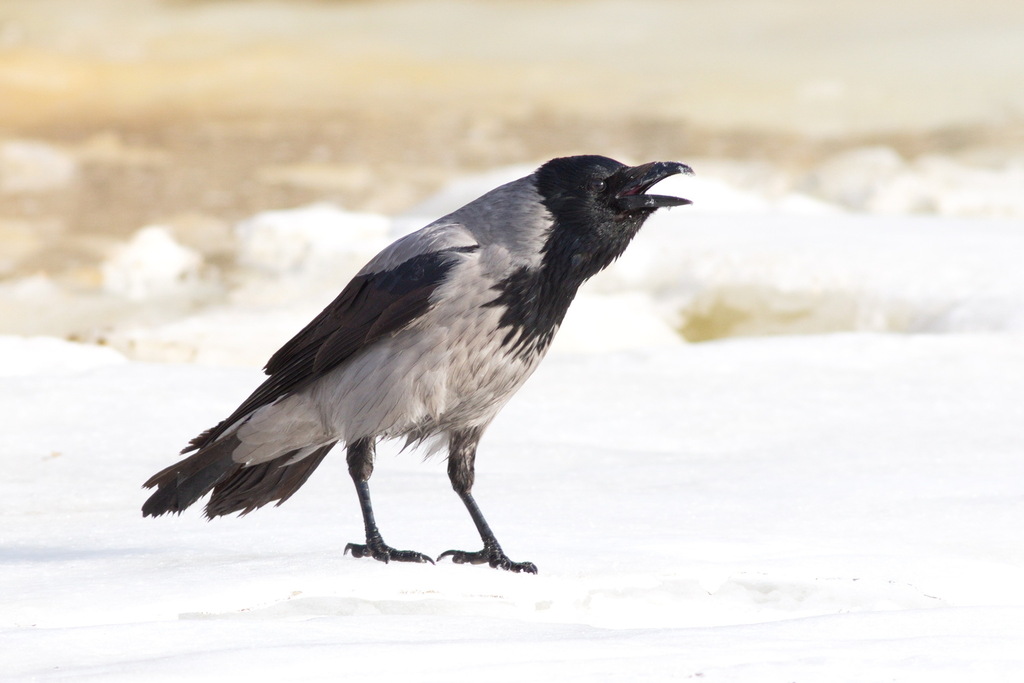
Hooded Crow
Photo © Вячеслав Юсупов
Photo © Вячеслав Юсупов — CC BY 4.0 — Source: iNaturalist photo #262778991Identification
The hooded crow is a striking and unmistakable bird, instantly recognizable by its distinctive two-tone plumage. Its head, throat, wings, tail, and thigh feathers are glossy black, while the rest of its body is ash-grey with dark shafts that give it a streaky appearance. The bird has a black bill, legs, and dark brown eyes. Measuring 48 to 52 centimetres in length, males tend to be noticeably larger than females, though otherwise the sexes appear similar. In flight, hooded crows display a slow, heavy, and typically straight trajectory. Juveniles appear much blacker overall than adults, with duller plumage and bluish or greyish eyes, gradually acquiring their distinctive grey-and-black adult colouration.
Range & Habitat
The hooded crow is widely distributed across Northern, Eastern, and Southeastern Europe, as well as parts of the Middle East. Different subspecies occupy distinct ranges: the nominate subspecies occurs in Ireland, Scotland, and northern, eastern, and southeastern Europe south to Corsica; the paler C. c. sharpii is found from western Siberia through to the Caucasus region and Iran; C. c. pallescens, the smallest subspecies, inhabits southern Turkey through the Levant to Egypt; and C. c. capellanus, with its notably pale plumage, occurs in Iraq and southwestern Iran. The species shares a fascinating evolutionary history with the all-black carrion crow, with the two species' distributions believed to result from climate cycles during the Pleistocene ice ages.
Behaviour & Diet
Like other corvids, hooded crows are omnivorous and opportunistic foragers, demonstrating the intelligence and adaptability characteristic of their family. They will exploit a wide variety of food sources and environmental conditions, making them successful survivors across diverse habitats throughout their range. This opportunistic feeding strategy has allowed them to thrive in both rural and urban environments, where they scavenge and forage with equal efficiency.
Best Time & Places to See It
Hooded crows are most easily observed throughout their core range in Eastern and Northern Europe, particularly in countries such as Ireland, Scotland, and across Scandinavia. In some locations, such as eastern England, they appear as scarce winter visitors arriving from Scandinavia. Rural and urban areas alike support healthy populations, making the species relatively accessible to birdwatchers throughout much of the year in suitable regions.
Photography Tips
The hooded crow's striking contrast between grey and black plumage makes it a rewarding subject for photographers. The bird's slow, heavy flight provides opportunities for tracking shots, while its opportunistic foraging behaviour often brings it to predictable locations on the ground. The glossy black feathers of the head, wings, and tail photograph particularly well in good light, creating strong visual impact. Patient observers in parks, fields, and urban areas throughout the species' range should find ample opportunities to capture this distinctive corvid.
Aggtelek National Park
Alta Murgia National Park
Appennino Lucano Val d’Agri Lagonegrese National Park
Appennino Tosco-Emiliano National Park
Asinara National Park
Åsnens National Park
Aspromonte National Park
Baronnies Provençales Regional Nature Park
Beinn Eighe National Nature Reserve
Nothing matches these filters.
No community photos yet. Log in to add the first one.
No community observations of this species yet.