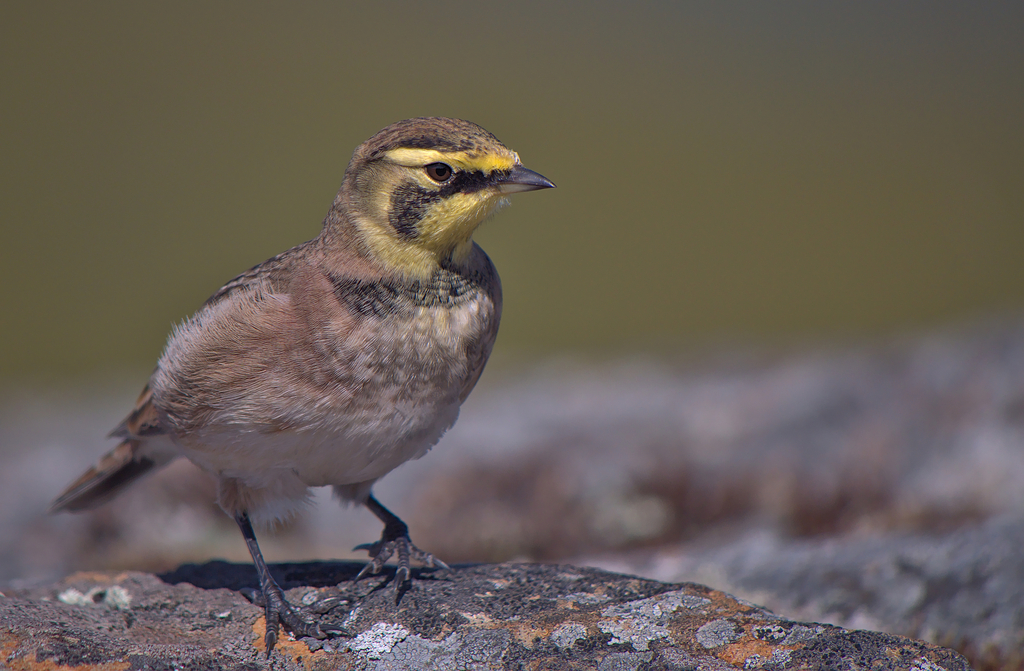
Horned Lark
Photo © Blake Ross
Photo © Blake Ross — CC BY 4.0 — Source: iNaturalist photo #248099403Identification
The Horned Lark is a distinctive small lark with brown-grey upperparts and pale underparts, marked by a striking black and yellow face pattern. The tail is mostly black except for the central feathers, creating a noticeable contrast with the paler body, particularly visible in flight. Summer males display distinctive black "horns"—two tufts of feathers on the head—which give the species its North American name. The southern European mountain race (E. a. penicillata) is greyer above, with white replacing the yellow in the face pattern. This species measures 16-20 cm in length with a wingspan of 30-34 cm and weighs 28-48 grams. Vocalizations are high-pitched, lisping, and weak; the flight song consists of chips followed by a warbling, ascending trill.
Range & Habitat
The Horned Lark breeds across much of the northern hemisphere, including North America from the high Arctic south to the Isthmus of Tehuantepec, northernmost Europe and Asia, and the mountains of southeast Europe, with an isolated population on a Colombian plateau. Northern populations are migratory, moving south in winter, while southern populations are largely resident. In Eurasia, the species breeds above the tree line in mountains and the far north. In most of Europe, it is most commonly seen on seashore flats in winter—hence its European name "Shore Lark." In the UK, it occurs as a winter stopover along coasts and eastern England. In North America, where it faces no competing lark species, it inhabits farmland, prairies, deserts, golf courses, and airports.
Behaviour & Diet
Males defend territories from other males during breeding season, while females occasionally chase away intruding females. Courtship involves the male singing while flying in circles above the female, then folding his wings and diving toward her, opening his wings just before landing. The female selects the nest site in early spring, either finding a natural depression or excavating a cavity with her bill and feet over 2-4 days. She constructs the nest from fine grasses, cornstalks, small roots, and plant material, lining it with down, fur, feathers, and occasionally lint. Notably, she often adds a "doorstep" of pebbles, corncobs, or dung to one side, possibly to conceal the excavated soil. Females lay 2-5 gray, brown-spotted eggs measuring approximately 1 cm by 0.5 cm; incubation lasts 10-12 days and nestling period 8-10 days. Both parents feed and defend chicks during the nestling period. Southern females may raise 2-3 broods annually, while northern birds typically raise only 1 brood per year.
Best Time & Places to See It
In Europe, winter is the prime season for observing Horned Larks on coastal flats and seashores, particularly in the UK along the coast and eastern England. In North America, the species is visible year-round across its breeding range; breeding season (spring and summer) offers opportunities to observe territorial males and their distinctive courtship displays in open habitats including grasslands, mountains, and high-altitude areas. Migration periods present chances to encounter the species in less typical habitats.
Photography Tips
Photograph breeding males in spring and summer to capture the distinctive black "horns" on the head and the striking black-and-yellow face pattern. Capture birds in flight to showcase the contrast between the black tail and paler body. The species' preference for open ground provides clear sight lines and minimal obstruction for photography. Use fast shutter speeds when photographing the high-altitude courtship flight displays, particularly the dramatic diving behavior. Winter coastal visits in Europe offer opportunities to photograph the species in seashore settings, where open flats provide excellent lighting conditions.
Tombstone Territorial Park
Acadia National Park
Alaska Maritime National Wildlife Refuge
Algonquin Provincial Park
Alligator River National Wildlife Refuge
Altai Tavan Bogd National Park
Altun Mountain National Nature Reserve
Arches National Park
Arctic National Wildlife Refuge
Nothing matches these filters.
No community photos yet. Log in to add the first one.
No community observations of this species yet.