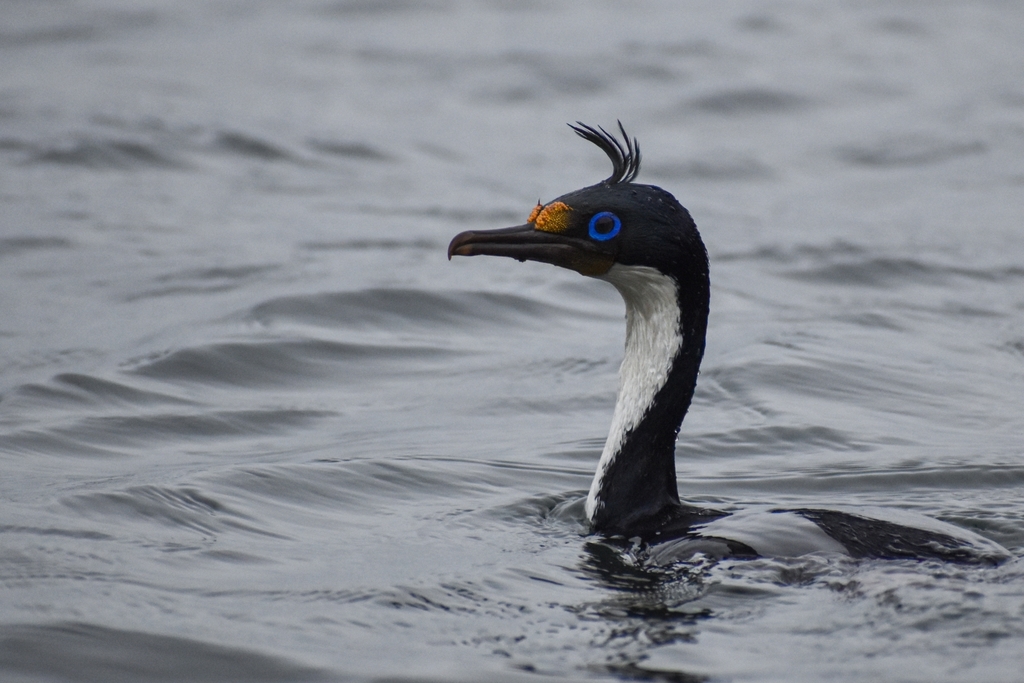
Imperial Shag
Photo © Ezequiel Racker
Photo © Ezequiel Racker — CC BY 4.0 — Source: iNaturalist photo #168559558Identification
The imperial shag is a striking black-and-white cormorant measuring 70–79 cm in length and weighing 1.8–3.5 kg, with males typically larger than females. Its most distinctive features are its glossy black plumage covering the back and wings, contrasting sharply with a white belly and neck. The species is unmistakable thanks to its vivid blue eye-ring, orange-yellow nasal knob, and pinkish legs and feet. During breeding season, adults display an impressive erectile black crest that is absent in non-breeding plumage. The bill is notably serrated, an adaptation for gripping slippery prey. Subspecific variation exists primarily in cheek and ear-covert coloration: most taxa display white cheeks, while others show entirely black cheeks. Chicks appear uniformly brownish, while immatures are brownish and white with duller facial features and lack the vibrant eye-ring and nasal knob of adults.
Range & Habitat
The imperial shag is native to southern South America, subantarctic islands, and the Antarctic Peninsula. Its range extends from south-central Chile and Argentina southward to Cape Horn, with eight recognized subspecies distributed across the Falkland Islands, South Georgia, the South Sandwich Islands, South Orkney Islands, the Crozet Islands, Prince Edward and Marion Islands, the Antarctic Peninsula and South Shetland Islands, Kerguelen Islands, Heard Island, and Macquarie Island. The species primarily inhabits rocky coastal regions, though it also occurs locally at large inland lakes. Recent molecular studies suggest that despite the wide geographic separation of breeding colonies and the species' sedentary behaviour, genetic evidence points to a circumpolar dispersal from South America following the Last Glacial Maximum.
Behaviour & Diet
The imperial shag is colonial and monogamous, with breeding colonies ranging from small groups to hundreds of pairs. These colonies are often shared with other seabirds including rock shags, southern rockhopper penguins, and black-browed albatrosses. Nests are constructed from seaweed and grass cemented together with mud and excrement, typically containing two to five eggs that hatch after about five weeks. Both parents brood the eggs and chicks, though predation by skuas and sheathbills causes significant losses.
The diet consists primarily of small benthic fish—especially Argentine anchoita—supplemented with crustaceans, polychaetes, gastropods, and octopuses. These skilled divers typically descend to almost 25 m, with recorded dives reaching depths of 60 m to forage on the sea floor. Most feeding occurs in inshore regions, though some populations travel considerable distances from shore.
Best Time & Places to See It
The imperial shag is most readily observed during the breeding season when birds are concentrated in their colonies. The species is not considered threatened and is relatively common throughout its range, with most subspecies numbering over 10,000 pairs. Dedicated travellers to subantarctic and Antarctic regions—particularly the Falkland Islands, South Georgia, the Antarctic Peninsula, and Kerguelen Islands—have excellent opportunities to encounter this species in its natural habitat.
Photography Tips
The imperial shag's bold plumage and distinctive facial features make it a rewarding photographic subject. The striking contrast between glossy black and white plumage is best captured in clear, bright light. During breeding season, focus on capturing the erected crest and vivid blue eye-ring, which are diagnostic features. Patience in colonial settings will yield opportunities to photograph courting pairs, nest-building behaviour, and brooding adults. The bird's aquatic lifestyle offers action photography possibilities, particularly when diving or returning to shore with catch. The white facial patches and orbital ring provide natural focal points that help draw the viewer's eye in composition.
Sea Lion Island
Sealion Island Settlement, Falkland Islands
+74 birds+3 mammals
Windswept tussock grasslands roll across volcanic terrain where Southern Ocean swells crash against rocky shores, creating one of the Falkland Islands' most dramatic wildlife theatres. This…
VIEW ISLAND & ARCHIPELAGOKidney Island
Stanley, Falkland Islands
+47 birds
Wind-scoured tussock grassland sweeps across this remote South Atlantic outcrop, where peaty soils and exposed rock formations create a landscape as austere as it is vital.…
VIEW ISLAND & ARCHIPELAGOPort Stephens
Port Stephens, Falkland Islands
+29 birds
Windswept moorlands sweep down to pristine beaches where kelp forests fringe the turquoise shallows, their giant fronds swaying in the southern current. Port Stephens, cradled on…
VIEW NATURE RESERVEMurrell Farm
falskland islands, Falkland Islands
+54 birds
Rolling grasslands sweep across windswept plateaux where the South Atlantic exerts its relentless influence on the vegetation, sculpting tussock grassland into a tapestry of browns and…
VIEW NATURE RESERVECape Dolphin
falskland islands, Falkland Islands
+54 birds+1 mammals
Where windswept grasslands meet dramatic coastal cliffs, the Falkland Islands' northern reaches reveal one of the Southern Hemisphere's most compelling seabird sanctuaries. The terrain here is…
VIEW NATURE RESERVEVolunteer Point
Stanley, Falkland Islands
+70 birds+3 mammals
Windswept grasslands meet volcanic black sand beaches where three penguin species converge in the South Atlantic's most theatrical wildlife theatre. This remote peninsula on East Falkland…
VIEW NATURE RESERVEWest Point Island
West Point, Falkland Islands
+67 birds+3 mammals
Windswept cliffs plunge dramatically into the South Atlantic, their rust-coloured rock faces sculpted by millennia of gales and spray. This northwestern outpost of the Falkland Islands…
VIEW ISLAND & ARCHIPELAGOChiloé National Park
Dalcahue, Chile
+122 birds+6 mammals
Temperate rainforest cloaks the Chiloé archipelago's northwestern reaches, where granite ridges thrust through dense, moisture-laden canopy and freshwater streams carve ravines toward the Pacific. Across approximately…
VIEW NATIONAL PARKCorcovado National Park
Chaitén, Chile
+39 birds+1 mammals
Where temperate rainforest meets the raw Pacific coastline of Chilean Patagonia, Corcovado National Park sprawls across 6,585 square kilometres of some of South America's most pristine…
VIEW NATIONAL PARKTorres del Paine National Park
Torres del Paine, Chile
+143 birds+10 mammals
Where granite spires pierce the Patagonian sky, Torres del Paine commands one of South America's most dramatic landscapes. Across 4,106 square kilometres of southern Chile, jagged…
VIEW NATIONAL PARKPatagonia National Park
Cochrane, Chile
+133 birds+8 mammals
Where the Andes meet the Patagonian steppe, vast grasslands and shrublands sweep across rolling terrain carved by ancient glaciation, their contours softened by distance and dramatic…
VIEW NATIONAL PARKParque Provincial Península de Magallanes
Argentina
+125 birds+4 mammals
Granite peaks and windswept steppe converge across this 415-square-kilometre peninsula jutting into the cold Atlantic waters of southern Patagonia, where the Magallanes landscape embodies the raw,…
VIEW NATIONAL PARKMonte León National Park
Argentina
+100 birds+4 mammals
Where the Patagonian steppe meets the Atlantic, Monte León National Park protects a landscape of windswept coastal cliffs, rocky outcrops, and semi-arid grassland spanning over 1,200…
VIEW NATIONAL PARKLos Glaciares National Park
Argentina
+121 birds+3 mammals
Where granite peaks and sprawling ice fields dominate the landscape, Los Glaciares National Park encompasses over ten thousand square kilometres of Patagonian wilderness in southern Argentina.…
VIEW NATIONAL PARKNahuel Huapi National Park
Argentina
+124 birds+11 mammals
Where the Andes descend toward Patagonia, vast glacial lakes cut through a landscape of southern beech forest and granite peaks, creating one of South America's most…
VIEW NATIONAL PARKDeception Island
Gabriel de Castilla Base, Antarctica
+26 birds+10 mammals
Steaming geothermal vents pierce a landscape of blackened volcanic sand and ice, where the earth's raw power still trembles beneath your feet. This horseshoe-shaped caldera, flooded…
VIEW ISLAND & ARCHIPELAGOCuverville Island
Cuverville Island, Antarctica
+19 birds+10 mammals
Granite peaks and sculpted ice define this windswept archipelago off the Antarctic Peninsula, where steep rocky shores plunge into waters thick with drifting brash ice. Cuverville…
VIEW ISLAND & ARCHIPELAGONeko Harbour
Neko Harbour, Antarctica
+18 birds+10 mammals
Towering peaks of fractured ice rise abruptly from gunmetal waters, their faces scarred by millennia of glacial advance and retreat. This pocket of the Antarctic Peninsula…
VIEW PROTECTED LANDSCAPEParadise Bay
Brown Station, Antarctica
+18 birds+9 mammals
Where the Antarctic Peninsula's rugged coastline meets the Southern Ocean, Brown Station stands sentinel over Paradise Bay—a protected landscape of ice-carved inlets, towering glacial faces, and…
VIEW PROTECTED LANDSCAPEBrown Bluff
Brown Bluff, Antarctica
+23 birds+9 mammals
Where rust-colored volcanic peaks pierce the Antarctic Peninsula's icy realm, a geologist's dreamscape unfolds beneath towering cliffs of iron oxide and ancient lava. Brown Bluff rises…
VIEW PROTECTED LANDSCAPEPort Lockroy
Port Lockroy, Antarctica
+19 birds+9 mammals
Towering peaks of black rock pierce through Antarctic pack ice on the Gerlache Strait, where one of the continent's most accessible harbors cradles a living microcosm…
VIEW PROTECTED LANDSCAPEHalf Moon Island
Cámara Base, Antarctica
+25 birds+8 mammals
Jagged volcanic peaks rise from the cobalt waters of the South Shetland Islands, their slopes carpeted in moss and lichen where hardy vegetation clings to windswept…
VIEW ISLAND & ARCHIPELAGOPetermann Island
Petermann Island, Antarctica
+16 birds+9 mammals
Icebound cliffs rise dramatically from the Bellingshausen Sea, their weathered faces sculpted by millennia of Antarctic wind and tide. This slender wedge of rock and ice,…
VIEW ISLAND & ARCHIPELAGOPaulet Island
Paulet Island, Antarctica
+20 birds+6 mammals
Windswept ice and weathered rock converge at this remote Antarctic outcrop, where jagged peaks pierce through perpetual pack ice and glacial moraines descend toward cobalt waters.…
VIEW ISLAND & ARCHIPELAGODanco Island
Danco Island, Antarctica
+17 birds+10 mammals
Dramatic black rock pierces the Antarctic Peninsula's icy waters, crowned with permanent snow and ringed by calving glaciers that thunder into the sea. This volcanic outcrop…
VIEW ISLAND & ARCHIPELAGOWilhelmina Bay
Wilhelmina Bay, Antarctica
+20 birds+10 mammals
Sheer cliffs of black volcanic rock plunge into waters so pristine they reflect the Antarctic sky like polished obsidian. This remote western Antarctic inlet, ringed by…
VIEW PROTECTED LANDSCAPELemaire Channel
Orne Harbour, Antarctica
+25 birds+13 mammals
Where granite peaks plunge into steel-grey waters, the Lemaire Channel carves one of Antarctica's most dramatic passages. This narrow strait, squeezed between the Antarctic Peninsula and…
VIEW PROTECTED LANDSCAPESalisbury Plain
South Georgia, South Georgia and the South Sandwich Islands
+33 birds+4 mammals
Where tussock grasses bow to relentless Antarctic winds and glacial meltwater carves braided channels through obsidian volcanic soil, one of Earth's most remote wildlife sanctuaries reveals…
VIEW PROTECTED LANDSCAPESt. Andrews Bay
South Georgia, South Georgia and the South Sandwich Islands
+34 birds+6 mammals
Where windswept tundra dissolves into obsidian beaches, one of the planet's most extraordinary wildlife theaters unfolds across St. Andrews Bay. This remote corner of South Georgia…
VIEW PROTECTED LANDSCAPEFortuna Bay
Stromness, South Georgia and the South Sandwich Islands
+37 birds+5 mammals
Where tussock grasslands sweep down to black-sand beaches and elephant seals haul out in thunderous colonies, the raw sub-Antarctic landscape reveals itself in its most dramatic…
VIEW PROTECTED LANDSCAPEPrion Island
Prince Olav Harbour, South Georgia and the South Sandwich Islands
+36 birds+2 mammals
Windswept tussock grasslands rise sharply from boulder-strewn beaches where the Southern Ocean hurls its grey swells against black volcanic rock. This remote speck in South Georgia's…
VIEW ISLAND & ARCHIPELAGOCooper Bay
Cooper Bay, South Georgia and the South Sandwich Islands
+28 birds+5 mammals
Where black-sand beaches meet towering cliffs striped with cascading meltwater, one of the Southern Ocean's most dramatic amphitheaters reveals itself. Cooper Bay cuts a deep indent…
VIEW PROTECTED LANDSCAPEElsehul Bay
Bird Island Station, South Georgia and the South Sandwich Islands
+33 birds+4 mammals
Granite peaks rise sheer from the Southern Ocean, their weathered faces streaked with cascading meltwater and cloaked in tussock grass that bends beneath relentless winds. This…
VIEW PROTECTED LANDSCAPENo community photos yet. Log in to add the first one.
No community observations of this species yet.