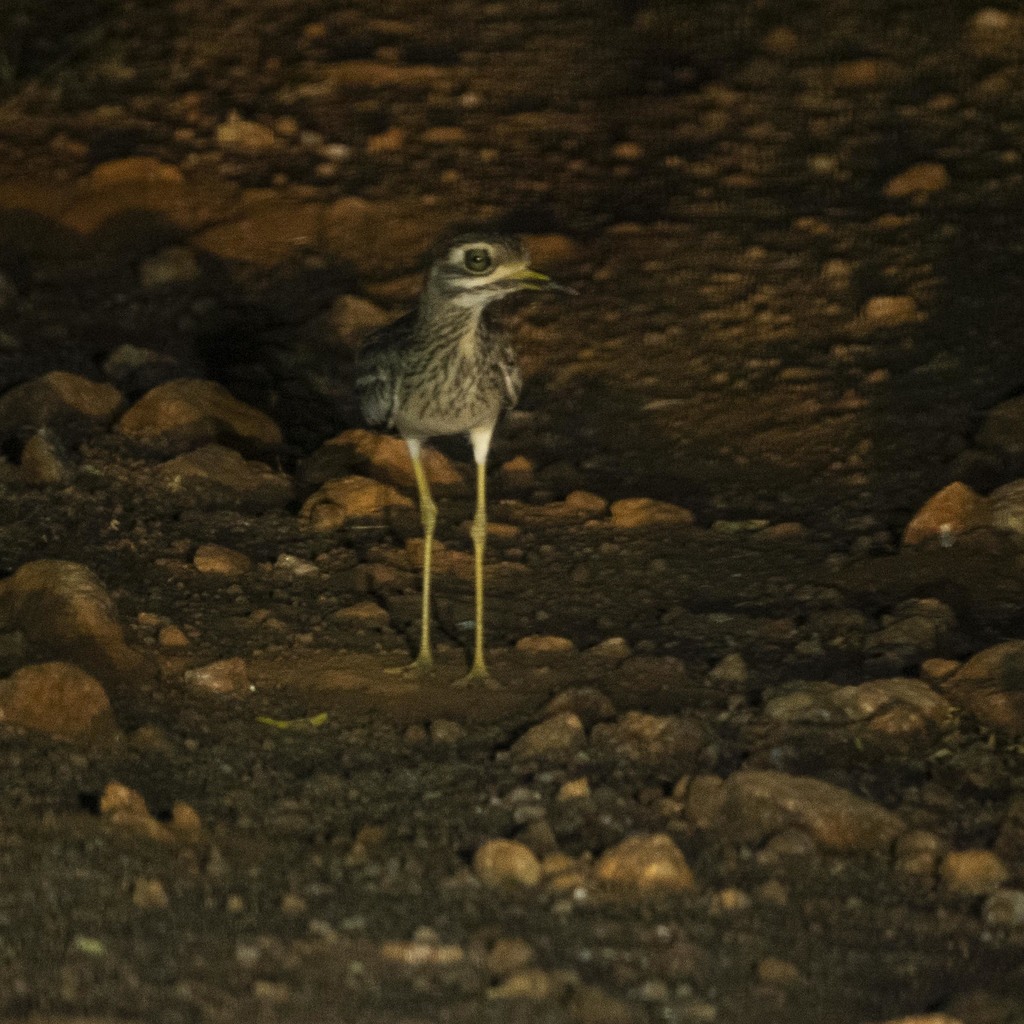
Indian Stone-curlew
Photo © Paulmathi Vinod
Photo © Paulmathi Vinod — CC BY 4.0 — Source: iNaturalist #109834596Identification
The Indian stone-curlew is a stocky, ground-dwelling bird approximately 41 centimetres in length, characterized by its large, striking yellow eyes and thick, stout legs—features that give the thick-knee family its distinctive name. Its plumage is sandy brown with dark streaks and pale markings, providing excellent camouflage against rocky and soil-covered terrain. A dark stripe borders a creamy moustachial stripe below the eye, complemented by a narrow creamy supercilium above. The sexes are alike, though immatures are paler with more pronounced buff and streaks on their underparts. In flight, two prominent white bands appear on the darker primaries, and at rest a broad pale band is visible across the wing.
Range & Habitat
This non-migratory species is found across South and South-eastern Asia, with its range restricted to Bangladesh, Bhutan, Cambodia, India, Laos, Myanmar, Nepal, Pakistan, Sri Lanka, Thailand and Vietnam. The Indian stone-curlew favours dry deciduous forests, thorn forests, scrubby riverbeds, stony hillsides and fallow lands, adapting readily to gardens and groves. Its preference for arid, open habitats makes it well-suited to the diverse landscapes throughout its range.
Behaviour & Diet
Primarily nocturnal and crepuscular, the Indian stone-curlew is most active at dawn and dusk, producing distinctive calls mainly at night—a series of sharp whistling notes described as "pick-pick-pick-pick," sometimes ending with a "pick-wick" cadence that inspired the bird's common name. During daylight hours, these birds remain largely motionless in the shade of bushes, relying on their cryptic plumage for concealment. They are found in small groups and breed mainly in March and April, laying 2–3 stone-coloured eggs in a simple scrape on bare ground, sometimes at the base of a bush. The incubation is handled primarily by the female whilst the male stands guard. Young chicks are downy and cryptically coloured, freezing and crouching when alarmed—an effective defence strategy given their concealing plumage.
The diet consists mainly of insects, worms and small reptiles, with occasional seeds supplementing their intake.
Best Time & Places to See It
Travellers seeking the Indian stone-curlew should visit during the breeding season of March and April, when birds are most vocal and active. Dawn and dusk provide the best viewing opportunities, when the birds emerge from daytime shelter. Look in dry deciduous forests, thorn scrubland, scrubby riverbeds and fallow lands across the species' range. Patience is essential—standing still under shade during the heat of the day mimics the bird's own behaviour and may yield rewarding sightings.
Photography Tips
The Indian stone-curlew's cryptic plumage and preference for remaining motionless make it a challenging subject. Photograph during dawn or dusk when light is soft and birds are active. Focus on capturing the distinctive large yellow eyes, which are a key identification feature and create striking images. The pale bands visible on the wings in flight are particularly photogenic. A slow approach and patient waiting near suitable habitat—scrubby ground with scattered bushes—will maximize your chances of capturing this elusive thick-knee.
Lunugamvehera National Park
Sri Lanka
+204 birds+14 mammals
Dry scrubland and shallow wetlands converge in Sri Lanka's southeastern lowlands, where Lunugamvehera National Park anchors one of the island's most ecologically vital landscapes. The park's…
VIEW NATIONAL PARKMinneriya National Park
Sri Lanka
+158 birds+9 mammals
Across the dry zone of Sri Lanka's North Central Province spreads a landscape of shallow tanks, grassland margins, and scattered dry forest—a mosaic of water and…
VIEW NATIONAL PARKOrang National Park
Rangagarapathar, India
+298 birds+1 mammals
Where the Brahmaputra's floodplains meet the foothills of Assam, Orang National Park unfolds across a mosaic of riverine grasslands, forests and wetlands that pulse with the…
VIEW NATIONAL PARKRanthambhore National Park
Sawai Madhopur, India
+294 birds+20 mammals
Granite ridges and ravines carved through the Aravalli Range frame this protected landscape in eastern Rajasthan, where deciduous forest mingles with open scrubland and seasonal water…
VIEW NATIONAL PARKKhao Yai National Park
Prachantakham District, Thailand
+377 birds+46 mammals
Evergreen dipterocarp forest blankets the rolling terrain of this national park in eastern Thailand, where limestone hills rise abruptly from the forest floor and seasonal streams…
VIEW NATIONAL PARKKanha Tiger Reserve
Kanha Kisli F.V., India
+321 birds+23 mammals
Where sal forests give way to emerald meadows and crystalline streams carve through ancient valleys, one of India's finest wilderness reserves unfolds across the Maikal Range.…
VIEW NATIONAL PARKTadoba National Park
Palasgaon Singru, India
+270 birds+20 mammals
Where sal forests meet open grasslands and rocky outcrops rise from red laterite soil, central India's landscape unfolds in raw, untamed beauty. Ancient teak woodlands and…
VIEW NATIONAL PARKBandhavgarh National Park
Garhpuri, India
+285 birds+17 mammals
Where granite ridges rise dramatically above sal and bamboo forests, one of India's most pristine tiger reserves unfolds across the Vindhyan plateau. Ancient rock formations tower…
VIEW NATIONAL PARKPanna National Park
Badgadi Kalan, India
+271 birds+17 mammals
Where granite gorges slice through central India's Vindhyan plateau, a landscape of stark beauty unfolds across nearly six hundred square kilometers. The Ken River carves through…
VIEW NATIONAL PARKKaziranga National Park
Kohora, India
+422 birds+26 mammals
Dawn breaks over the floodplains of the Brahmaputra, where tall grasslands stretch endlessly beneath monsoon-heavy skies. This sprawling wilderness of northeastern Assam is a mosaic of…
VIEW NATIONAL PARKKeoladeo National Park
Shreenagar Rural, India
+326 birds+14 mammals
Where shallow wetlands shimmer beneath vast Rajasthani skies, one of Asia's finest bird sanctuaries pulses with extraordinary life. This former maharaja's hunting reserve, now spanning 29…
VIEW NATIONAL PARKBandipur National Park
Hirehalli, India
+302 birds+19 mammals
Where the Western Ghats descend into the Deccan plateau, ancient deciduous forests blanket a landscape carved by the Nugu River. Bandipur unfolds across 880 square kilometres…
VIEW NATIONAL PARKNagarahole Tiger Reserve
Nalkeri Forest, India
+323 birds+23 mammals
Where granite escarpments rise above dense deciduous forests and the Kabini River carves through pristine wilderness, one of India's most biodiverse landscapes unfolds across the Western…
VIEW NATIONAL PARKGir National Park
Asundrali, India
+258 birds+13 mammals
Dry deciduous forests cloak the rolling hills of western Gujarat where the Gir landscape rises as a final sanctuary for one of the world's rarest felids:…
VIEW NATIONAL PARKNo community photos yet. Log in to add the first one.
No community observations of this species yet.