Ivory Gull
Photo © steve b
Photo © steve b — CC0 1.0 — Source: iNaturalist photo #501501612Identification
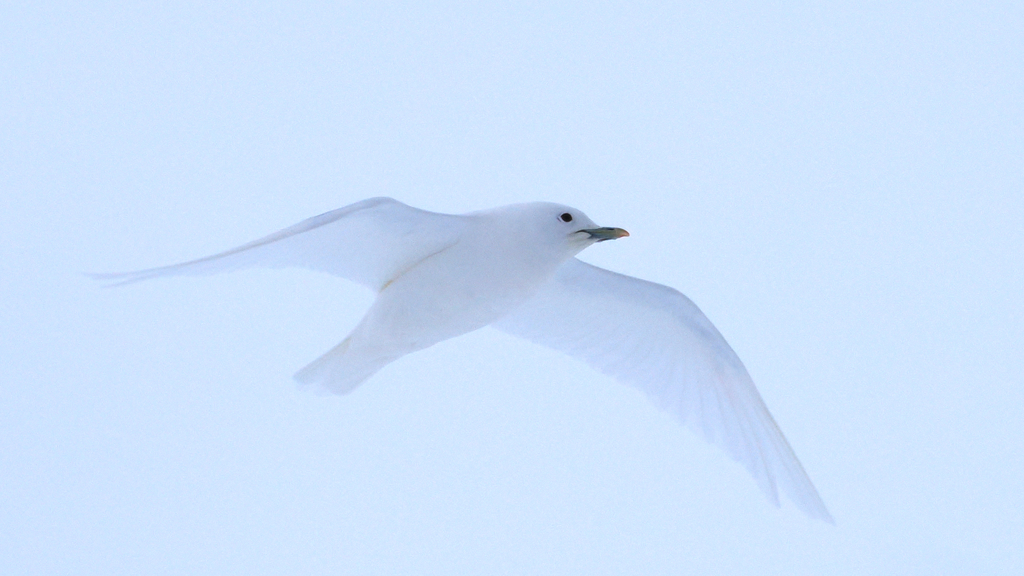
The ivory gull is a small, distinctive Arctic gull measuring 40–43 cm in length with a wingspan of 108–120 cm. Adults are unmistakable: they possess completely pure white plumage lacking the grey backs of other gulls, creating a striking appearance. The thick bill is blue with a yellow tip, the legs are black, and the eyes are dark with a narrow dark red orbital ring. The bird has a notably pigeon-like shape compared to typical Larus gulls, reinforced by its short legs, and in flight displays long, broad-based wings with a strong wingbeat reminiscent of skuas.
Juveniles and first-winter birds show a dusky face with variable black flecking in the wings and tail, requiring two years to attain full adult plumage. Second-winter birds display intermediate plumage with smaller dark spots and a less dusky face. The ivory gull's flight call is a harsh, tern-like cry, and it produces various other vocalizations including a distinctive warbling "fox-call" that warns of predators near the nest.
Range & Habitat
The ivory gull has a circumpolar Arctic distribution, breeding on coasts and cliffs throughout the high Arctic. In Europe and Asia, it breeds on Svalbard and island archipelagos north of Russia, while in North America it breeds exclusively in the Canadian Arctic, with Seymour Island, Nunavut hosting the largest known breeding colony. Other significant breeding sites include Ellesmere, Devon, Cornwallis, and north Baffin islands, though undiscovered small colonies likely exist.
During winter, ivory gulls congregate near polynyas—large areas of open water surrounded by sea ice. North American birds and some from Greenland and Europe winter along the ice edge between the Labrador Sea and Davis Strait, with birds frequently seen on the eastern coasts of Newfoundland and Labrador. The species also winters in the Bering Sea and Chukchi Sea, where it is most widespread throughout polynyas and pack ice. Juveniles tend to wander further from the Arctic than adults, occasionally appearing as vagrants along coastal Canada and the northeastern United States.
Behaviour & Diet
Ivory gulls are highly specialized for Arctic life, migrating only short distances south in autumn. Most of the population winters in northern latitudes at the pack ice edge, though some birds reach more temperate areas. In Arctic winter conditions, these gulls are often reluctant to land on water due to the risk of water droplets freezing onto their plumage.
The ivory gull's diet combines active hunting with opportunistic scavenging. They take fish, crustaceans, eggs, and small chicks, but are primarily known for following polar bears and other predators to feed on the remains of their kills. They also consume polar bear and seal faeces and seal placentae, making them important cleanup specialists in the Arctic ecosystem.
Best Time & Places to See It
The best opportunities to observe ivory gulls occur during winter months, from late November through early March, when birds move to the ice edge regions. The area between Labrador and southwestern Greenland, stretching some 2,000 km along the ice edge, offers reliable sightings. The eastern coasts of Newfoundland and Labrador are particularly productive locations during this period.
Summer breeders might access Arctic breeding sites, though these remain remote and challenging to reach. Observers should note that juveniles are more likely to appear in southern locations during winter than adults, making them occasional vagrants to Atlantic coastal regions.
Photography Tips
The ivory gull's pure white plumage presents unique photographic challenges and opportunities. The completely white coloring requires careful exposure compensation to avoid underexposure; bracket your shots and use your camera's histogram to ensure details are retained in the plumage. The black legs, dark orbital ring, and colored bill provide excellent contrast points for focusing and composition.
Capture the bird's distinctive flight characteristics—the strong, skua-like wingbeat and broad-based wings—by shooting at higher shutter speeds. During winter, photograph birds near polynyas and ice edges where they congregate. The Arctic lighting at this latitude, particularly during the blue hour, can create striking images. Finally, document their scavenging behavior around marine mammal remains to tell the story of their ecological role in the Arctic.
South Spitsbergen National Park
Norway
+41 birds+15 mammals
Glaciers and tundra meet in Norway's high Arctic, where South Spitsbergen National Park sprawls across the southernmost reaches of the Svalbard archipelago. Here, massive valley glaciers…
VIEW NATIONAL PARKNorthwest Spitsbergen National Park
Norway
+58 birds+17 mammals
Where the High Arctic converges with the Norwegian mainland, Northwest Spitsbergen National Park sprawls across one of Earth's most extreme and pristine wildernesses. Crowned by jagged…
VIEW NATIONAL PARKNorthern Isfjorden National Park
Norway
+40 birds+12 mammals
Where the Arctic fjord system cuts deep into Svalbard's northwestern coast, Northern Isfjorden National Park protects a landscape of stark geological drama—towering cliff faces, tidewater glaciers,…
VIEW NATIONAL PARKSchleswig-Holsteinisches Wattenmeer National Park
Germany
+378 birds+49 mammals
Where the North Sea ebbs and flows across a vast expanse of exposed mud and sand, the Schleswig-Holsteinisches Wattenmeer National Park reveals one of Europe's most…
VIEW NATIONAL PARKSassen-Bünsow Land National Park
Soere, Norway
+30 birds+10 mammals
Where Arctic tundra sprawls across glaciated plateaus in the remote Svalbard archipelago, a realm of raw geological drama unfolds. Sassen-Bünsow Land National Park encompasses a landscape…
VIEW NATIONAL PARKForlandet National Park
Vera, Norway
+38 birds+12 mammals
Windswept Arctic tundra meets jagged coastal cliffs where the Barents Sea crashes against Norway's northernmost wilderness. This sliver of protected terrain on the Nordkapp Peninsula comprises…
VIEW NATIONAL PARKDisko Bay
Kitsissuarsuit, Greenland
+46 birds+9 mammals
Where Arctic fjords carve deep into Greenland's western coast, Disko Bay creates a protected landscape of extraordinary ecological complexity. The waters here merge temperate Atlantic currents…
VIEW PROTECTED LANDSCAPEScoresby Sund
Vandreblok, Greenland
+43 birds+9 mammals
Where granite peaks pierce an Arctic sky and the world's largest fjord system carves deep into northeastern Greenland, a primordial landscape unfolds in shades of ice-blue…
VIEW PROTECTED LANDSCAPENortheast Greenland National Park
Northeast Greenland National Park, Greenland
+34 birds+10 mammals
Where granite peaks plunge into the Arctic Ocean and pack ice dominates a landscape of incomparable vastness, one of Earth's most remote wildernesses reveals itself. Spanning…
VIEW NATIONAL PARKNuuk Fjord System
Nuuk, Greenland
+54 birds+3 mammals
Where granite peaks plunge directly into the Arctic Ocean, a labyrinth of deep fjords carves through Greenland's southwestern coast, their waters eternally shadowed by towering rock…
VIEW PROTECTED LANDSCAPERussian Arctic National Park
Russia
+23 birds+3 mammals
Across the stark tundra of Russia's northwestern Arctic, where permafrost defines the land and sunlight dictates the rhythm of life, lies a landscape sculpted by ice…
VIEW NATIONAL PARKAlaska Maritime National Wildlife Refuge
Alaska, United States
+391 birds+58 mammals
Where the North Pacific collides with Alaska's rugged coastline, a sprawling archipelago of islands, rocky outcrops, and coastal headlands forms one of North America's most remote…
VIEW WILDLIFE SANCTUARYNo community photos yet. Log in to add the first one.
No community observations of this species yet.