Identification
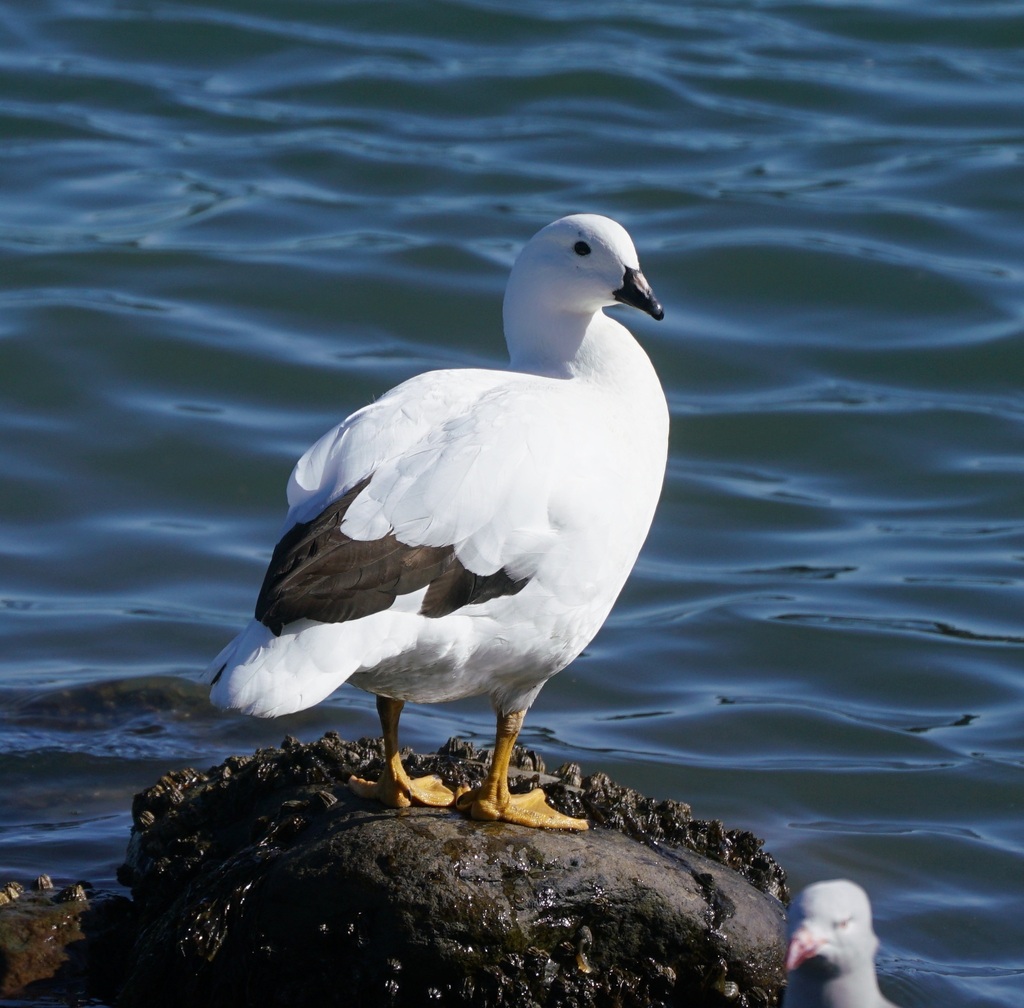
The kelp goose is a medium-sized waterfowl measuring 55 to 65 cm in length, with strikingly different plumage between the sexes. Adult males are entirely white except for a black bill with a distinctive pink spot on the maxilla, and yellow legs and feet. Adult females present a completely different appearance: they display a pale brown crown, chocolate brown head, neck, and mantle, with black and white barring on the breast and flanks, while their back, tail, and undertail coverts are white. Females also have pink bills and yellow legs and feet. Juvenile males resemble adult females but with brown "shoulders" and greenish-yellow legs, while juvenile females are distinguished by a dark crown and dark uppertail coverts.
Two subspecies exist: the nominate C. h. hybrida found on mainland South America, and the heavier C. h. malvinarum endemic to the Falkland Islands. While they share identical plumage patterns, the Falklands subspecies is noticeably larger, with males weighing up to 3.6 kg compared to the mainland subspecies' maximum of 2.58 kg.
Range & Habitat
The kelp goose is endemic to southern South America and the Falkland Islands. The nominate subspecies inhabits coastal southern Chile and Argentina, including the Tierra del Fuego archipelago, while C. h. malvinarum is found exclusively on the Falkland Islands. Except during the breeding season, these geese favour rocky coasts and shingle beaches where kelp beds grow offshore. For nesting, they move to coastal freshwater lakes, building their grass nests lined with down in vegetation or beside boulders and driftwood.
Behaviour & Diet
The kelp goose is predominantly sedentary, though some movement occurs seasonally. The mainland subspecies remains year-round along the southern Chilean coast and in Tierra del Fuego, with some individuals migrating further north during the austral winter. The Falklands population similarly stays resident, with occasional movements from exposed offshore islands to larger islands during winter months.
Kelp geese are almost entirely vegetarian, feeding primarily by grazing on coastal seaweeds and algae, though they occasionally dip underwater to feed. During breeding season they graze on grass, and in winter they may consume berries. The species is highly vocal, with males producing a whistled "si-si-si" call and females making low honking "arnk-arnk" or "ooer" sounds. Breeding occurs from October to January on the mainland and extends only to November on the Falklands. Pairs or loose groups nest together, laying clutches of three to seven eggs with an incubation period of about 30 days. Chicks fledge 12 to 13 weeks after hatching, with both parents providing care through winter.
Best Time & Places to See It
The kelp goose is year-round resident throughout its range, making it accessible to visitors any season, though breeding activity peaks from October through January on the mainland and September through November on the Falklands. Look for them along rocky coasts and shingle beaches where kelp beds are visible offshore. During summer, non-breeding flocks of 100 or more individuals may congregate on the shore, offering excellent viewing opportunities. The Falkland Islands population is particularly accessible to travellers visiting that region.
Photography Tips
The stark sexual dimorphism of kelp geese makes them rewarding photography subjects. Male's pure white plumage creates dramatic contrast against dark rocks and coastal vegetation, while females' intricate brown and barred patterns reward close-up work. Coastal habitats with kelp beds and rocky shorelines provide natural compositional elements. Early morning light along southern coastlines will enhance the contrast in male plumage. The birds' sedentary nature and tendency to gather in groups allows for patient approach and composition. Winter gatherings on larger Falkland Islands locations may provide opportunities to photograph both subspecies' size differences.
Chile: Fuegian Snipe & Juan Fernandez
Kidney Island
Stanley, Falkland Islands
+47 birds
Wind-scoured tussock grassland sweeps across this remote South Atlantic outcrop, where peaty soils and exposed rock formations create a landscape as austere as it is vital.…
VIEW ISLAND & ARCHIPELAGOPort Stephens
Port Stephens, Falkland Islands
+29 birds
Windswept moorlands sweep down to pristine beaches where kelp forests fringe the turquoise shallows, their giant fronds swaying in the southern current. Port Stephens, cradled on…
VIEW NATURE RESERVEMurrell Farm
falskland islands, Falkland Islands
+54 birds
Rolling grasslands sweep across windswept plateaux where the South Atlantic exerts its relentless influence on the vegetation, sculpting tussock grassland into a tapestry of browns and…
VIEW NATURE RESERVECape Dolphin
falskland islands, Falkland Islands
+54 birds+1 mammals
Where windswept grasslands meet dramatic coastal cliffs, the Falkland Islands' northern reaches reveal one of the Southern Hemisphere's most compelling seabird sanctuaries. The terrain here is…
VIEW NATURE RESERVEVolunteer Point
Stanley, Falkland Islands
+70 birds+3 mammals
Windswept grasslands meet volcanic black sand beaches where three penguin species converge in the South Atlantic's most theatrical wildlife theatre. This remote peninsula on East Falkland…
VIEW NATURE RESERVEWest Point Island
West Point, Falkland Islands
+67 birds+3 mammals
Windswept cliffs plunge dramatically into the South Atlantic, their rust-coloured rock faces sculpted by millennia of gales and spray. This northwestern outpost of the Falkland Islands…
VIEW ISLAND & ARCHIPELAGOChiloé National Park
Dalcahue, Chile
+122 birds+6 mammals
Temperate rainforest cloaks the Chiloé archipelago's northwestern reaches, where granite ridges thrust through dense, moisture-laden canopy and freshwater streams carve ravines toward the Pacific. Across approximately…
VIEW NATIONAL PARKCabo de Hornos National Park
Cape Horn, Chile
+88 birds+9 mammals
Where the Andes plunge into the Southern Ocean and the Drake Passage churns between two continents, Cabo de Hornos National Park sprawls across one of Earth's…
VIEW NATIONAL PARKTorres del Paine National Park
Torres del Paine, Chile
+143 birds+10 mammals
Where granite spires pierce the Patagonian sky, Torres del Paine commands one of South America's most dramatic landscapes. Across 4,106 square kilometres of southern Chile, jagged…
VIEW NATIONAL PARKNo community photos yet. Log in to add the first one.
No community observations of this species yet.