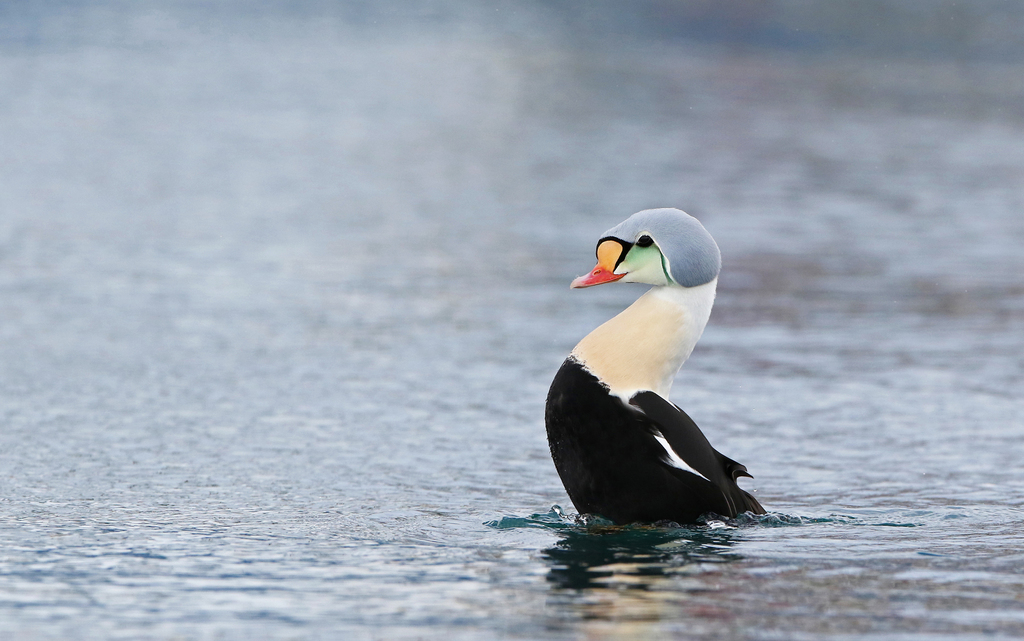
King Eider
Photo © Christoph Moning
Photo © Christoph Moning — CC BY 4.0 — Source: iNaturalist photo #193498965Identification
The king eider is a large sea duck measuring 50–70 cm in length with a wingspan of 86–102 cm. Males are unmistakable in breeding plumage: they feature a mostly black body with a buff-tinged white breast and a striking multicoloured head. The head, nape and neck are pale bluish grey, while the cheek is pale green. Most distinctive is the male's bill—red with a white nail and a large, prominent yellow knob above it, resembling a crown. Some tertials curve upward to form distinctive "spurs" along the back. Females are warm brown overall with blackish chevrons marking their upperparts and flanks, and fine black streaks on the head and neck. They have a buffy spot at the base of the bill and a buffy eye ring that extends into a downward curving stripe behind the eye. Juveniles are greyish brown, and young males take three years to achieve full adult plumage.
Range & Habitat
The king eider is circumpolar, found throughout the Arctic. It breeds on Arctic coasts from Alaska, Canada, and Greenland to Svalbard and Russia, utilizing various tundra habitats. These birds migrate to Arctic tundra to breed in June and July, then spend most of the year in coastal marine ecosystems at high latitudes. During winter, they concentrate in arctic and subarctic marine areas, most notably the Bering Sea, the west coast of Greenland, eastern Canada, and northern Norway. Wintering birds form large flocks on suitable coastal waters, with some flocks exceeding 100,000 individuals. The species also occurs annually off the northeastern United States, Scotland, and Kamchatka.
Behaviour & Diet
King eiders are highly specialized foragers whose feeding strategies vary seasonally. At sea for much of the year, they dive for benthic invertebrates including mollusks, crustaceans such as king crabs, sea urchins, starfish, and sea anemones. During breeding season, they shift to freshwater lakes and ponds, where they dabble and feed primarily on small invertebrates plucked from the water's surface. Breeding females construct a scrape nest on the ground near water, lining it with vegetation and down feathers from their own body. They lay a clutch of four to seven eggs and incubate them alone for 22 to 23 days, while the young are subsequently raised collectively by females. Males produce a distinctive quavering, dove-like cooing song transcribed as "croo-croo-croo" or "hoo-hoo-hooo," while females make low clucks, grunts, and growls.
Best Time & Places to See It
King eiders are best observed during their migrations and in their wintering grounds. In spring, several hundred thousand birds pass Point Barrow in northern Alaska in May on their way to Alaskan and Canadian breeding grounds, making this an excellent viewing opportunity. Winter concentrations occur in the Bering Sea, along the west coast of Greenland, in eastern Canada, and off northern Norway, where large flocks gather on coastal waters. The species also occurs regularly off the northeastern United States, Scotland, and Kamchatka. For breeding-season observations, Arctic tundra habitats from June to July offer chances to see nesting birds, though access to these remote areas is limited.
Photography Tips
Males in breeding plumage are highly photogenic subjects with their striking multicoloured heads and distinctive yellow knobs. The contrast between their pale head, black body, and buff-tinged white breast provides excellent compositional opportunities. Photographing birds on water allows you to capture their diving behavior and the characteristic postures they adopt while foraging. During spring migrations, the concentrated flocks passing known points provide opportunities for capturing large groups in flight or on the water. Winter coastal locations offer chances to photograph birds in their natural marine habitat, particularly when they gather in large flocks on suitable coastal waters. The pale coloring of breeding males makes them stand out well against darker water backgrounds, while females and juveniles blend better with brown tundra habitats, requiring careful attention to lighting and positioning.
Arctic Ecology and Ecosystem Conservation Tour
South Spitsbergen National Park
Norway
+41 birds+15 mammals
Glaciers and tundra meet in Norway's high Arctic, where South Spitsbergen National Park sprawls across the southernmost reaches of the Svalbard archipelago. Here, massive valley glaciers…
VIEW NATIONAL PARKNorthwest Spitsbergen National Park
Norway
+58 birds+17 mammals
Where the High Arctic converges with the Norwegian mainland, Northwest Spitsbergen National Park sprawls across one of Earth's most extreme and pristine wildernesses. Crowned by jagged…
VIEW NATIONAL PARKNorthern Isfjorden National Park
Norway
+40 birds+12 mammals
Where the Arctic fjord system cuts deep into Svalbard's northwestern coast, Northern Isfjorden National Park protects a landscape of stark geological drama—towering cliff faces, tidewater glaciers,…
VIEW NATIONAL PARKSchleswig-Holsteinisches Wattenmeer National Park
Germany
+378 birds+49 mammals
Where the North Sea ebbs and flows across a vast expanse of exposed mud and sand, the Schleswig-Holsteinisches Wattenmeer National Park reveals one of Europe's most…
VIEW NATIONAL PARKSirmilik National Park
Qikiqtaaluk Region, Canada
+58 birds+4 mammals
Where the Canadian Arctic archipelago fractures into a labyrinth of islands, Sirmilik National Park protects one of the High North's most pristine marine and terrestrial ecosystems.…
VIEW NATIONAL PARKL’Île-Bonaventure-Et-Du-Rocher-Percé National Park
Le Rocher-Percé, Canada
+214 birds+3 mammals
A dramatic thrust of russet sandstone pierces the Gulf of Saint Lawrence, its weathered arch framing a seascape where cool Atlantic currents sweep past cliffs alive…
VIEW NATIONAL PARKKenai Fjords National Park
Kenai Peninsula Borough, United States
+164 birds+19 mammals
Granite peaks and tidewater glaciers dominate Alaska's Kenai Peninsula, where nearly 7,900 square kilometers of pristine coastal wilderness descend from the Harding Icefield toward the Gulf…
VIEW NATIONAL PARKGlacier Bay National Park
Unorganized Borough, United States
+221 birds+15 mammals
Tidewater glaciers calving into fjords of impossible blue, where temperate rainforest rises steeply from the water's edge and alpine peaks pierce the clouds—this is the ecological…
VIEW NATIONAL PARKRedwood National Park
Humboldt County, United States
+343 birds+43 mammals
Where the Pacific fog rolls deep into northern California's coastal valleys, some of the tallest trees on Earth rise from a landscape shaped by tectonic forces…
VIEW NATIONAL PARKWapusk National Park
Unorganized Division No. 23, Canada
+140 birds+6 mammals
Across the subarctic lowlands of northern Manitoba, where permafrost underlies a mosaic of stunted boreal forest, open muskeg, and coastal tundra, Wapusk National Park sprawls across…
VIEW NATIONAL PARKQuttinirpaaq National Park
Qikiqtaaluk Region, Canada
+19 birds+4 mammals
Across the high Arctic archipelago of northern Nunavut, where bedrock emerges from permafrost and ice fields dominate the landscape, Quttinirpaaq National Park sprawls across more than…
VIEW NATIONAL PARKBic National Park
Rimouski, Canada
+250 birds+9 mammals
Where the St. Lawrence River meets the Gaspé Peninsula, a rugged coastline of forests, wetlands, and rocky shores unfolds across nearly 95 square kilometres of protected…
VIEW NATIONAL PARKForillon National Park
Gaspé, Canada
+258 birds+16 mammals
Where the Gaspésie Peninsula juts into the Gulf of Saint Lawrence, granite cliffs and coastal headlands frame one of eastern Canada's most dramatic marine-terrestrial boundaries. Forillon…
VIEW NATIONAL PARKSassen-Bünsow Land National Park
Soere, Norway
+30 birds+10 mammals
Where Arctic tundra sprawls across glaciated plateaus in the remote Svalbard archipelago, a realm of raw geological drama unfolds. Sassen-Bünsow Land National Park encompasses a landscape…
VIEW NATIONAL PARKForlandet National Park
Vera, Norway
+38 birds+12 mammals
Windswept Arctic tundra meets jagged coastal cliffs where the Barents Sea crashes against Norway's northernmost wilderness. This sliver of protected terrain on the Nordkapp Peninsula comprises…
VIEW NATIONAL PARKSt. Paul Island
Saint Paul, United States
+255 birds+8 mammals
Windswept tundra rolls across this remote Pribilof island, where volcanic basalt cliffs plunge into the Bering Sea and fog rolls in thick enough to erase the…
VIEW PROTECTED LANDSCAPEWrangel Island Nature Reserve
Wrangel Island, Russia
+25 birds+11 mammals
Where the Chukchi Sea fractures Arctic ice beneath an unforgiving sky, a lonely island holds one of Earth's most pristine ecosystems. Wrangel Island spans tundra so…
VIEW NATURE RESERVEDisko Bay
Kitsissuarsuit, Greenland
+46 birds+9 mammals
Where Arctic fjords carve deep into Greenland's western coast, Disko Bay creates a protected landscape of extraordinary ecological complexity. The waters here merge temperate Atlantic currents…
VIEW PROTECTED LANDSCAPEScoresby Sund
Vandreblok, Greenland
+43 birds+9 mammals
Where granite peaks pierce an Arctic sky and the world's largest fjord system carves deep into northeastern Greenland, a primordial landscape unfolds in shades of ice-blue…
VIEW PROTECTED LANDSCAPENortheast Greenland National Park
Northeast Greenland National Park, Greenland
+34 birds+10 mammals
Where granite peaks plunge into the Arctic Ocean and pack ice dominates a landscape of incomparable vastness, one of Earth's most remote wildernesses reveals itself. Spanning…
VIEW NATIONAL PARKNuuk Fjord System
Nuuk, Greenland
+54 birds+3 mammals
Where granite peaks plunge directly into the Arctic Ocean, a labyrinth of deep fjords carves through Greenland's southwestern coast, their waters eternally shadowed by towering rock…
VIEW PROTECTED LANDSCAPEAcadia National Park
Bar Harbor, United States
+291 birds+27 mammals
Where the Maine coast rises in granite cliffs and spruce-clad headlands, Acadia National Park unfolds across Mount Desert Island and its surrounding waters, a landscape carved…
VIEW NATIONAL PARKArctic National Wildlife Refuge
Arctic Village, United States
+132 birds+15 mammals
Across the northernmost reaches of Alaska's Unorganized Borough, where the Brooks Range rises from the coastal plain and tundra spreads endlessly toward the Arctic Ocean, lies…
VIEW WILDLIFE SANCTUARYKodiak National Wildlife Refuge
United States
+221 birds+22 mammals
Where temperate rainforest meets subarctic coast, Kodiak National Wildlife Refuge sprawls across Alaska's largest island, a sanctuary defined by steep valleys carved by tidewater glaciers and…
VIEW WILDLIFE SANCTUARYAlaska Maritime National Wildlife Refuge
Alaska, United States
+391 birds+58 mammals
Where the North Pacific collides with Alaska's rugged coastline, a sprawling archipelago of islands, rocky outcrops, and coastal headlands forms one of North America's most remote…
VIEW WILDLIFE SANCTUARYIzembek National Wildlife Refuge
Cold Bay, United States
+138 birds+9 mammals
Where the Aleutian archipelago reaches westward into the Bering Sea, subarctic tundra and shallow coastal waters converge to create one of Alaska's most ecologically vital wildlife…
VIEW WILDLIFE SANCTUARYChincoteague National Wildlife Refuge
Chincoteague, United States
+362 birds+16 mammals
Across the barrier islands and salt marshes of Virginia's Eastern Shore, where Atlantic tides sculpt an intricate mosaic of sandy spits and tidal flats, lies one…
VIEW WILDLIFE SANCTUARYPea Island National Wildlife Refuge
Dare County, United States
+356 birds+15 mammals
Where the Outer Banks taper toward the Atlantic, a sliver of barrier island creates a microcosm of coastal ecology. Pea Island National Wildlife Sanctuary spans over…
VIEW WILDLIFE SANCTUARYDyfi National Nature Reserve
Aberdyfi, United Kingdom
+148 birds+25 mammals
Where the River Dyfi widens into a broad coastal basin, a 2,400-hectare mosaic of saltmarsh, reedbed, mudflat and freshwater wetland spreads across the Cardigan Bay estuary…
VIEW NATURE RESERVECors Fochno National Nature Reserve
Borth, United Kingdom
+179 birds+27 mammals
Where the Dovey Estuary opens to the Irish Sea, a sprawling wetland mosaic of reedbed, fen and mire transforms the coastal flats of mid-Wales into one…
VIEW NATURE RESERVENo community photos yet. Log in to add the first one.
No community observations of this species yet.