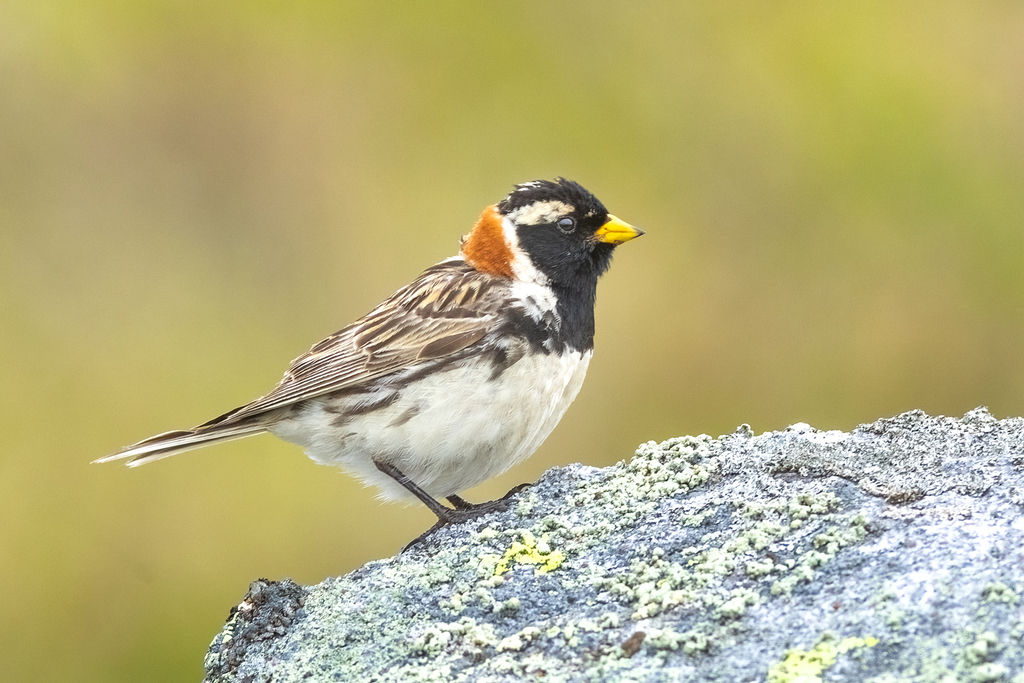
Lapland Longspur
Photo © egorbirder
Photo © egorbirder — CC BY 4.0 — Source: iNaturalist photo #601779136Identification
The Lapland longspur is a compact, sturdy songbird measuring 15–16 cm in length with a wingspan of 22–29 cm. Its most distinctive feature is a thick, conical yellow bill adapted for cracking seeds. In breeding plumage, males are striking with a jet-black head and throat, bold white eyestripe, chestnut nape, white underparts, and heavily streaked grey-black back. Non-breeding birds and females show a more subdued appearance with an orange-brown head, browner back, and chestnut nape and wing panels, making them more challenging to identify in winter quarters.
Range & Habitat
This is the only longspur species found across Eurasia, making it truly circumpolar in its breeding range. It nests throughout Arctic Europe, the Palearctic region, Canada, and the northernmost United States, with five recognized subspecies distributed across these areas. During winter, populations migrate southward to the Russian steppes, the Great Plains and northeastern United States, southern Canada, and as far south as coastal Denmark, Sweden, and Great Britain. The species has maintained a presence in Eastern Europe for at least 30,000 years.
Behaviour & Diet
Lapland longspurs are ground-nesting birds, constructing cup nests among tussocks and heavily vegetated slopes in wet tundra, riparian areas, and marshes, typically laying around five eggs per brood. Their diet is highly seasonal: in winter they feed almost exclusively on seeds from grasses, foxtail, wheat, and cultivated millet, gleaned from the ground in agricultural fields. During the breeding season in the Arctic, they switch dramatically to arthropods, particularly dipteran larvae and adults, often catching insects in flight. These birds are remarkably efficient foragers, capable of consuming between 3,000 and 10,000 prey items daily, increasing this intake by up to 3,000 additional items when feeding young. In winter, they often join mixed-species flocks with horned larks and snow buntings.
Best Time & Places to See It
Winter is the prime season for observing Lapland longspurs in accessible locations. The Great Plains and northeastern United States, as well as southern Canada, offer the best opportunities during the colder months, particularly in agricultural areas where the birds forage. Look for them in open fields and grasslands, often in company with other species. Arctic breeders seeking the full breeding plumage spectacle would need to travel to the High Arctic during the breeding season, though accessibility is limited in these remote regions.
Photography Tips
Patience and fieldcraft are essential when photographing these birds. Winter birds are often found in open agricultural landscapes where they are relatively exposed, allowing closer approaches than in their breeding grounds. Early morning light is ideal for capturing the subtle plumage details. Photographing breeding males requires Arctic travel but offers stunning contrast with their striking black-and-white facial patterns and chestnut napes. Use a long lens, as these birds may be skittish when foraging. The combination of their ground-feeding behavior and habit of flying to new foraging areas presents opportunities for action shots, particularly during takeoff from snowy or agricultural fields.
Tombstone Territorial Park
Acadia National Park
Alaska Maritime National Wildlife Refuge
Algonquin Provincial Park
Alligator River National Wildlife Refuge
Altai Tavan Bogd National Park
Arctic National Wildlife Refuge
Auyuittuq National Park
Badlands National Park
Nothing matches these filters.
No community photos yet. Log in to add the first one.
No community observations of this species yet.