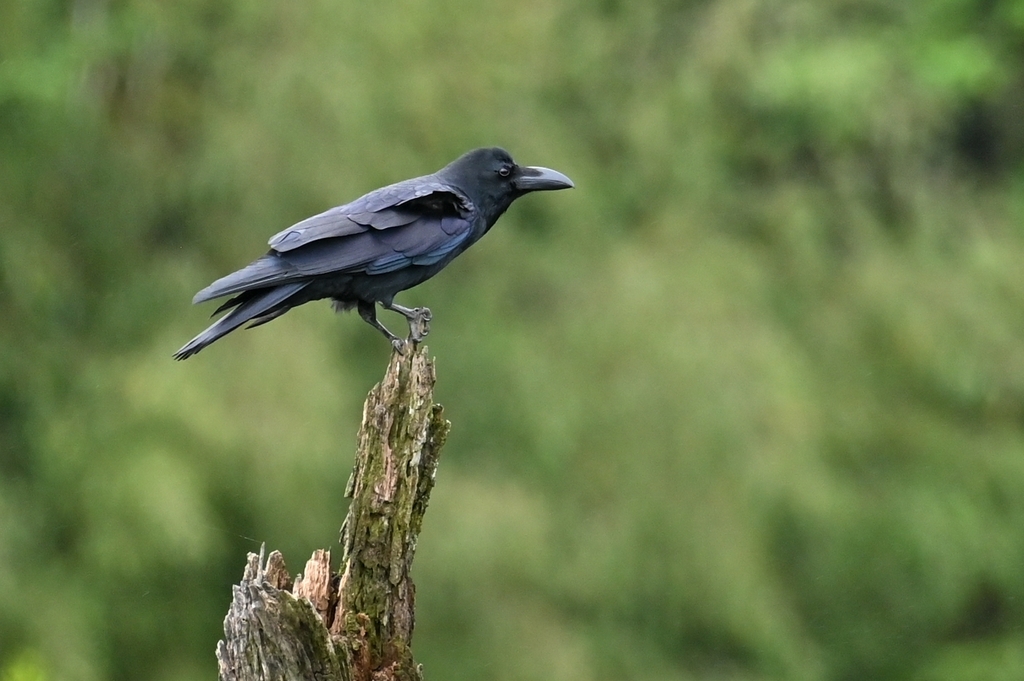
Large-billed Crow
Photo © Omar Haroon
Photo © Omar Haroon — CC0 1.0 — Source: iNaturalist photo #513407392Identification
The large-billed crow is a relatively large, all-black corvid measuring 46–59 cm in length and weighing 450–1,000 g. Its most distinctive feature is a large black bill with an arched culmen, partially hidden by overlapping black rictal bristles. The glossy black plumage displays a distinctive purple sheen, while the bases of neck feathers are pale grey. Elongated hackle feathers on the throat add character to this striking bird. The irises are dark brown and legs black. Sexes are similar, though females average smaller with less arched culmen. Juveniles show less glossy plumage and smoky blue irises rather than brown. Subspecific variation is notable: the largest subspecies, C. m. japonensis, has a bill measuring 70–80 mm, while the smallest, C. m. culminatus, measures only 52–67 mm. The large-billed crow can be mistaken for a common raven, requiring careful observation to distinguish.
Range & Habitat
This widespread Asian species ranges extensively from the northeastern Asian seaboard through South Asia to Afghanistan and eastern Iran in the west, encompassing India, Sri Lanka, Southeast Asia, and the Lesser Sundas. The species is highly adaptable, occupying woodland, parks and gardens, cultivated regions with scattered trees, and more open country in southern regions where it avoids competition with common ravens and carrion crows. Ten recognized subspecies are distributed across this vast range, from Japan and northeastern Asia through the Himalayas to peninsular India and Indonesia.
Behaviour & Diet
The large-billed crow is extremely versatile and bold, particularly in urban areas. It feeds on a remarkably wide range of items—both plant and animal matter, alive or dead—demonstrating remarkable adaptability that enables colonization of new areas. This persistence and opportunism have made it a nuisance in many regions. In Japan, these crows are notorious for ripping open garbage bags and taking wire coat hangers for nesting material. The Japanese subspecies are also known for regular, unprovoked attacks on humans passing near nesting areas. In Sri Lanka, jungle crows are important predators of small animals, displaying particular skill at catching lizards.
Best Time & Places to See It
The large-billed crow's widespread distribution and adaptability make it relatively easy to encounter throughout its Asian range. Look for it in woodland edges, parks, gardens, and cultivated areas with trees. Urban environments, particularly areas with human settlement and food sources, offer reliable sightings. The species is present year-round across most of its range, making it accessible to travellers visiting Asia at any season.
Photography Tips
The glossy black plumage with its distinctive purple sheen photographs beautifully in good light, so seek strong, directional sunlight to capture the iridescent quality of the feathers. The large, prominent bill and pale grey neck-feather bases provide excellent contrast and compositional elements. Urban settings often provide opportunities for dynamic behaviour shots—watch for feeding activity, interaction with human environments, and social interactions between birds. The bird's boldness means it often tolerates closer approach than many wild species, allowing for detailed portraits that showcase the dark brown eyes and powerful bill structure.
Kanha Tiger Reserve
Minneriya National Park
Baima Snow Mountain National Nature Reserve
Bandhavgarh National Park
Bandipur National Park
Banke National Park
Bardiya National Park
Batang Gadis National Park
Caohai National Nature Reserve
Nothing matches these filters.
No community photos yet. Log in to add the first one.
No community observations of this species yet.