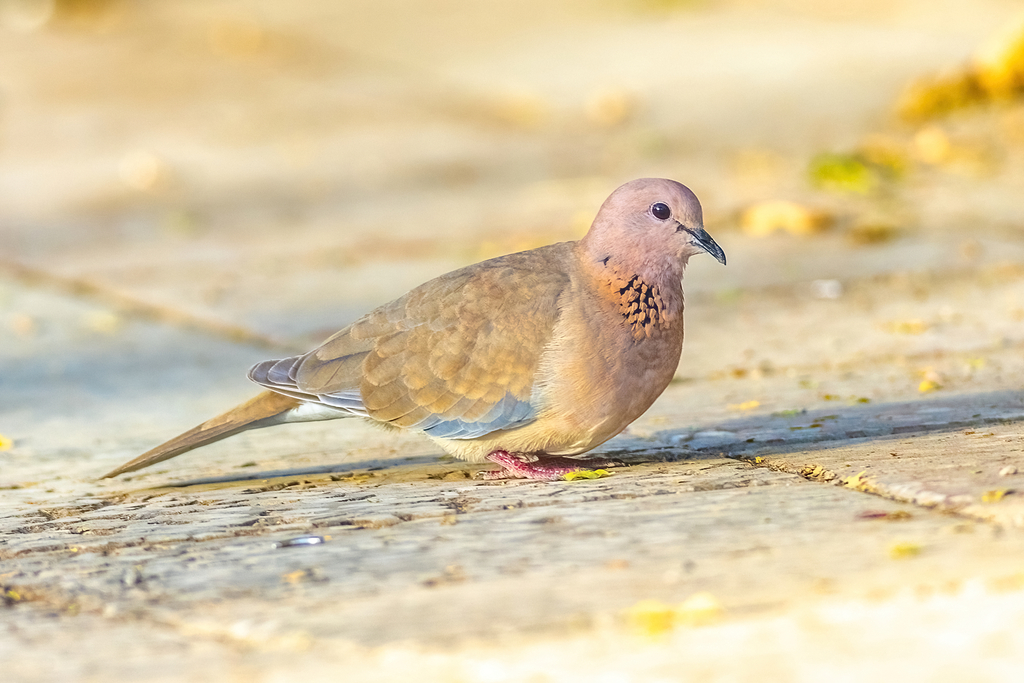
Laughing Dove
Photo © egorbirder
Photo © egorbirder — CC BY 4.0 — Source: iNaturalist photo #500856895Identification
The laughing dove is a small, long-tailed pigeon measuring typically 25 cm in length. It is pinkish-brown on the underside with a lilac-tinged head and neck, shading to buff on the lower abdomen. The most distinctive feature is a chequered rufous and grey patch on the sides of the neck in adults, created by split feathers. The upper parts are brownish with a bluish-grey band along the wing, while the tail is graduated with white-tipped outer feathers. Young birds lack the chequered neck markings. The legs are red, and the sexes are indistinguishable in the field. Plumage varies slightly among populations, with birds from more arid zones appearing paler than those from lusher habitats.
Range & Habitat
This common and widespread species is found across much of Sub-Saharan Africa, the Middle East, and South Asia, including Saudi Arabia, Iran, Pakistan, and India. It has also established populations in Cyprus, Greece, and around the Mediterranean region, with birds present in Western Australia following an introduction to Perth in 1889. The laughing dove favours dry scrub, semi-desert habitats, dry farmland, and areas of human habitation, often becoming remarkably tame. Most populations are sedentary, though some individuals undertake movements, with ringed birds in Gujarat recovered over 200 km away in Pakistan.
Behaviour & Diet
Laughing doves are usually seen in pairs or small parties, gathering in larger groups only occasionally, particularly at waterholes in arid regions where they congregate on nearby trees before drinking. Like other pigeons, they are able to suck up water directly. These fairly terrestrial birds forage on the ground for fallen grass seeds, other vegetable matter, and small insects such as termites and beetles. Their flight is quick and direct with characteristic rapid wing beats and sharp flicks typical of pigeons.
Courtship involves the male following the female with head-bobbing displays and cooing, sometimes launching into the air with wing clapping before gliding down in a gentle arc. Males peck their folded wings in "displacement-preening" to solicit copulation, which the female accepts by crouching and begging for food. The species is vocal, with a distinctive chuckling call described as a low rolling croo-doo-doo-doo-doo with rising and falling amplitude.
Best Time & Places to See It
The laughing dove's breeding season varies geographically: almost year-round in Malawi and Turkey, mainly May to November in Zimbabwe, and February to June in Egypt and Tunisia. These birds are common and easy to locate in their preferred dry scrub and semi-desert habitats throughout their range. They are particularly visible around human habitation and agricultural areas, and can be reliably found near waterholes in arid regions where they gather to drink.
Photography Tips
The laughing dove's small size and terrestrial habits mean ground-level or low-angle photography will prove most effective for capturing birds as they forage. Their tameness in human-inhabited areas makes close approach possible, though patience near waterholes will reward photographers with images of drinking birds and courtship displays. The distinctive chequered neck patch and rufous markings are best rendered with good side lighting. Early morning and late afternoon light will enhance the subtle pinkish and lilac tones of the plumage. Pairs and small groups offer opportunities for behavioural photography, including head-bobbing courtship displays and wing-clapping aerial manoeuvres.
Nothing matches these filters.
Bwindi Impenetrable National Park
Kanha Tiger Reserve
Lake Mburo National Park
Mabamba Swamp
Murchison Falls National Park
Queen Elizabeth National Park
Aberdare National Park
Addo Elephant National Park
Agulhas National Park
Nothing matches these filters.
No community photos yet. Log in to add the first one.
No community observations of this species yet.